

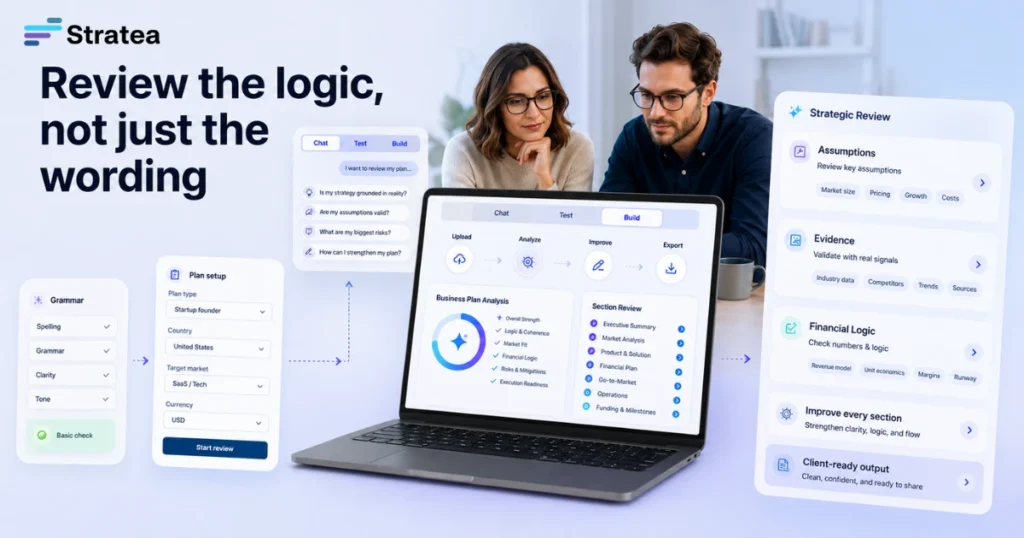
If you already have a draft and are looking for a business plan reviewer, you need more than proofreading. A meaningful review should show whether your plan can withstand scrutiny. stratea.ai helps founders examine the assumptions, market evidence, business model, and financial logic that sit behind the document – not just the words on the page.
This matters especially when a draft was created with an AI business plan generator. These tools can produce a professional-looking plan quickly, but presentation alone does not prove that the customer demand is real, the projections are credible, or the operating model can work in practice.
A useful business plan review tests the reasoning behind each major claim. It asks whether the target market is defined, the competitive position is defensible, the numbers support the strategy, and the plan meets the expectations of a lender, investor, or potential partner. The result should be clear, practical revisions-not a vague score or a generic pass-or-fail judgment.
What a Good Business Plan Reviewer Looks For
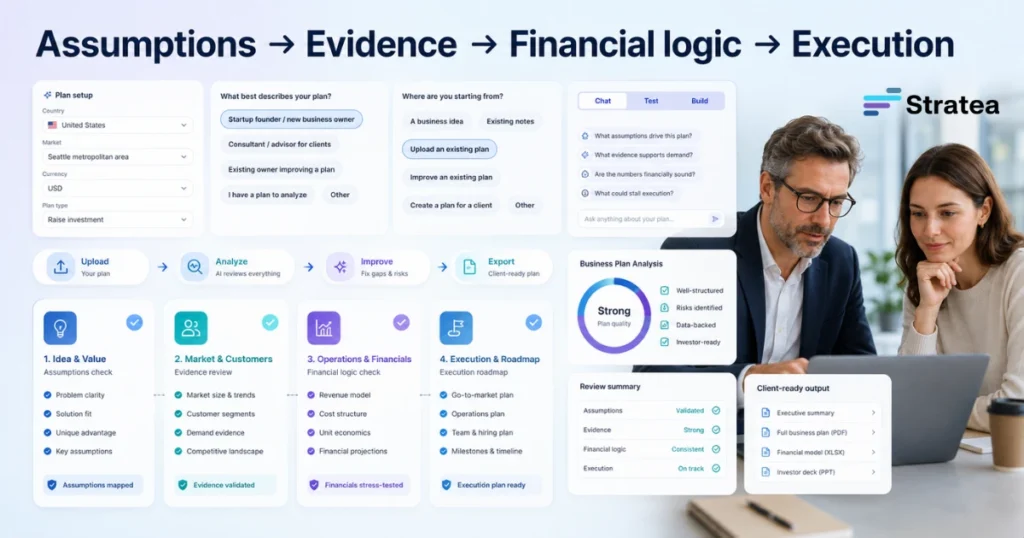
A useful review works through the plan in a specific order: assumptions first, then evidence, then financial logic, then execution. Skipping straight to sentence-level edits misses the problems that actually sink a plan once it reaches a real decision-maker.
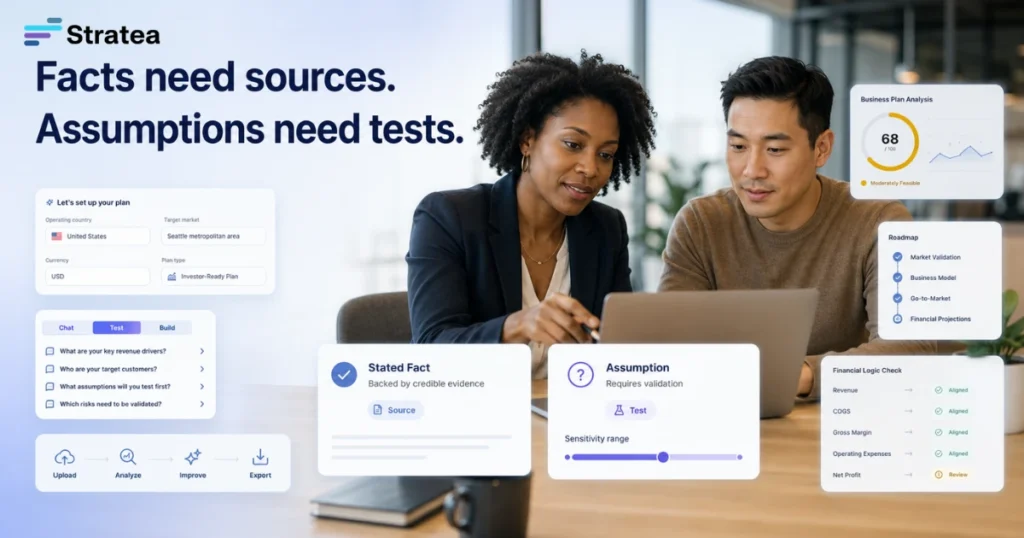
Assumptions Versus Stated Facts
Most drafts blend assumptions and facts without flagging which is which. A reviewer should separate “we assume 15% of local homeowners will need this service annually” from an actual data point, and ask what happens if that assumption is off by half. Weak assumptions aren’t a writing problem, they’re a planning problem, and no amount of polishing the prose fixes them.
Market Evidence Versus Market Claims
Claims like “there is strong demand in this market” need something behind them: local data, comparable business performance, direct customer conversations, or industry reports. A review should flag any claim that isn’t backed by at least one credible reference point, and treat AI-generated market research as a structured starting point to validate, not a finished source.
Financial Logic and Internal Consistency
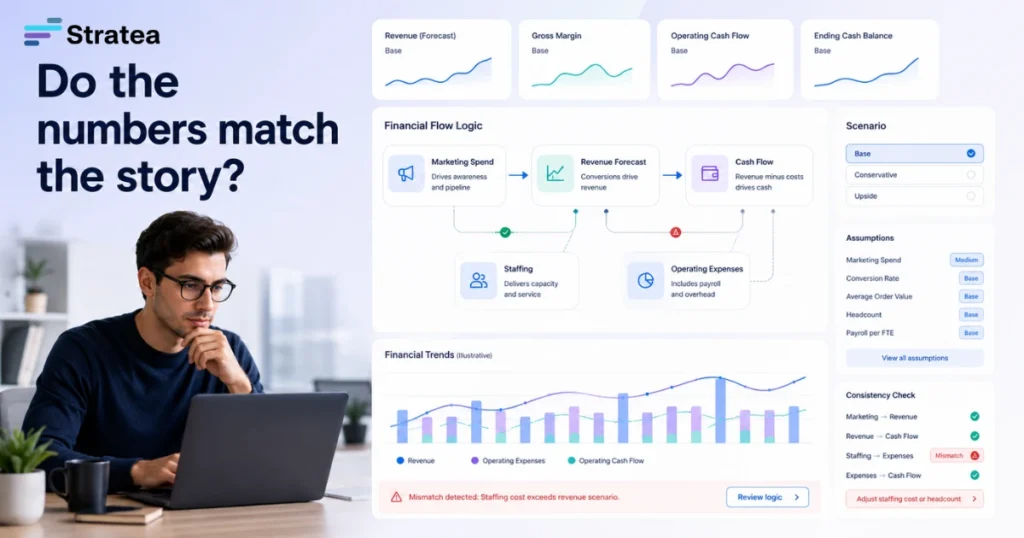
This is where plans fall apart under scrutiny. Do the revenue projections match the stated customer acquisition numbers? Does the cost structure account for the team size described elsewhere in the plan? A reviewer should trace the numbers back to the assumptions that generated them, because the people reading the plan next (loan officers, investors, program evaluators) will do exactly that.
Internal consistency also means checking the plan against itself in both directions. If the marketing section describes a paid advertising push starting in month two, the financial section needs a matching line item at that point, not three months later. Small timing mismatches like this are one of the fastest ways a reader loses confidence in the rest of the numbers, even when the underlying math is otherwise sound.
Execution and Roadmap Clarity
A plan with solid numbers but no credible path to hitting them still reads as unfinished. Good review feedback checks whether the roadmap, milestones, and resource plan actually connect to the financial projections, not just whether they sound organized on paper.
Proofreading and Reviewing Are Not the Same Job
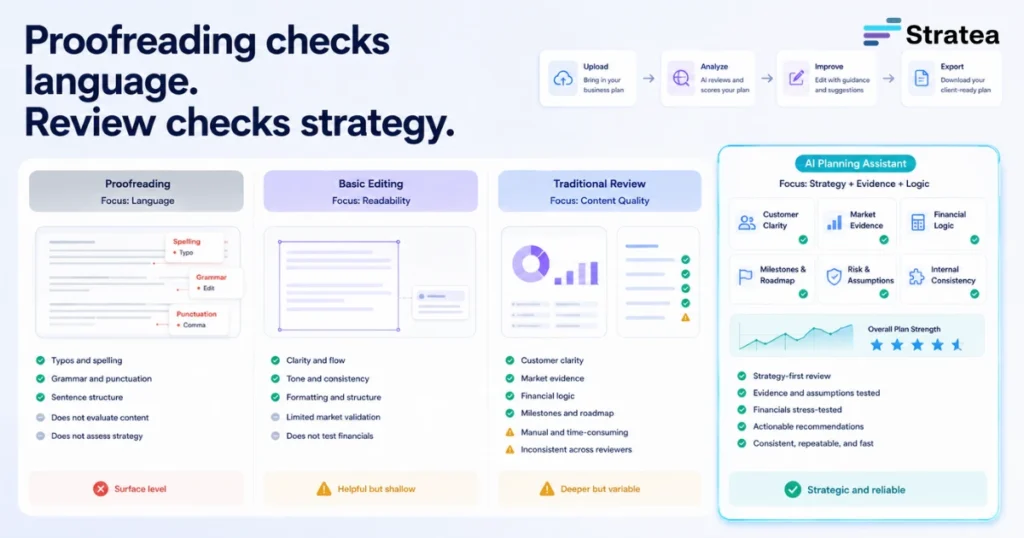
Grammar checkers and generic AI writing tools catch typos and awkward phrasing. That’s useful, but it’s a different job from reviewing a business plan. Proofreading asks whether the document reads well. Reviewing asks whether it would survive someone actively trying to poke holes in it.
A plan can be well written and still fail a review because the customer acquisition cost assumption is unrealistic, or because the competitive section names competitors without explaining why customers would switch. Founders who only run a plan through a grammar tool often walk into a lender meeting or investor call with a document that reads smoothly and doesn’t hold up once questions start.
This distinction matters more as the stakes go up. A pitch deck skim tolerates rough language. A loan committee, an investor’s associate, or a program evaluator reading closely will notice a financial section that doesn’t match the narrative, even if every sentence is grammatically clean.
There’s also a timing problem with proofreading-only feedback. If you polish the language before the underlying logic is fixed, you end up rewriting the same paragraphs twice, once for clarity and again once the assumption or number underneath changes. Reviewing the substance first, then the language, saves a full editing pass later and keeps the plan from drifting further from what you can actually explain out loud.
Full Rewrite Tools Versus Section-by-Section Review
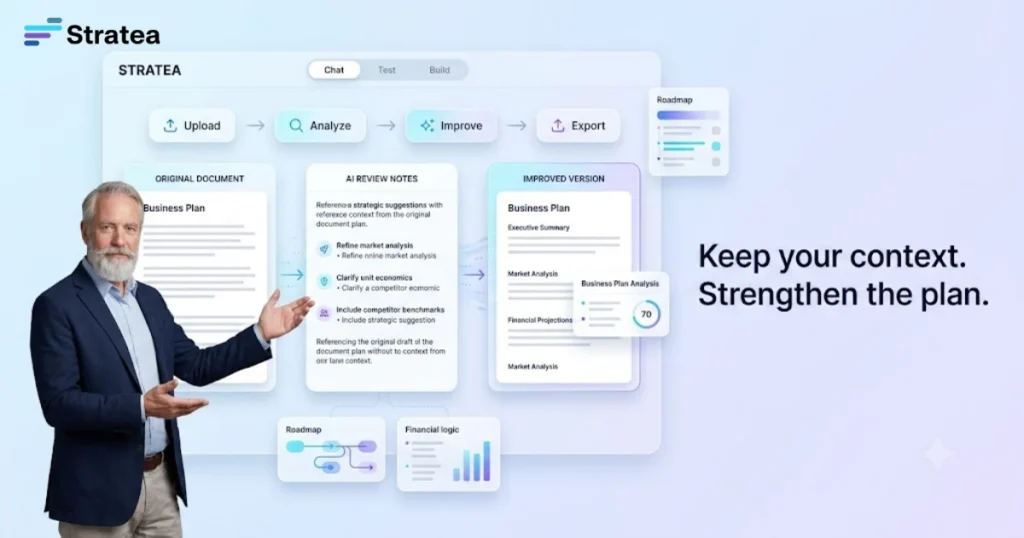
Some tools respond to “review my plan” by rewriting the whole document from scratch. That might feel productive at first glance, but it often strips away the founder’s original context, local market knowledge, and specific numbers, replacing them with generic language that sounds plausible while actually saying very little.
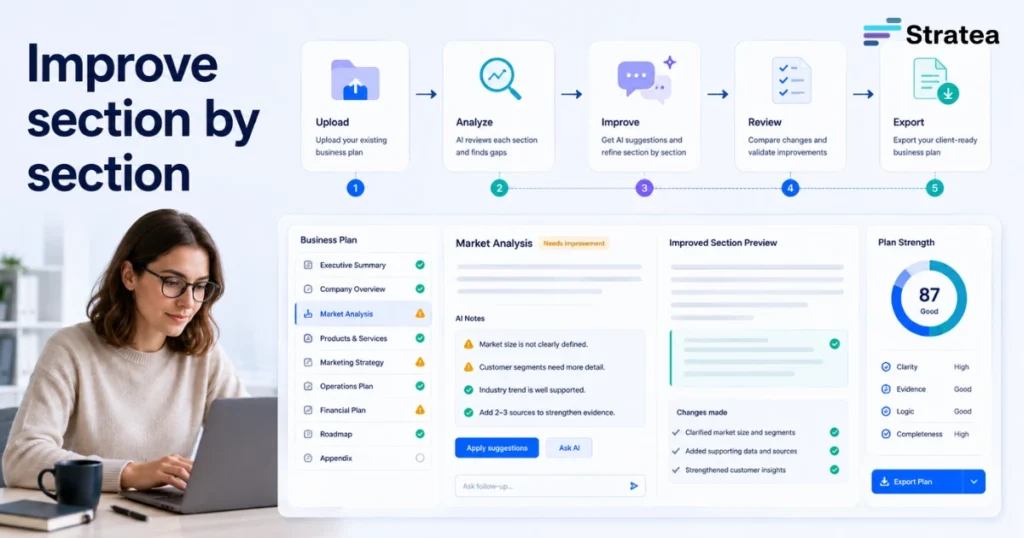
A section-by-section review takes a different approach. It keeps your original plan intact and lets you improve business plan content piece by piece, so the founder’s voice, assumptions, and hard-won details stay exactly where they belong.
| Approach | What it does | Best for |
| Full rewrite tools | Regenerates the plan text from a short prompt, often losing specific detail | A rough first draft when nothing exists yet |
| Section-by-section review | Works from your existing draft, flags weak points by section, suggests targeted fixes | Improving a real plan before a lender, investor, or partner sees it |
| Manual self-review | You reread your own draft and try to spot problems | Early sanity checks before deeper review |
| Paid human reviewer or consultant | An outside expert reads the plan and gives feedback | High-stakes submissions where budget allows for expert judgment |
Section-by-section review tends to produce a plan you can actually explain in a meeting, because you understand why each part changed. A full rewrite can leave you holding a document you didn’t really write and can’t defend under questioning, which defeats the purpose of getting it reviewed in the first place.
Improving an Existing Draft Without Losing Your Original Thinking
Most founders searching for a business plan reviewer already have something written, whether it’s a rough outline, a plan from a previous funding round, or a document a partner drafted. The goal isn’t to start over. It’s to keep the parts that reflect real knowledge of the business and fix the parts that won’t survive scrutiny.
This is where uploaded-plan analysis matters. Instead of generating a new plan from a short prompt, the process should take your existing draft, your follow-up answers, and any supporting numbers, then identify specific weak points: an assumption with no support, a financial section that doesn’t match the roadmap, a market claim with nothing behind it. STRATEA’s Strategic Discovery Process is built around this kind of guided discovery: it asks the questions a good advisor would ask about your draft, section by section, instead of handing back a generic rewrite.
If you’re deciding between tools right now, it’s worth trying a low-commitment first pass. STRATEA is free to start, so you can see how section-by-section feedback works on your own draft before deciding whether the paid tier fits your next step.
Working this way also keeps a paper trail. When a lender or partner asks why a number changed, you can point to the specific assumption that was tested and revised, instead of explaining that a tool regenerated the whole document and you’re not entirely sure what changed.
Where AI Review Helps and Where Human Judgment Still Matters
AI-assisted review is strong at consistency checks: catching mismatched numbers, flagging unsupported claims, spotting missing sections, and organizing feedback so you know what to fix first. It can move through a full draft faster than most founders can review their own work objectively, since it isn’t emotionally attached to the plan the way the writer usually is.
It has real limits, though. For SBA loans, bank financing, or BDC programs in Canada, a plan should be structured to align with what lenders typically expect, and a qualified loan officer or advisor is still the right source for final compliance questions. For E-2, Canada Start-up Visa, EB-5, L-1, or other immigration-related plans, treat AI review as preparation, not legal guidance, and involve qualified legal counsel before submission.
No review process, AI or human, can guarantee funding, loan approval, visa approval, or investor interest. What a good review can do is reduce the number of weak points a decision-maker finds first, and give you a clearer sense of which parts of the plan need more work before you submit it anywhere.
This also matters for consultants and advisors reviewing plans on behalf of clients across the United States and Canada, and for founders working in a second language who need the review itself available in more than one language. A review process that supports multiple languages doesn’t change what gets checked, but it removes a barrier for teams who think through the business in one language and need the final plan in English for a US or Canadian audience.
Worked Example: Reyes Mechanical Services Runs a Business Plan Review
Reyes Mechanical Services is a five-person HVAC contracting business in its third year, expanding from residential repair work into commercial maintenance contracts. The owner, Marcus Reyes, had a plan from an earlier bank conversation that got quiet, unspecific feedback: strengthen your financials. He didn’t know what that meant in practice, and the plan sat untouched for months.
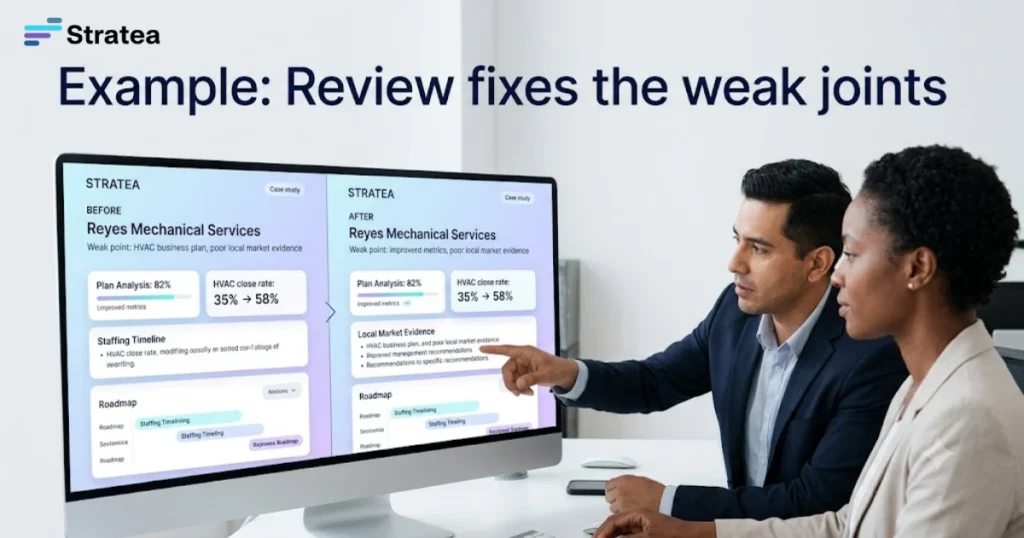
Running the existing draft through a structured business plan review surfaced three specific issues. First, the revenue projection for commercial contracts assumed a 30% close rate on cold outreach, with no evidence behind that number and no comparison to his actual residential close rate, which was closer to 12%. Second, the staffing plan described hiring two technicians in month four, but the payroll numbers in the financial section didn’t update until month seven, an inconsistency a lender would likely catch immediately. Third, the market section claimed strong demand for commercial HVAC maintenance without citing any local data or even a rough count of commercial buildings in his service area.
Working section by section, Marcus revised the close rate assumption downward and added a sensitivity note showing the plan still worked at 15%. He aligned the staffing timeline with the payroll figures so both told the same story. He also added two concrete reference points: a count of commercial properties within his service radius and pricing from two comparable regional HVAC companies, both flagged clearly as data to validate further rather than verified figures.
The revised plan didn’t get longer. It got more specific, which is what reviewers actually respond to. When Marcus went back to the bank three months later, the loan officer’s questions were about growth timing, not about whether the numbers made sense, a very different conversation than the first attempt.
What to Do With Review Feedback Once You Have It
Feedback is only useful if you act on it in order. Start with assumptions, since the financial logic and roadmap sections are built on top of them and won’t hold if the foundation underneath is shaky. Then check that the financial numbers actually match the roadmap and staffing plan. Then look at market evidence and replace vague claims with specific, sourced references. Formatting and language polish should come last, after the substance is solid.
If your plan is heading toward a loan application, an investor conversation, or a formal program, budget time for at least one more review pass after you make these changes. Plans rarely survive scrutiny on the first revision, and a second pass often catches something the first one missed. If you’re working with a consultant or advisor on someone else’s plan, a consultant-ready planning workflow that keeps section-by-section notes attached to the draft makes that back-and-forth faster than starting fresh with each client every time.
It also helps to separate what needs fixing now from what needs ongoing tracking. Some issues, like a mismatched staffing timeline, get resolved once. Others, like a market assumption based on limited data, are worth revisiting as you gather more real evidence over the following months, especially if the plan will keep evolving alongside the business.
Keep a short log of what changed and why. When Marcus revised his close rate assumption, he didn’t just update the number, he noted the original assumption, the actual residential close rate that prompted the change, and the sensitivity range he tested. That log became useful again months later when a growth partner asked how the projections were built. Instead of reconstructing his reasoning from memory, he had a record of it. This kind of documentation is a small habit, but it’s the difference between a plan you can walk someone through with confidence and one you’re hoping nobody questions too closely.
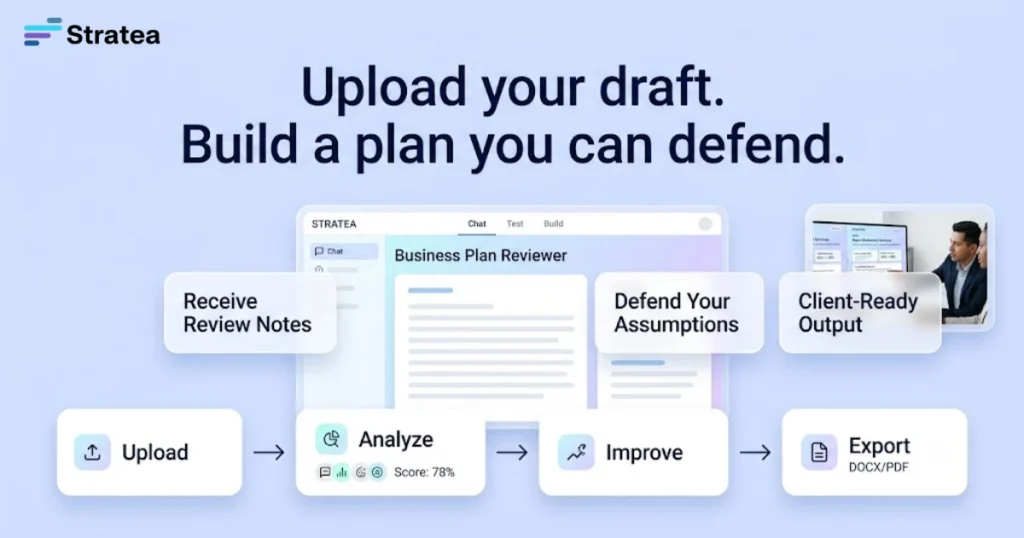
Build a Plan You Can Defend
A business plan reviewer should leave you with a shorter list of real problems, not a longer document that sounds better and says less. If you have a draft that’s been sitting untested, or one that already got quiet feedback you couldn’t act on, that’s a reasonable place to start.
STRATEA is free to start. Start Strategic Discovery and work through your existing plan section by section, with guided questions built around building a plan you can defend, not just generate.
FAQ
What does a business plan reviewer actually check?
A thorough review checks assumptions, market evidence, financial logic, and execution roadmap, not just grammar or formatting. The goal is to find weak points before a lender, investor, or program evaluator does.
Is an AI business plan review reliable enough for a loan application?
It’s a strong preparation step. AI review is good at catching inconsistencies and unsupported claims, but for SBA, bank, or BDC loans, the plan should also align with what your specific lender expects, which is worth confirming with a loan officer or advisor.
Can I upload my existing business plan for review instead of starting over?
Yes. Uploaded-plan analysis is meant to work from what you already have, using your original numbers and context, and improving the plan section by section rather than replacing it.
How is a business plan reviewer different from a proofreading tool?
Proofreading checks spelling, grammar, and readability. A business plan reviewer checks whether the plan’s logic, assumptions, and numbers would survive scrutiny from someone evaluating the business seriously.
Will a business plan review guarantee funding or approval?
No legitimate review process can guarantee funding, loan approval, visa approval, or investor interest. A good review reduces weak points and strengthens the plan’s defensibility, but the final decision belongs to the lender, investor, or program.
Is STRATEA free to use for a business plan review?
STRATEA is free to start. Advanced and continued use involves paid plans, and that’s worth knowing upfront before you build a workflow around it.