A business plan outline is not just a list of sections to fill in. For founders and startup teams, it should work like a decision system: organizing assumptions, market research, operations, financial projections, and execution milestones before the full plan is written. A useful outline helps you see what must be proven, what still needs evidence, and what a reader needs to understand before trusting the plan.
This is also where an ai business plan generator can either help or hurt you. Used well, it speeds up the outlining process by prompting you for the right inputs at the right stage. Used carelessly, it can hand you a finished-looking outline before you have actually worked out what each section is supposed to prove.
Instead of asking only “What should I include?”, a stronger outline asks, “What decision should each section support?”
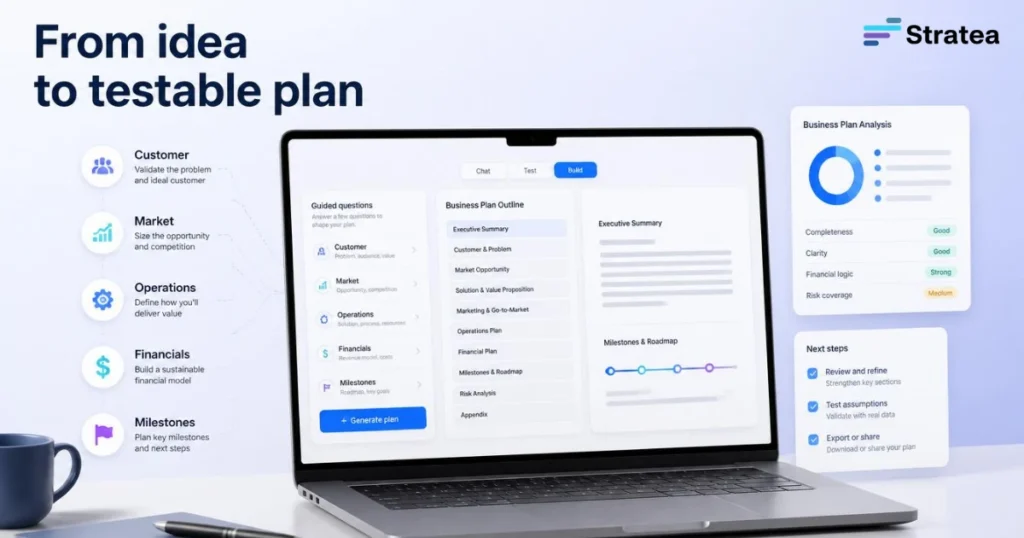
What Is a Business Plan Outline?
It is a section by section framework for building a complete business plan, defining the order of the plan, the information each section should include, and the logic that connects the business idea to execution.
In simple terms, it is the skeleton of your plan. But for founders, the outline should also function as a planning filter. It should show whether your idea has a defined customer, a practical business model, a realistic go-to-market strategy, an operations path, and financial assumptions that can be explained.
A business plan itself is commonly defined as a written document that describes a business, its objectives, strategies, sales and marketing plans, and financial forecasts. Government business guidance in the UK explains that a business plan can help clarify an idea, identify potential problems, set goals, measure progress, and support investment or loan conversations.
That is why the outline matters. A weak outline produces a document that sounds organized but leaves important questions unanswered. A strong outline helps you write a plan that can guide decisions.
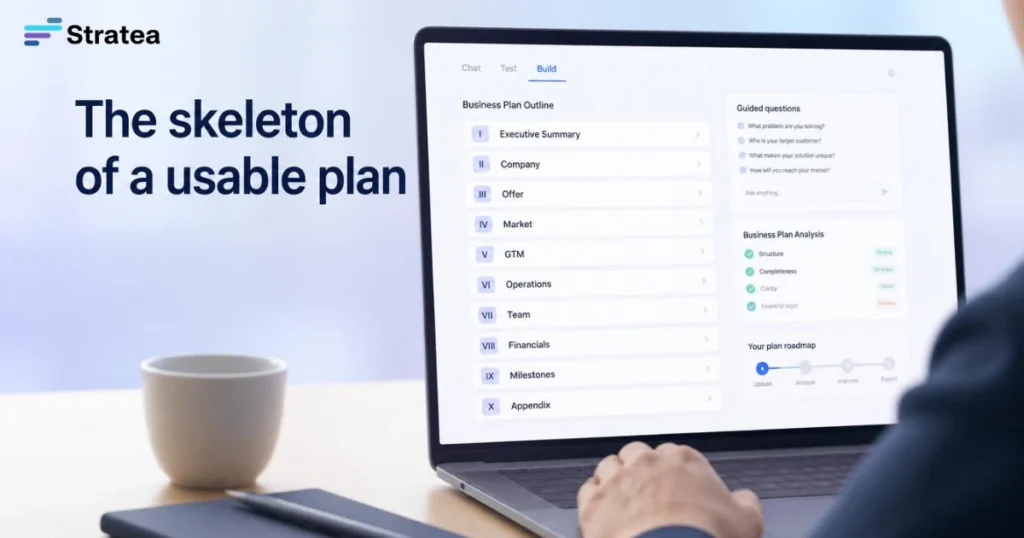
A Template Organizes Information, a Decision-Based Outline Tests It
Many founders start with a downloadable template and begin filling in boxes. That can be useful, but it often creates a plan that looks complete before the thinking is complete.
A template helps you remember the standard parts of a business plan. This is useful when you need a clean format or when a lender, partner, or consultant expects a familiar structure. Common frameworks list sections such as executive summary, company description, market research, organization and management, product or service line, marketing and sales plan, funding request, financial projections, and appendix. That structure is helpful, but it does not automatically tell you whether your business model works.
A decision-based outline asks a sharper question for every section instead of just naming it:
- Executive summary: What should the reader understand first?
- Company description: What business are we really building?
- Market analysis: Who has the problem, and how do we know?
- Go-to-market strategy: How will customers actually find and choose us?
- Operations plan: Can we deliver consistently?
- Financial plan: What assumptions drive the numbers?
- Milestones: What must happen next to reduce risk?
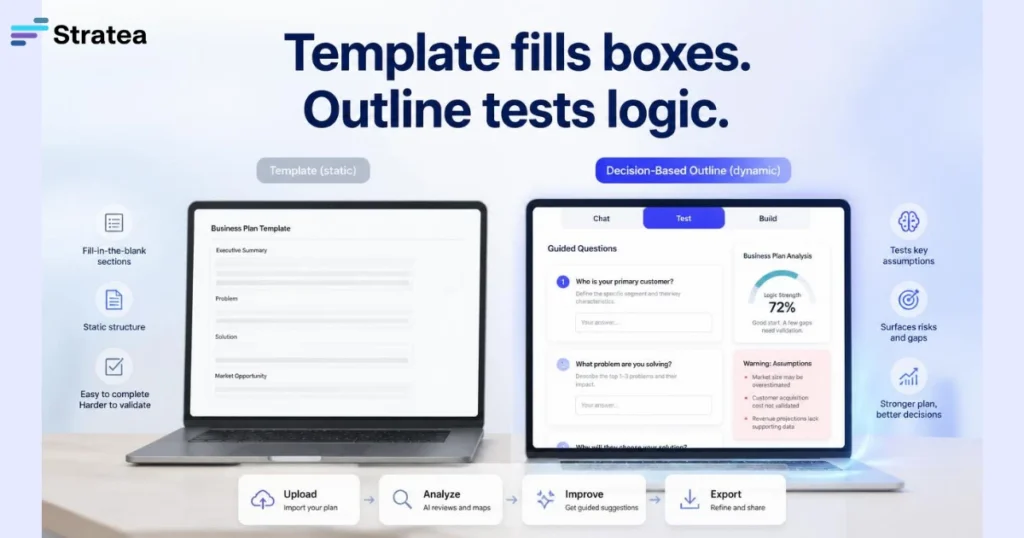
This distinction matters most for startup teams. At an early stage, most of the plan is still assumption-based. You may not have complete sales data, retention history, or proven margins yet. A decision-based outline makes those assumptions visible so you can test them, instead of letting them hide behind a tidy heading.
| Approach | What It Does | Best For |
| Template-based outline | Lists standard sections in a familiar order, with little guidance on what each one needs to prove | A first pass when you need a recognizable format fast |
| Decision-based outline | Turns each section into a question the plan must answer, surfacing weak assumptions early | Founders who need the plan to hold up under real scrutiny |
| Guided, AI-assisted outline | Works through your raw ideas or existing draft section by section, asking follow-up questions as an advisor would | Turning scattered notes or a rough draft into a structured, defensible plan |
The Core Outline Every Founder Should Start With
A strong outline should be complete enough for serious planning but flexible enough to adapt. The sections below form a practical base for most founders, small business owners, and consultants.
Executive summary
The executive summary comes first in the document, but it is usually easier to write after the rest of the plan is clear. This section should briefly explain the business, target customer, problem, solution, business model, traction or validation, financial highlights, funding need if relevant, and near-term milestones.
The executive summary should not be a motivational introduction. It should tell a busy reader what the plan is about and why the opportunity deserves attention. For a founder, this section should answer: What are we building? Who is it for? Why now? How will the business make money? What decision or support are we asking for? For an internal plan, the summary can be short. For a lender or investor plan, it may need more detail on funding use, financial projections, and risk.
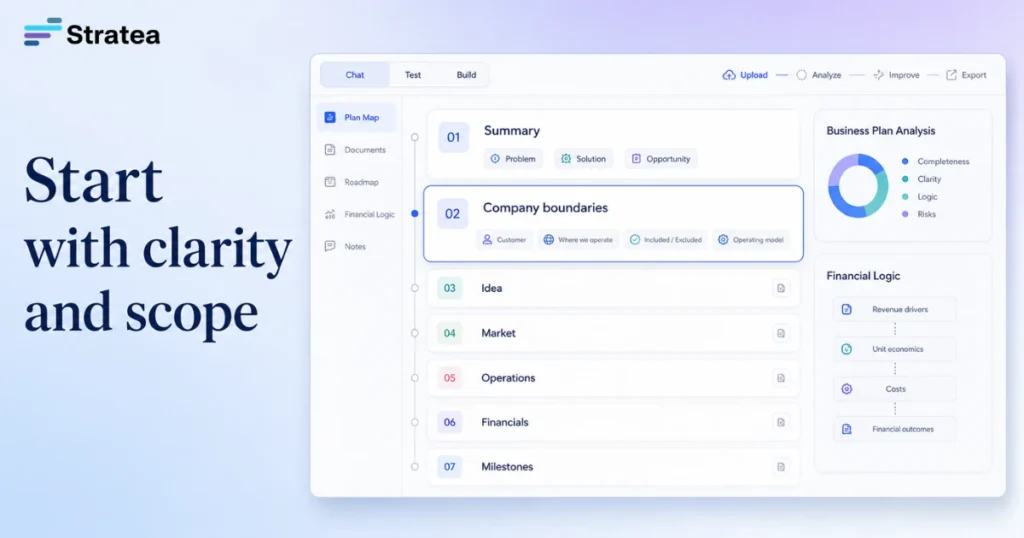
Company description
The company description explains the business in plain language. It should include the legal or planned business structure, location or market focus, mission, business model, ownership or founding team, and the problem the business exists to solve.
This section should also clarify scope. A home services founder, for example, may be tempted to write that the company will handle cleaning, repairs, landscaping, and property management. The outline should force a decision: what is the first service line, what is the expansion path, and what will not be offered yet. A good company description creates boundaries. Without boundaries, the rest of the plan becomes vague.
Product or service section
This section explains what you sell and why customers will choose it. It should cover the offer, pricing logic, delivery method, customer benefits, differentiation, and any future product roadmap. The goal is not to list every possible feature. The goal is to show a clear connection between customer pain and your offer.
For a telehealth startup, this section might explain whether the first service is urgent virtual care, chronic condition support, mental health triage, or employer-sponsored care. Each choice changes the market analysis, compliance review, staffing plan, pricing model, and financial projections. Your outline should make those dependencies visible.
Market analysis
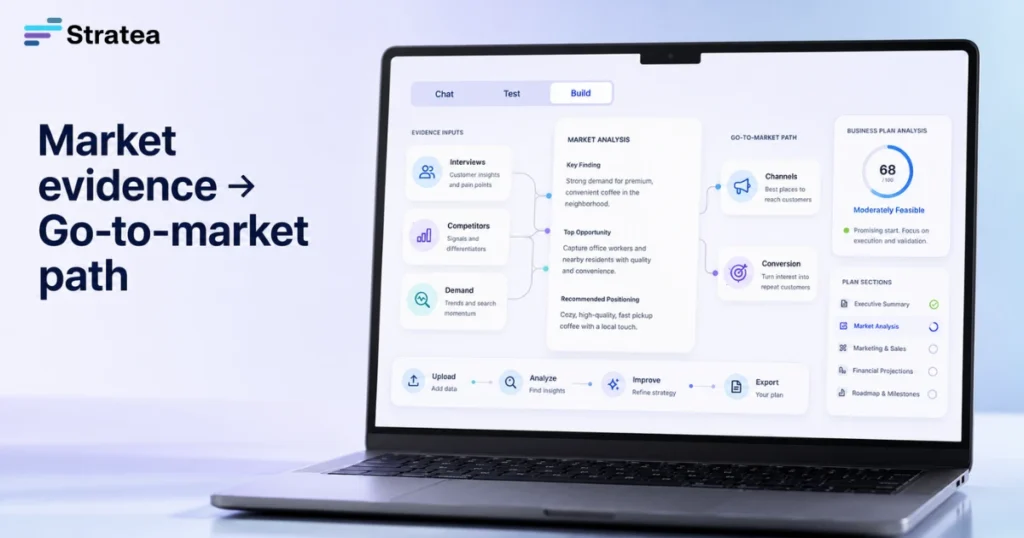
Market analysis is where many business plans become either too thin or too inflated. A useful market analysis does not only describe a large industry. It identifies the specific customer segment you can realistically reach.
This section should cover target customers, market size if relevant, customer behavior, competitors, alternatives, pricing expectations, market trends, and evidence gathered from interviews, search data, surveys, pilots, or early sales. For founders, the strongest market analysis often answers four questions: Who has the problem? How do they solve it today? Why would they switch? What evidence supports that belief? A market analysis should be honest about uncertainty. If a number is an estimate, say so. If demand is based on early interviews rather than sales, make that clear.
Go-to-market strategy
The go-to-market section explains how the business will attract, convert, and retain customers. It should include channels, messaging, sales process, partnerships, pricing strategy, marketing budget, and early validation metrics. This section is where the plan moves from “there is a market” to “we know how to reach it.”
For example, a founder selling software to independent consultants may test LinkedIn outreach, partner referrals, SEO content, and webinar demos. Each channel has different costs, conversion rates, timelines, and staffing needs. A useful outline asks the founder to define which channels come first and how success will be measured. Common metrics include customer acquisition cost, conversion rate, sales cycle length, retention or repeat purchase rate, referral rate, and payback period. You do not need perfect data at the beginning. You do need a measurable plan.
Operations plan
The operations plan explains how the business will deliver the product or service. This includes staffing, suppliers, systems, tools, location, fulfillment, customer support, compliance needs, quality control, and day-to-day workflows. Daily operations deserve their own section in most established outline frameworks, a useful reminder that execution matters as much as strategy.
For a service business, this section might explain scheduling, hiring, training, quality checks, customer communication, and capacity limits. For a software startup, it may cover product development, onboarding, support, data handling, roadmap priorities, and vendor dependencies. A strong operations plan should answer: can the business actually deliver what the marketing section promises?
Team and management
This section explains who is responsible for execution. It should include founders, key team members, advisors if relevant, hiring needs, ownership structure, and gaps that must be filled. Do not treat this section as a biography page. Connect each role to the plan’s execution risk.
If the business depends heavily on one founder, say so and explain how that dependency will be reduced. If a key hire is required before launch, connect that hire to the budget and milestones.
Financial plan
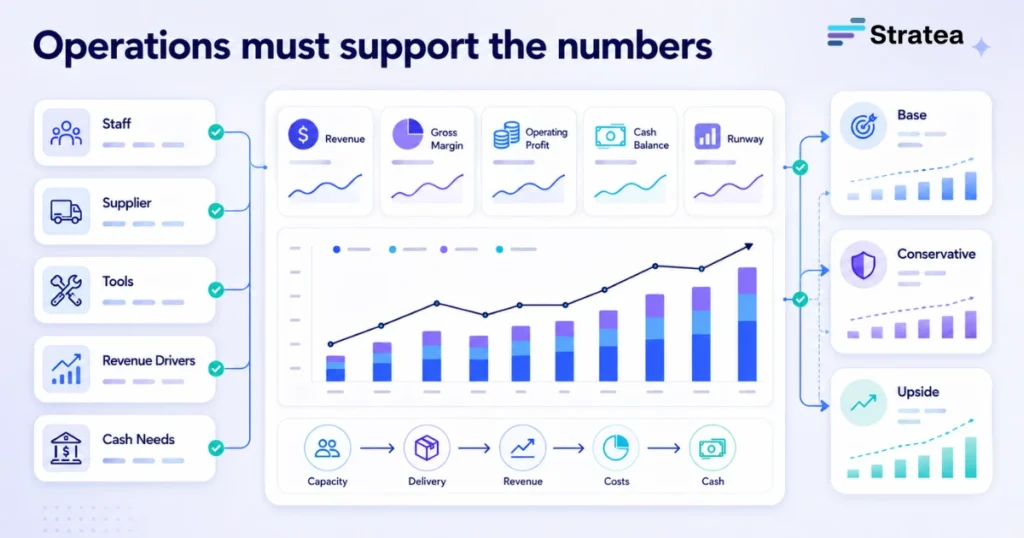
The financial plan turns the business model into numbers. It should include revenue assumptions, pricing, cost of goods or service delivery, operating expenses, staffing costs, cash flow, break-even logic, and financial projections. For funding-oriented plans, this section may also include use of funds, repayment logic, investor return assumptions, or scenario analysis. For internal plans, it may focus more on runway, monthly burn, margin targets, and decision thresholds.
A strong financial plan is not about making the numbers look impressive. It is about making assumptions visible. If revenue depends on 200 monthly customers, how will those customers be acquired? If margins depend on a certain supplier cost, is that cost confirmed? If hiring begins in month three, what revenue or workload milestone triggers it? If the base case misses by 20 percent, does the company still have runway?
Financial projections are most useful when they include sensitivity. A single forecast can create false confidence. A range of scenarios helps founders make better planning decisions.
Milestones and roadmap
The milestones section translates the plan into action. It should show what must happen next, by when, and how success will be measured. For a startup team, milestones might include completing customer discovery interviews, launching a beta or pilot, reaching the first 25 paying customers, validating pricing, hiring the first operations role, reaching break-even contribution margin, preparing funding materials, or expanding to a second market.
The roadmap should not be a wish list. It should connect actions to risk reduction. Each milestone should help answer a real planning question.
Appendix
The appendix holds supporting material that would clutter the main plan. This may include detailed financial tables, research notes, customer interview summaries, resumes, product screenshots, supplier quotes, legal documents, lease information, permits, technical documentation, or additional market data. Use the appendix to keep the main plan readable while still giving reviewers access to evidence.
| Map your own outline
If you are working through your own outline right now, STRATEA’s free-to-start Strategic Discovery Process works through these same questions with you, section by section, instead of handing back a generic template. |
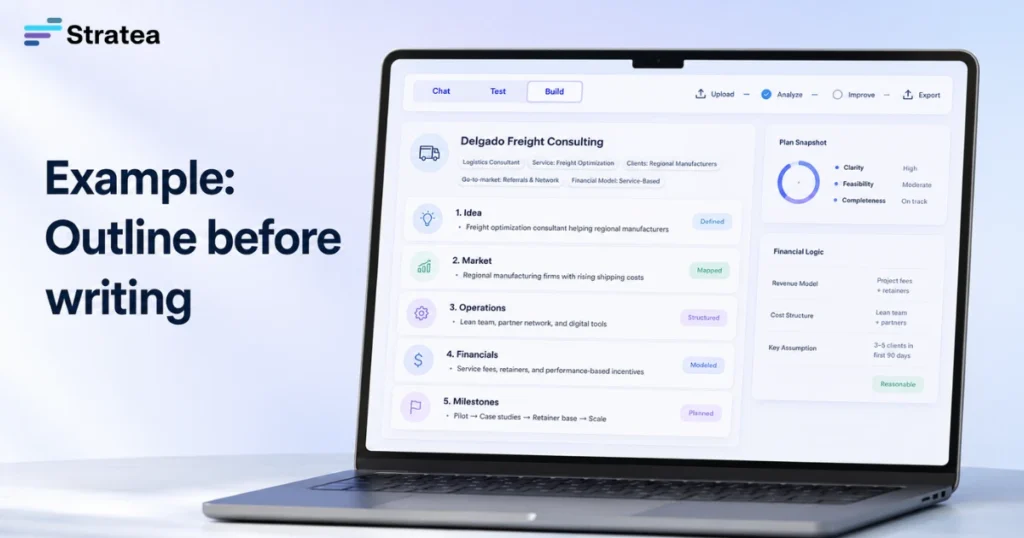
Worked Example: Delgado Freight Consulting Maps Its Outline First
Marisol Delgado spent eleven years managing logistics for a regional distributor before starting her own freight consulting practice, advising small manufacturers on carrier contracts and shipping cost reduction. She had strong expertise and two early clients, but no written plan, only a mental list of what she wanted to offer.
Before writing a full plan, she worked through a decision-based outline first. The exercise itself surfaced three gaps she had not noticed. First, her company description did not draw a boundary: she had been telling prospects she could help with “any logistics problem,” which made her offer sound unfocused next to specialized competitors. Second, her market analysis leaned entirely on her industry experience, with no count of manufacturers in her target region or evidence of what they currently spent on freight. Third, her financial plan assumed four new clients per quarter with no acquisition channel attached to that number.
Working section by section, Marisol narrowed her company description to a single first service line: carrier contract audits for manufacturers shipping under $2 million a year in freight. She added a rough count of qualifying manufacturers within her target region, pulled from a state business directory, and flagged it clearly as a figure to refine rather than a verified total. She also connected her client acquisition assumption to a specific channel: warm referrals from her former distributor network, with a fallback plan if referrals underperformed in the first two quarters.
The outline did not just organize her plan. It exposed where her thinking was still a guess dressed up as a fact. By the time she wrote the full plan, the hardest questions had already been answered, which made the writing itself go faster.
How to Adapt the Outline for Your Planning Purpose
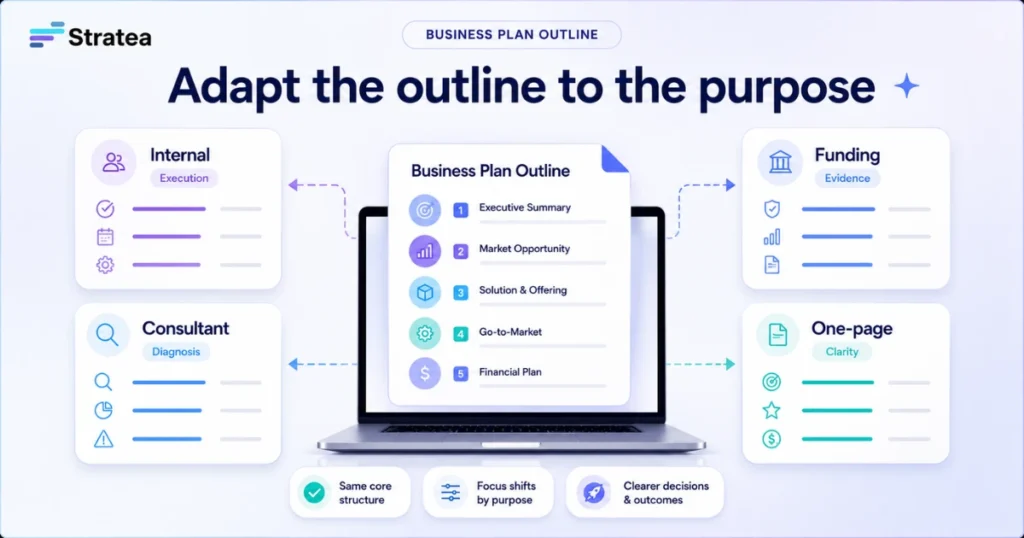
Not every business plan needs the same level of detail. The right outline depends on why you are creating the plan.
Internal launch plan
An internal launch plan can be shorter and more operational. The goal is to help the team make decisions and stay aligned. Prioritize customer segment, offer and pricing, launch channels, operating model, budget and runway, first 90-day milestones, and assumptions to test. You can reduce formal language and investor-style narrative. The plan should be clear enough that the team knows what to do next.
Funding or lender plan
A funding plan needs more evidence, financial detail, and risk explanation. Readers will look for repayment capacity, use of funds, market logic, management capability, and realistic projections. Prioritize the executive summary, business model, market analysis, management team, financial projections, funding request, use of funds, risk and mitigation, and appendix. Avoid unsupported claims. Reviewers do not need hype; they need clear assumptions, evidence, and a credible execution path.
Consultant or client plan
Consultants often work from messy drafts, founder interviews, partial spreadsheets, and scattered notes. In this case, the outline becomes a diagnostic tool. The consultant should ask which sections are missing, which assumptions are unsupported, which numbers do not connect to the strategy, which claims need evidence, and which parts need rewriting for the intended reader.
One-page plan
A one-page business plan is useful when the goal is alignment, early validation, or quick communication. It should still follow the same logic, but with less detail: business concept, customer, problem, solution, revenue model, key channels, main costs, next milestones, and biggest assumptions. A one-page plan is not a replacement for a full plan when detailed financial or funding review is required. It is a starting point.
How Much Detail Each Section Needs
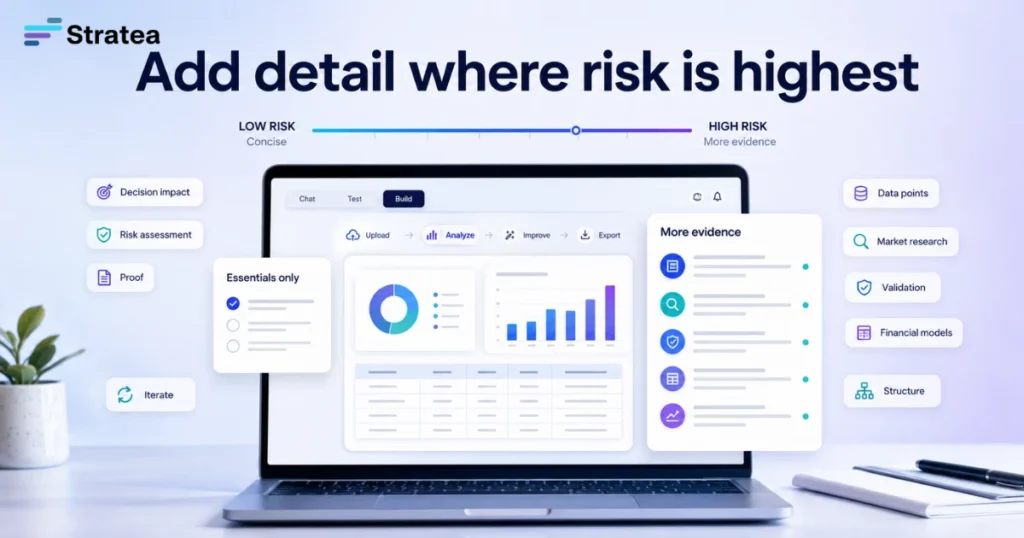
The amount of detail depends on the reader and the decision. For internal planning, keep the outline practical and action-oriented. For funding, include more evidence, financial detail, and risk analysis. For partners, focus on market opportunity, operating model, responsibilities, and execution timeline.
A useful rule is this: add detail where the decision risk is highest. If the business depends on local demand, strengthen market analysis. If it depends on complex delivery, strengthen operations. If it depends on outside funding, strengthen the financial plan and use-of-funds logic. If it depends on a new channel, strengthen go-to-market assumptions. Do not make every section equally long. Make every section useful.
Common Outline Mistakes That Weaken a Business Plan
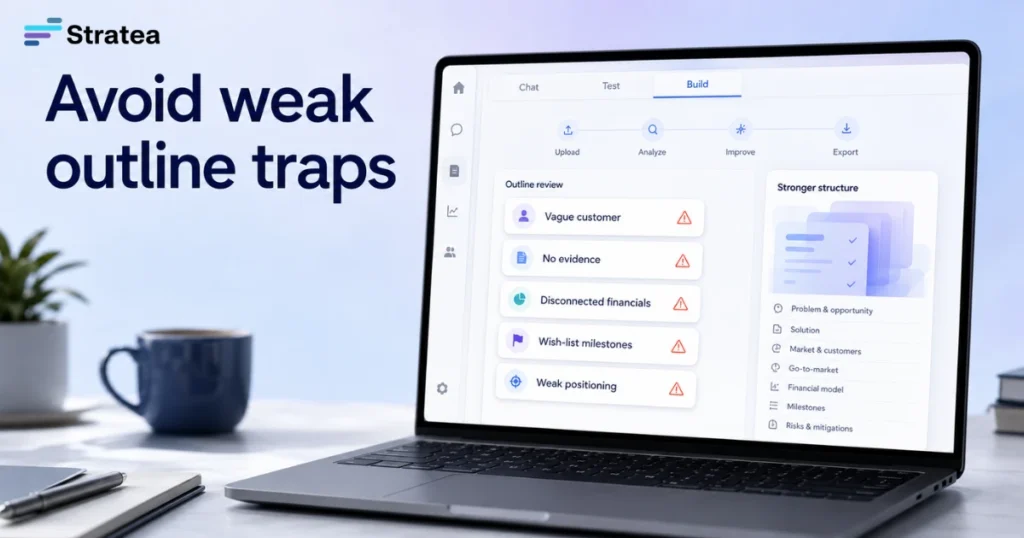
The first mistake is treating the outline as a table of contents instead of a thinking tool. A plan can have all the right headings and still fail to explain how the business works.
The second mistake is putting market size before customer clarity. A large market does not matter if the business cannot reach a specific customer segment.
The third mistake is separating financial projections from the rest of the plan. Numbers should connect to pricing, staffing, customer acquisition, operations, and milestones.
The fourth mistake is writing the executive summary too early. If the rest of the plan changes, the summary becomes inaccurate.
The fifth mistake is hiding uncertainty. Early-stage plans always include assumptions. Strong founders identify those assumptions and show how they will test them.
How STRATEA Turns Raw Inputs Into a Structured Plan
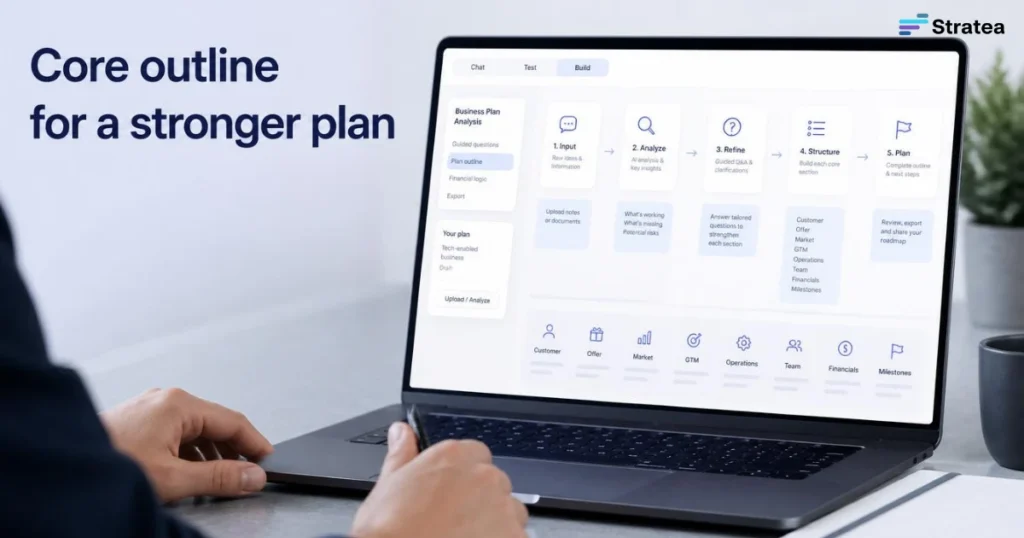
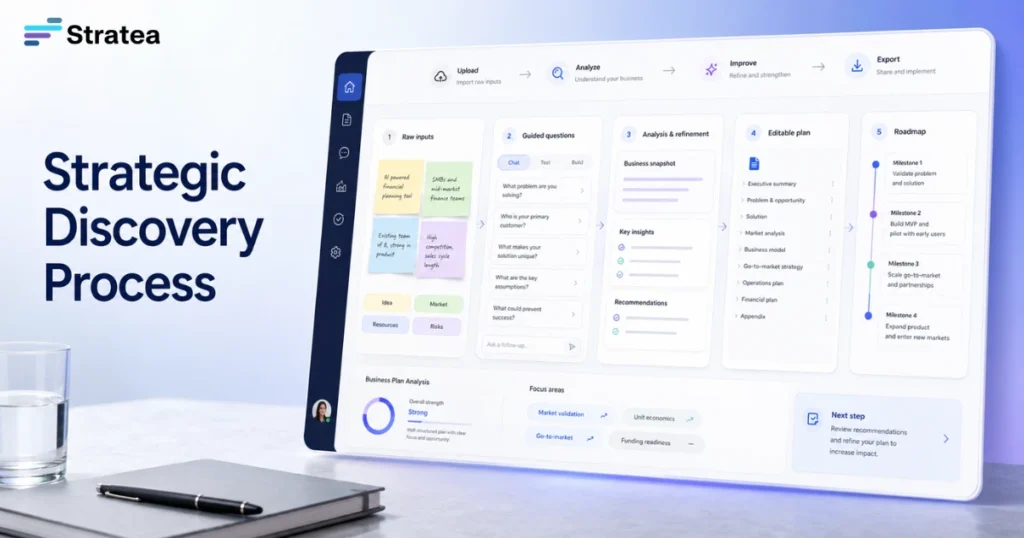
STRATEA is built as an AI Planning Assistant, not a basic chatbot or a simple document generator. Its guided, question-to-plan workflow helps founders and teams turn raw inputs into a structured business plan. You can also work from an existing draft: uploaded material and follow-up answers inform the analysis, revision, and improvement of your plan.
That matters because the hard part of a business plan is not only writing paragraphs. The hard part is organizing assumptions, identifying gaps, connecting sections, and making the plan editable enough to improve. For a founder starting with rough notes, STRATEA helps build a clearer planning structure from guided answers. For someone with an existing draft, it supports plan improvement using the draft and additional answers to strengthen the next version. STRATEA is also expanding toward faster uploaded-plan analysis, in-line chat and edit flows, section-level review, and consultant-focused workflows as the product grows.
The practical value is planning clarity. A good AI Planning Assistant should help you move from scattered information toward better planning decisions.
Final Checklist Before You Write the Full Plan
Before turning your outline into a full business plan, review it as a decision system:
- Does the executive summary reflect the full plan?
- Is the customer specific enough?
- Does the market analysis include evidence, not only broad claims?
- Is the go-to-market strategy measurable?
- Can the operations plan deliver what the sales plan promises?
- Do the financial projections connect to real assumptions?
- Are milestones tied to risk reduction?
- Is the appendix ready to support key claims?
- Are current facts separated from future plans?
A business plan outline is not the final plan. It is the structure that helps you build one with discipline. When the outline is clear, the writing becomes easier. More importantly, the business decisions become sharper.
Build a Plan You Can Defend
A template can help you start. A decision-based business plan outline helps you think. When you are ready to turn raw ideas, guided answers, or an existing draft into a structured plan, STRATEA can help.
| Start Strategic Discovery
STRATEA is free to start. Work through your outline section by section, with guided questions built around building a plan you can defend, not just generate. |
FAQ
What is a business plan outline?
A business plan outline is a section-by-section structure for organizing a business plan. It usually includes an executive summary, company description, products or services, market analysis, marketing strategy, operations plan, financial plan, milestones, and appendix.
What are the main sections of a business plan outline?
The main sections are executive summary, company description, product or service description, market analysis, go-to-market strategy, operations plan, team and management, financial plan, milestones, and appendix.
How detailed should a business plan outline be?
It should be detailed enough to show what each section must prove. An internal outline can be brief, while a funding or lender plan needs more evidence, financial projections, risk analysis, and supporting documents.
Should I write the executive summary first?
It is usually better to draft the executive summary after the rest of the plan is clear. The summary appears first, but it should reflect the final business model, market logic, financial assumptions, and milestones.
Can I use the same outline for investors, lenders, and internal planning?
You can start with the same core outline, but you should adapt the level of detail. Investors and lenders usually need more financial detail, risk analysis, and evidence. Internal plans can focus more on execution, milestones, and assumptions.
How does AI help with a business plan outline?
AI can help organize raw ideas, guided answers, or an existing draft into a clearer structure. STRATEA, as an AI Planning Assistant, supports planning logic, assumption review, feasibility thinking, and editable business plan development rather than only generating static text.