

Solid financial projections for business plan use are often what separates a credible plan from a fragile one. For consultants, founders, and visa business plan writers, the numbers should do more than look polished. Whether built manually or drafted with an ai business plan tool, they need to show visible assumptions, cash flow logic, break-even timing, and realistic scenarios that a reviewer can understand, question, and defend.
What financial projections actually mean in a business plan
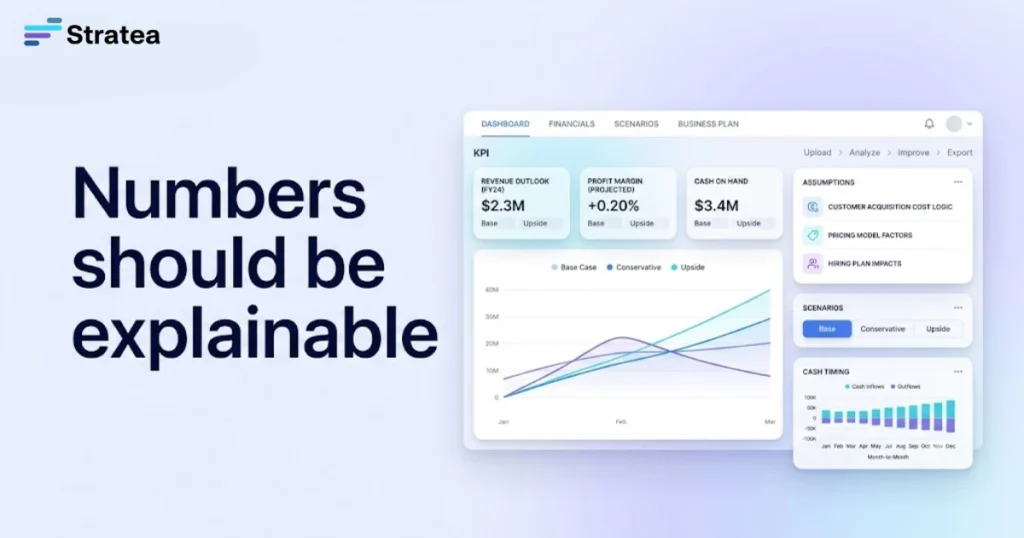
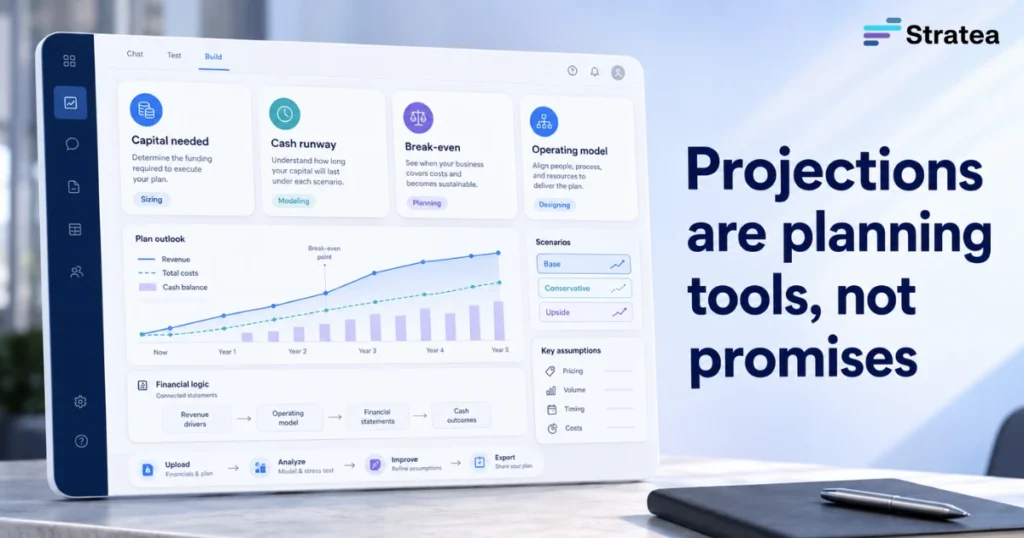
Financial projections are estimates of how a business may perform over time. They are not promises, and they should never be framed as guaranteed outcomes. For a business plan, they help answer practical questions: how much capital is needed, when cash may run low, what revenue must be reached to cover costs and whether the operating model makes sense.
For consultants and visa business plan writers, projections also serve another function. They turn a client’s story into a testable financial case. A plan that says “the company will grow” is weak. A plan that shows how growth depends on leads, conversion rate, staffing, service capacity, gross margin and cash reserves is easier to review.
The core financial statements
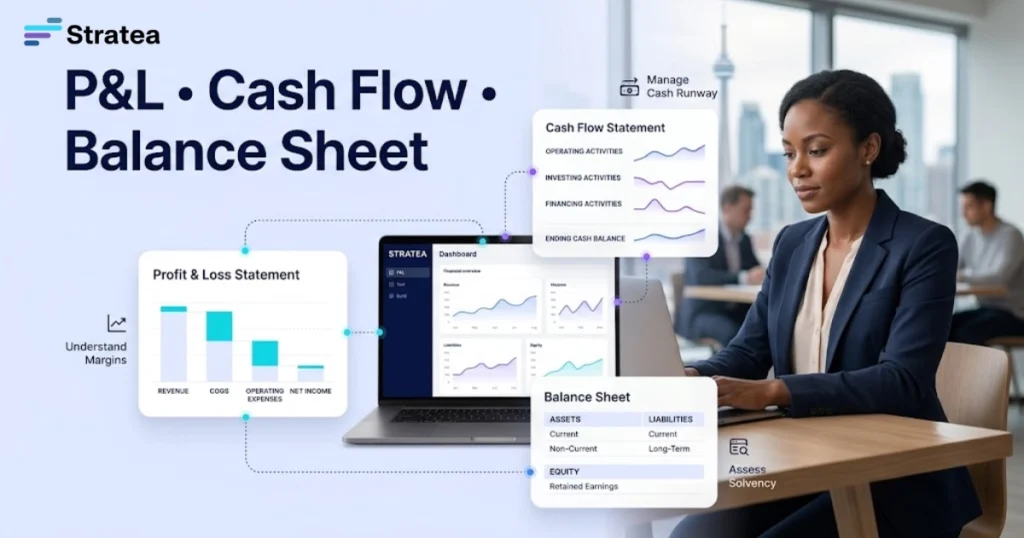
Most serious plans include three linked financial views:
Profit and loss forecast: Shows revenue, cost of goods sold, gross profit, operating expenses and net income.
Cash flow forecast: Shows when money comes in and goes out, including funding, deposits, inventory, payroll, loan payments and owner draws.
Balance sheet forecast: Shows assets, liabilities and equity over time.
A startup plan may not need a complex model at first, but it still needs coherent logic. If the company needs $180,000 to launch, the plan should show where that cash goes, how long it lasts and what must happen before the business becomes self-sustaining.
The planning logic behind the numbers
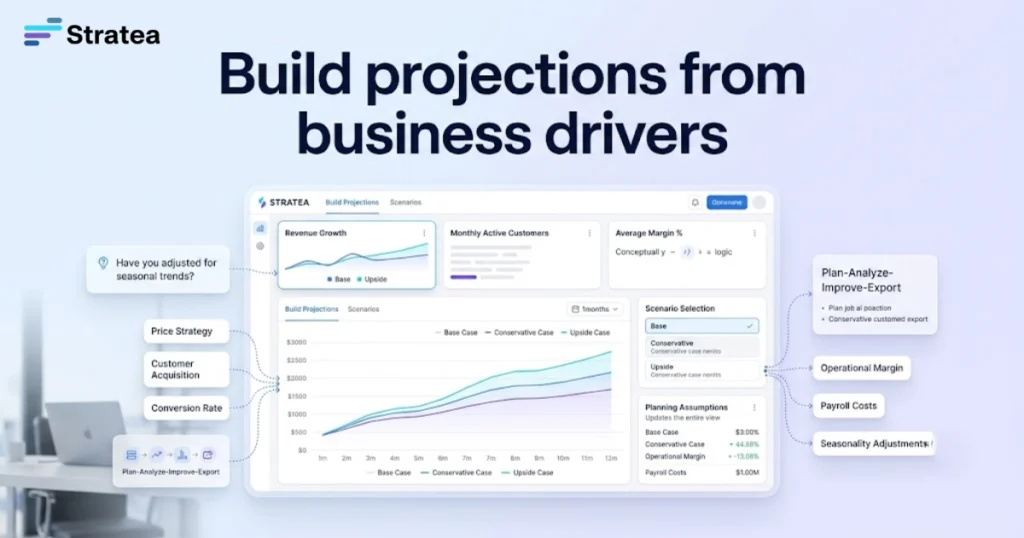
The best projections are built from business drivers. These drivers may include:
- Average price per unit or service
- Number of customers or accounts
- Conversion rate from leads to sales
- Repeat purchase rate
- Gross margin by product or service
- Payroll by role
- Rent, insurance, software and other fixed costs
- Seasonality and ramp-up timing
This matters because reviewers often challenge the story behind the model. If revenue doubles in year two, the plan should explain what changes: more staff, higher marketing spend, a second territory, better retention or a new revenue stream.
What reviewers look for before they trust projections
The reader of a business plan is usually looking for consistency. They want to know whether the market section, operations section, staffing plan and financial model tell the same story.
For US and Canada-facing plans, this may include lenders, bank officers, BDC-style financing reviewers, investors, immigration professionals, internal partners or client stakeholders. BDC describes financial planning as a way to anticipate cash fluctuations, identify financing needs and determine when projects should move forward. That is the same mindset a business plan should support.
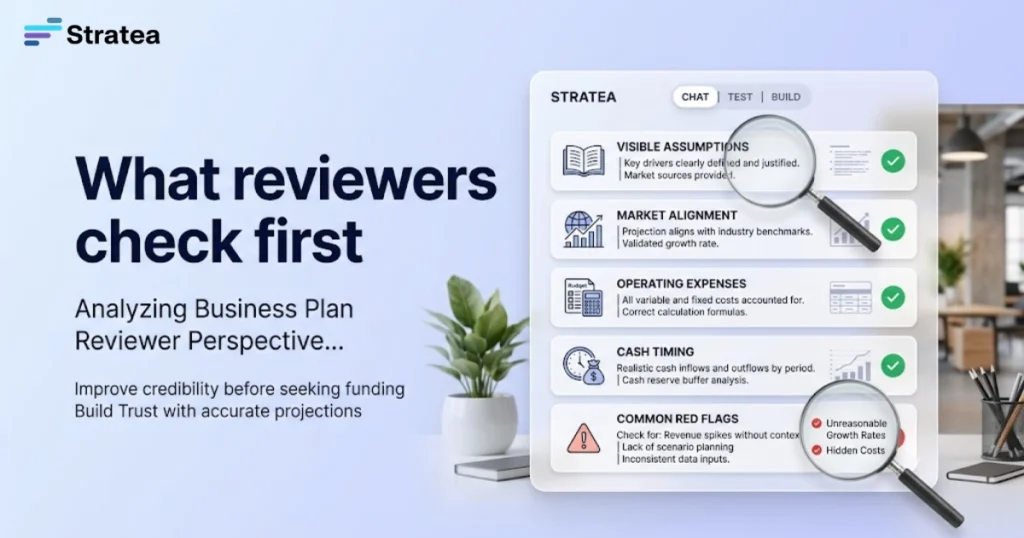
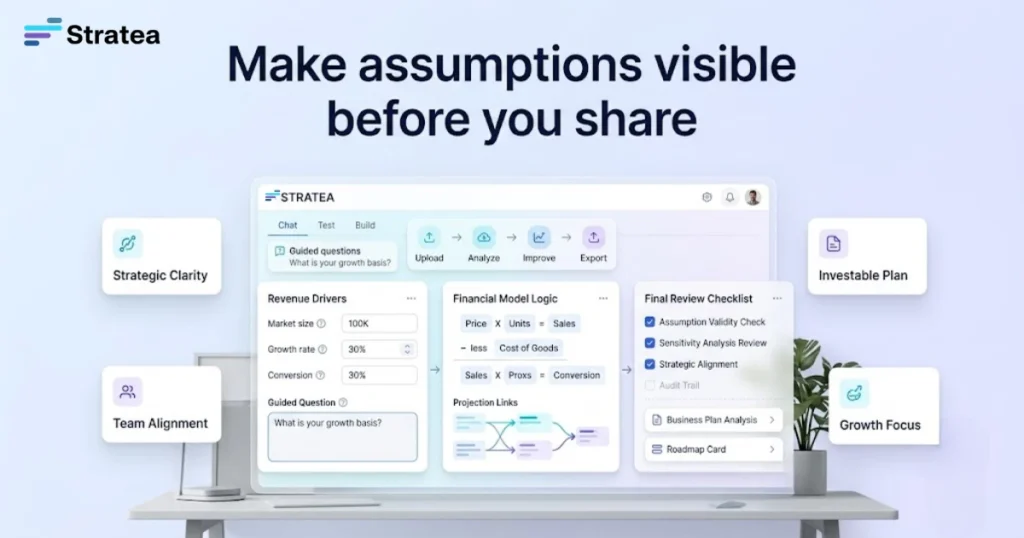
Assumptions that are visible
Every important number should have a source, formula or explanation. A projection that says “Year 1 revenue: $600,000” is not enough.
A stronger version says:
- 500 monthly leads
- 12 percent conversion rate
- 60 new customers per month
- $850 average initial project value
- 30 percent repeat service rate within six months
Now the reviewer can challenge the assumptions. That is a good thing. If the assumptions survive review, the plan becomes more defensible.
Revenue that connects to market demand
Revenue projections should match the market analysis. If the plan claims a small local service business will reach $2 million in the first year, the market section should support that level of demand, staffing and capacity.
This is especially important for immigration consultants and visa business plan writers. A reviewer may not expect certainty, but they will expect the business model to be coherent. The revenue forecast should connect to customers, geography, pricing, sales channels and operational capacity.
Expenses that match the operating model
Many weak plans underestimate expenses. They include marketing and rent, but forget payroll taxes, insurance, software, professional fees, vehicle costs, repairs, refunds, payment processing, licenses or seasonal labor.
A service company with trucks needs maintenance and fuel. An e-commerce company needs fulfillment, returns and platform fees. A consultant-led agency needs subcontractors, software and account management time. When expenses fit the operating plan, the model feels grounded.
Cash flow that shows timing risk
Profit and cash are not the same. A company can show profit on paper and still run out of cash because payments arrive late, inventory must be purchased early or payroll is due before customer collections.
That is why a cash flow forecast is often the most important part of the model. BDC’s cash flow tools focus on forecasting cash movement, protecting against unexpected events and supporting discussions with financial partners.
The Financial Projections for Business Plan Model: What to Include
A business plan does not need to overwhelm the reader with every spreadsheet tab. It should summarize the right numbers and explain the assumptions behind them.
For commercial, funding or immigration-related plans, the following components are usually the most useful.
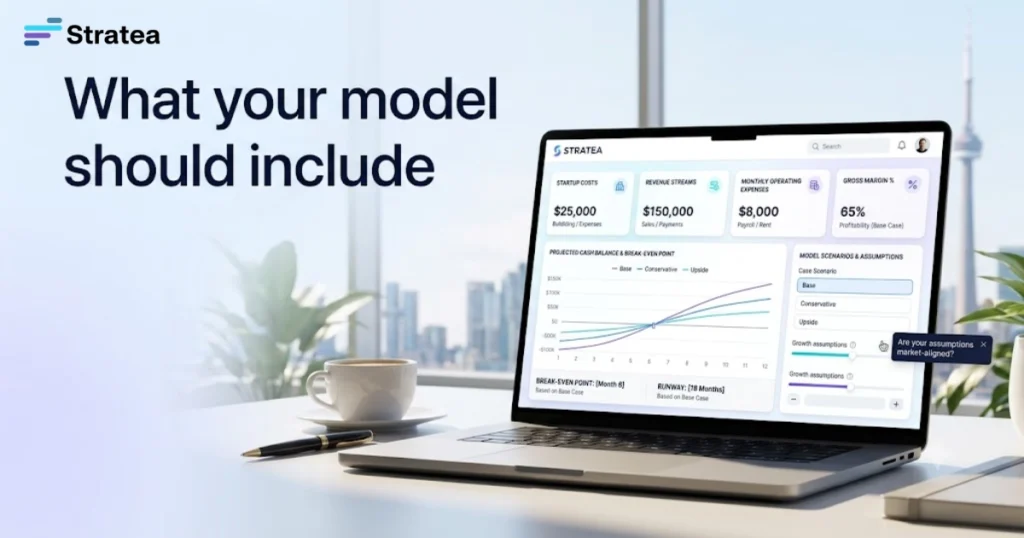
Startup costs
Startup costs show what the business needs before revenue becomes reliable. These may include:
- Legal setup
- Licenses and permits
- Equipment
- Lease deposits
- Website or software setup
- Initial inventory
- Vehicle purchases or leases
- Branding and launch marketing
- Professional services
- Working capital reserve
The key is to separate one-time launch costs from recurring monthly expenses. This prevents the model from overstating ongoing cost levels or understating the capital needed to open.
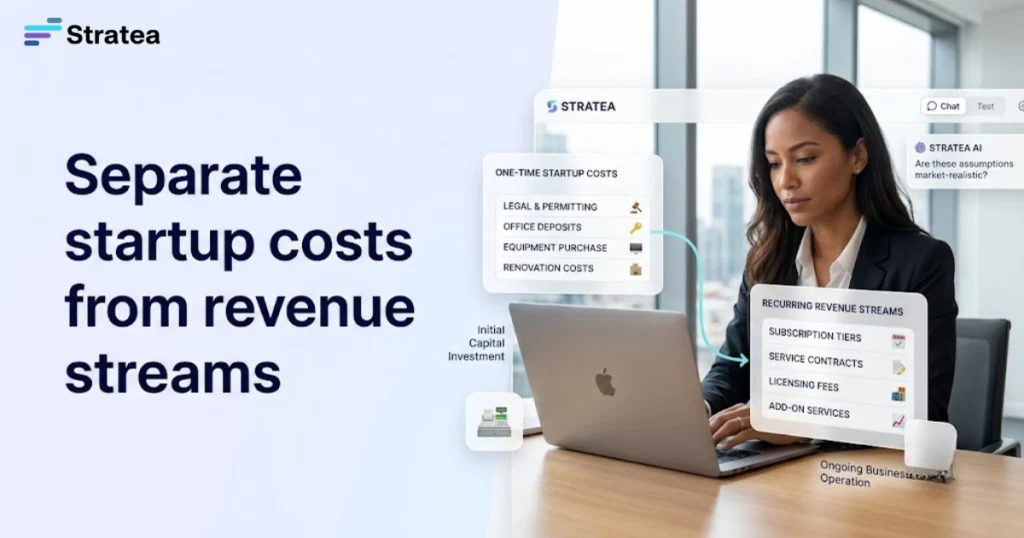
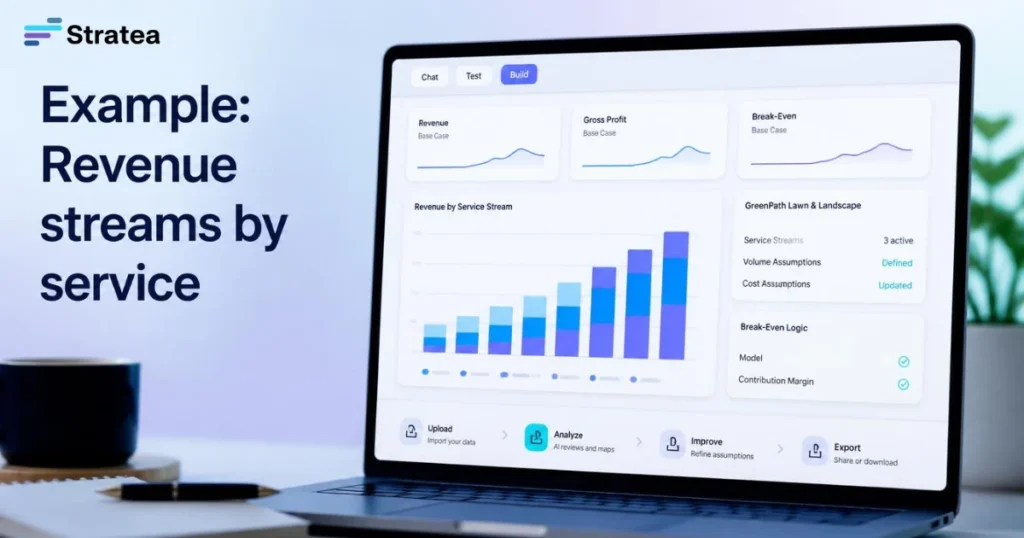
Revenue streams
Revenue streams show how the business earns money. A landscaping company may have lawn maintenance, seasonal cleanups, irrigation repair and snow removal. A consulting firm may have project fees, retainers and add-on services. A software company may have subscriptions, setup fees and professional services.
Each stream should have its own assumptions because margins, sales cycles and capacity can differ.
Gross margin
Gross margin shows what remains after direct costs. In product businesses, that may include inventory, packaging and shipping. In service businesses, it may include direct labor, subcontractors, fuel or materials.
A plan with strong revenue but weak gross margin may struggle to cover operating expenses. Gross margin also helps consultants explain why two businesses with the same revenue can have very different financial outcomes.
Operating expenses
Operating expenses are the recurring costs needed to run the company. These may include rent, payroll, payroll taxes, insurance, marketing, software, professional fees, utilities, travel and administrative support.
The operating expense section should match the staffing and execution plan. If the plan says the company will serve 400 clients a month but has one employee, the reviewer will notice.
Cash flow forecast
A cash flow forecast shows when cash enters and leaves the business. It should include timing, not just totals.
For example, a business may invoice commercial clients on net 30 terms. That means revenue may appear in the profit and loss forecast before cash arrives. If payroll is weekly and vendors require deposits, the business may need more working capital than the income statement suggests.
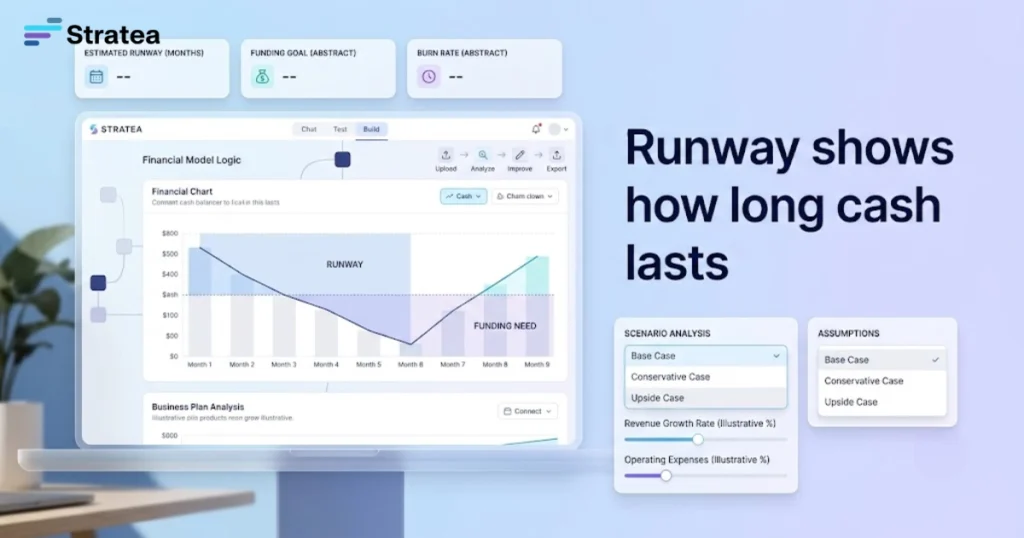
Runway
Runway shows how long the company can operate before it needs more cash. It is usually calculated as available cash divided by monthly net cash burn.
For a business plan, runway is useful because it shows whether the funding request, owner investment or loan amount is realistic. A plan that asks for too little money may be riskier than a plan that asks for a larger amount with clear use of funds.
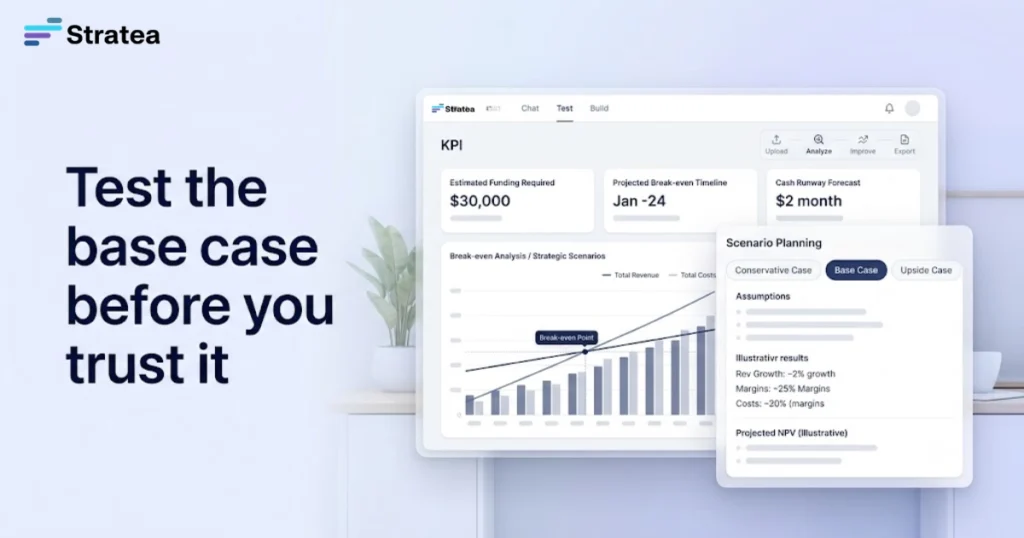
Break-even analysis
Break-even analysis shows the sales level required to cover costs. It can be expressed as monthly revenue, units sold, customers per day or contracts per month.
A simple break-even formula is:
Fixed costs ÷ contribution margin percentage = break-even revenue
If fixed costs are $24,000 per month and contribution margin is 60 percent, break-even revenue is $40,000 per month.
Scenario planning
Scenario planning shows how the business performs under different assumptions. A good plan often includes conservative, base and upside cases.
The point is not to predict the future perfectly. The point is to show which assumptions matter most. If a 10 percent drop in price destroys profit, pricing risk is high. If a 20 percent increase in rent still leaves the business stable, real estate risk may be manageable.
Comparison table: polished projections vs defensible projections
| Area | Polished but weak projections | Defensible projections |
| Revenue | Shows large year-over-year growth with little explanation | Builds revenue from price, volume, conversion, capacity and timing |
| Expenses | Uses broad categories with missing costs | Includes direct costs, payroll, taxes, insurance, software and operating overhead |
| Cash flow | Assumes revenue equals cash collected | Shows payment timing, deposits, working capital and cash gaps |
| Market link | Numbers feel separate from market analysis | Sales assumptions connect to customer segments and go-to-market strategy |
| Scenario planning | Only shows one optimistic case | Includes conservative, base and upside cases |
| Reviewer readiness | Looks attractive at first glance | Can be questioned, revised and defended |
How to build revenue projections from real business logic
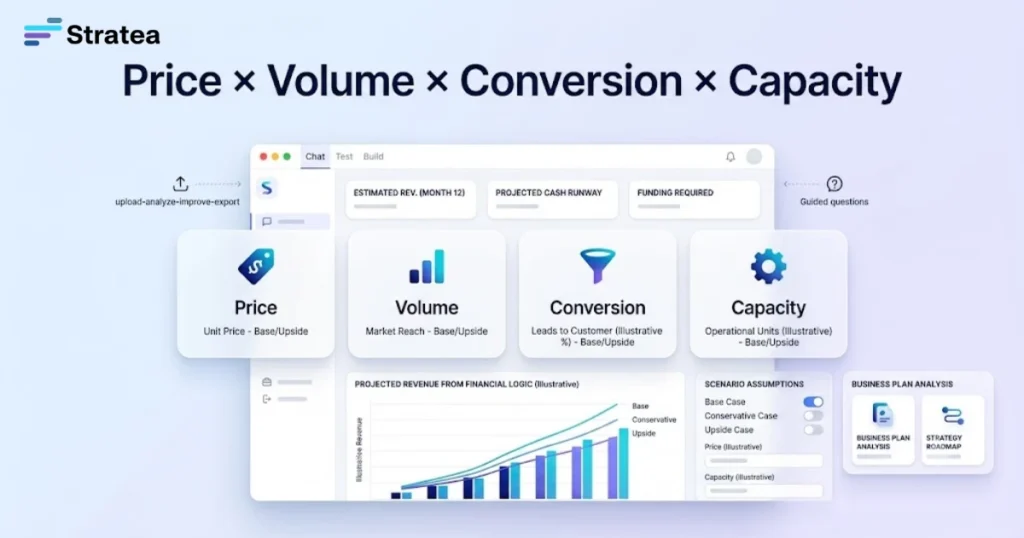
Revenue is the section where many business plans become too vague. The solution is to build revenue from drivers that can be explained.
Price
Start with actual or planned pricing. Use price ranges only when the business truly has variable pricing.
Examples:
- $85 per recurring lawn-care visit
- $1,500 monthly consulting retainer
- $39 monthly software subscription
- $240 average e-commerce order value
If pricing is not finalized, show the planned range and explain what will determine the final price.
Volume
Volume is the number of units, visits, projects, subscribers or customers. It should match the company’s capacity.
A lawn-care company with two crews can only complete a certain number of jobs per day. A consultant can only manage a certain number of client projects at once. Capacity puts a natural ceiling on revenue unless the company hires, automates or changes pricing.
Conversion
Conversion rate connects marketing activity to sales. If a company expects 200 leads per month, what percentage become paying customers?
A model that includes conversion rate is easier to test. If the business misses its revenue target, the owner can see whether the problem is lead volume, conversion, pricing or retention.
Capacity
Capacity is often missing from projections. It matters because growth usually requires people, equipment, systems or time.
A company cannot triple revenue without asking what must change operationally. Does it need another truck, more installers, a sales manager, better scheduling software or a new supplier agreement?
Seasonality
Many businesses do not earn revenue evenly throughout the year. Landscaping, tourism, tax services, education, retail and construction can all have seasonal patterns.
Seasonality should appear in monthly projections. Annual summaries are useful, but monthly cash flow is where risk becomes visible.
How cash flow changes the story
Cash flow is where the financial model becomes practical. A company may look profitable in year one but still need funding because of timing.
Consider a business that sells large projects to commercial clients. It may collect 30 percent upfront, complete work over 45 days and collect the rest after invoicing. During that time, it still pays staff, subcontractors, fuel, insurance and materials.
This is why lenders and financial partners often care about cash flow as much as profit. The SBA asks for forecasted income statements, balance sheets and cash flow statements in the financial projection section of a business plan.
For consultants, this is also where client education matters. A founder may say, “We will be profitable by month six.” The better question is, “Will the company still have enough cash in month four to reach month six?”
Worked example: GreenPath Lawn & Landscape
GreenPath Lawn & Landscape is a fictional landscaping and lawn-care company serving residential homeowners and small commercial properties in Ontario and the northeastern United States. It offers recurring lawn maintenance, seasonal cleanups, mulch installation and small landscape upgrades.
The company is preparing a plan for financing and potential immigration-related business planning support. The owner wants the projections to look credible, but the consultant’s job is to make the assumptions visible and testable.
Business model
GreenPath has four revenue streams:
| Revenue stream | Pricing assumption | Volume assumption |
| Recurring lawn maintenance | $95 per visit | 160 visits per month by month 6 |
| Spring and fall cleanups | $450 per project | 18 projects per season month |
| Mulch and planting upgrades | $1,200 per project | 8 projects per month in peak season |
| Small commercial contracts | $750 per month | 10 accounts by year end |
This structure is stronger than one revenue line because each service has different seasonality, margin and staffing needs.
Revenue assumptions
A weak projection might say:
Year 1 revenue: $480,000
A defensible projection builds the number:
- Recurring maintenance revenue = 160 visits x $95 x 7 active months = $106,400
- Commercial contracts = average 6 accounts x $750 x 12 months = $54,000
- Seasonal cleanups = 36 projects x $450 = $16,200
- Mulch and planting upgrades = 40 projects x $1,200 = $48,000
This still does not complete the full model, but it gives the reviewer something to inspect. The next question becomes: can the company actually perform that work?
Cost assumptions
GreenPath’s direct costs may include crew labor, fuel, plants, mulch, disposal fees, equipment wear and subcontracted specialty work. Its operating expenses may include insurance, vehicle leases, software, marketing, owner salary, bookkeeping and phone service.
A consultant should ask:
- How many crew hours are needed per service?
- What is the gross margin by service type?
- How much equipment is needed before month 6?
- Does payroll rise before revenue rises?
- Are customer deposits collected before materials are purchased?
These questions turn the business plan into a feasibility review.
Break-even logic
Assume GreenPath has fixed operating expenses of $22,000 per month and a 58 percent contribution margin after direct labor and materials.
Break-even revenue = $22,000 ÷ 0.58 = $37,931
If average monthly revenue reaches $50,000, the company may show operating profit. But if customers pay late and payroll is weekly, the company may still need working capital.
This is the difference between profit logic and cash logic.
Scenario planning
GreenPath should include at least three cases:
| Scenario | Key assumption | Planning implication |
| Conservative | Slower customer acquisition and higher fuel costs | More working capital needed, hiring delayed |
| Base | Recurring accounts grow steadily through month 6 | Adds second crew when utilization is stable |
| Upside | Commercial accounts close earlier than expected | Needs equipment financing and hiring plan sooner |
For a reviewer, the scenario table is not a decoration. It shows whether the owner understands what drives risk.
Using projections for visa, loan and consultant client work
Financial projections often carry extra weight when a plan is prepared for a lender, investor, immigration file or consultant client. In these cases, the plan may be read by someone who is not involved in the day-to-day business.
That reader needs clarity.
US business plans
For US-facing plans, projections may be used in discussions with banks, SBA-related lenders, investors, partners or immigration professionals. SBA guidance asks for a prospective financial outlook, including forecasted income statements, balance sheets, cash flow statements and capital expenditure budgets when relevant.
This does not mean every business plan must look the same. It does mean the financial section should be organized enough for a reviewer to understand funding needs, repayment logic and operating assumptions.
Canadian business plans
For Canadian businesses, projections are often used for bank financing, BDC-style financing preparation, internal planning, expansion decisions and immigration-related planning. BDC’s financial plan template is designed to help businesses project revenues and expenses, anticipate cash flow and identify financing needs.
A Canadian plan should still avoid overstating certainty. Strong projections show what the business expects, why those assumptions are reasonable and what will happen if revenue is delayed.
Immigration-related planning
Immigration-related business plans require special care. For example, USCIS describes E-2 Treaty Investor eligibility in terms of a substantial investment in a new or existing US business. Canada’s Start-up Visa process has involved designated organizations and investment or support requirements, so applicants and consultants should always verify current program rules with official sources and qualified professionals.
STRATEA is not a legal, immigration or financial adviser. For E-2, L-1, EB-5, Canada Start-up Visa or similar use cases, projections should be reviewed by qualified legal and financial professionals before submission.
| What makes STRATEA different?
STRATEA is built around the Strategic Discovery Process, a guided discovery workflow that asks the kinds of questions a good planning adviser would ask. It is designed to help users build a plan they can defend, not just produce polished text. AI can help structure assumptions, compare logic and improve clarity, but it cannot guarantee funding, visa approval, legal compliance or business success. That honest scope is especially important for consultant and client-facing planning work. |
How STRATEA supports assumption-based planning
STRATEA is positioned as an AI Planning Assistant, not a basic chatbot or one-click document writer. Its current guided question-to-plan workflow helps users move from inputs into a structured, editable business plan. Existing drafts can also be used as input when combined with follow-up answers, allowing users to analyze, improve and regenerate a stronger plan rather than starting from zero.
For financial projections for business plan work, the key value is not speed. It is structured thinking.
A consultant can use guided discovery to surface missing assumptions:
- What drives revenue?
- Which costs scale with sales?
- What cash is needed before launch?
- What happens if sales ramp slower than expected?
- Which parts of the plan need validation before a reviewer should trust them?
STRATEA’s planned and near-term directions, including deeper uploaded-plan analysis, heading-level review, consultant workflows and export-ready planning support, should be understood as future-facing unless confirmed as live. The current value is the guided planning structure, assumption review and better planning decisions.
| Test the logic behind your draft
Use STRATEA’s guided planning workflow to stress-test assumptions before turning a plan into a client-ready or reviewer-ready document. Try Strategic Discovery → |
Final review checklist before using projections
Before using financial projections for business plan work, review the model against the following questions.
Assumption review
Can every major number be explained? Revenue, gross margin, payroll, rent, marketing, inventory, loan payments and owner compensation should not appear without logic.
Market alignment
Do the sales projections match the market analysis? If the plan depends on 300 monthly customers, the customer acquisition strategy should explain where they come from.
Operations alignment
Do staffing, equipment, capacity and delivery timelines support the revenue plan? Growth should trigger operational changes.
Cash timing
Does the plan show when cash comes in and goes out? Monthly cash flow is often more useful than annual profit for early-stage businesses.
Scenario planning
Does the plan include downside and upside cases? A single optimistic forecast is rarely enough for funding, lending or serious review.
Professional review
Has the plan been reviewed by the right professionals? For loans, legal filings, immigration cases or investor materials, qualified legal, tax, accounting or financial review may be needed.
FAQ
How many years of financial projections should a business plan include?
Many funding-oriented business plans include three to five years of projections. SBA guidance refers to a prospective financial outlook for the next five years, including forecasted income statements, balance sheets and cash flow statements. The right length depends on the purpose of the plan.
What should financial projections include?
They usually include revenue, cost of goods sold, gross margin, operating expenses, cash flow, startup costs, break-even analysis, runway and scenario planning. More formal plans may also include balance sheet forecasts and capital expenditure budgets.
What is the difference between profit and cash flow?
Profit shows whether revenue exceeds expenses over a period. Cash flow shows when money actually enters and leaves the business. A company can be profitable on paper and still run out of cash if payments arrive late or expenses are due earlier.
Are AI-generated financial projections reliable?
AI-generated projections should be treated as a structured starting point, not verified financial advice. The assumptions should be reviewed against real pricing, costs, market data, capacity and professional judgment before being used for funding, lending or immigration-related planning.
Can STRATEA create projections for visa business plans?
STRATEA can help structure business planning logic and improve plan clarity, including assumptions and financial reasoning. It is not a legal or immigration adviser, and visa-related plans should be reviewed by qualified professionals before use.
What makes projections defensible?
Defensible projections show the assumptions behind the numbers. They connect revenue to customers, pricing and capacity, connect costs to operations and include cash flow and scenario planning.