
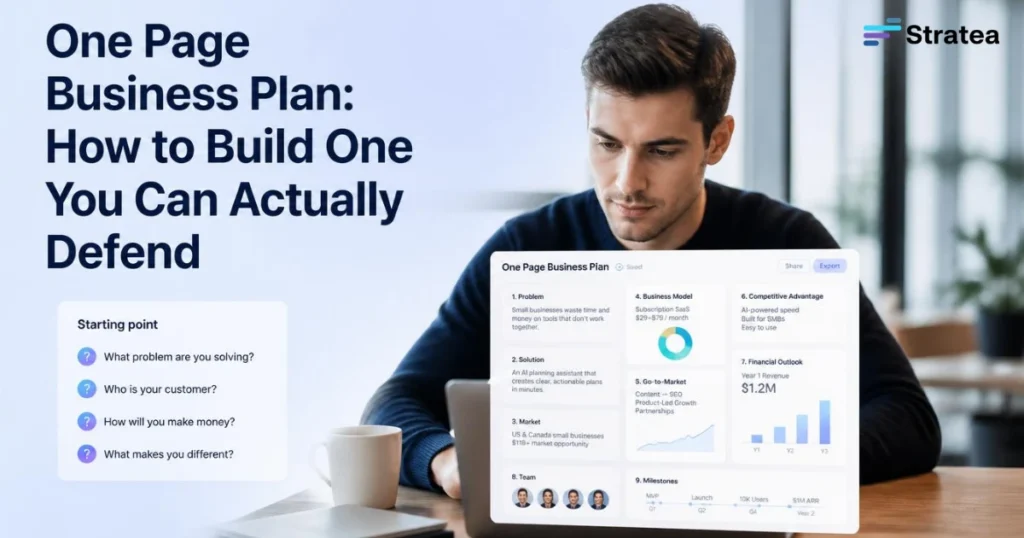
A loan officer looks up from your file and says, “Walk me through this in one page.” A co-founder asks for the plan before a strategy meeting, but only has ten minutes to read it. A consultant needs something a client’s leadership team will actually open, not a 20-page PDF that sits unread. In every one of these moments, a one page business plan is being asked to do a full plan’s job in a fraction of the space.
This kind of plan condenses your full business strategy onto a single page: the problem, the market, how the business runs, the numbers, and what happens next. It’s built to be read in under five minutes and to hold up if someone asks a follow-up question. Drafting one from scratch with an AI business plan generator can save time on the first pass, but it still works as a standalone document for internal decisions and quick pitches, and as a front page or summary for a longer plan when one is needed later.
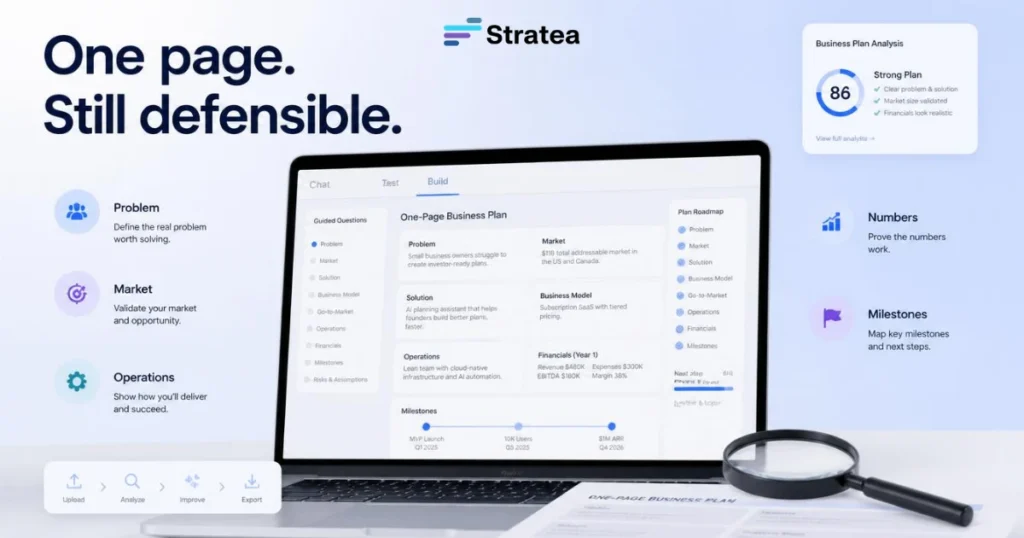
The Sections That Belong on a One Page Business Plan
A one page format doesn’t mean fewer decisions, it means the same decisions written more tightly. Each section below answers a question a reader will have, whether they say it out loud or not. Skipping one doesn’t save space so much as it invites a question you weren’t ready for.
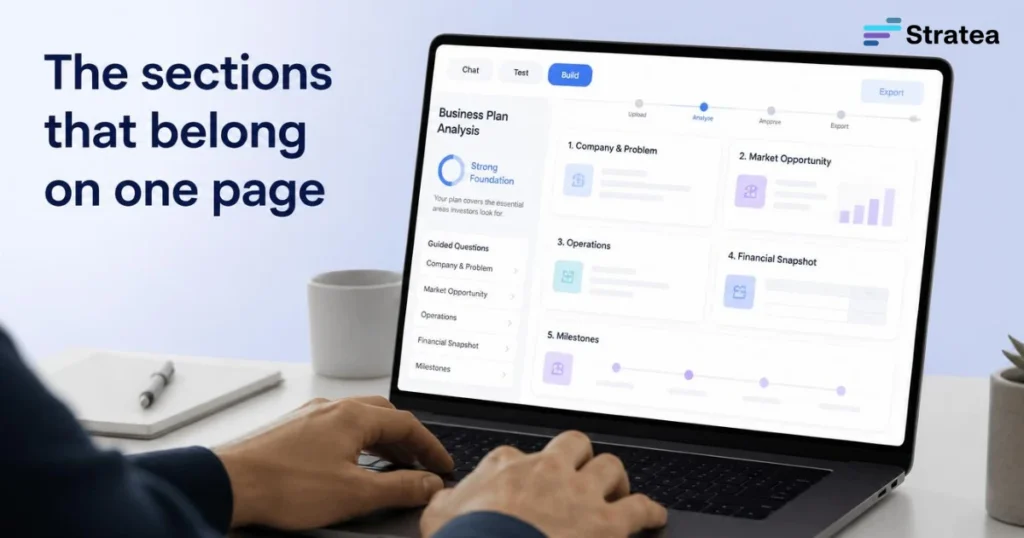
Company description and the problem you solve
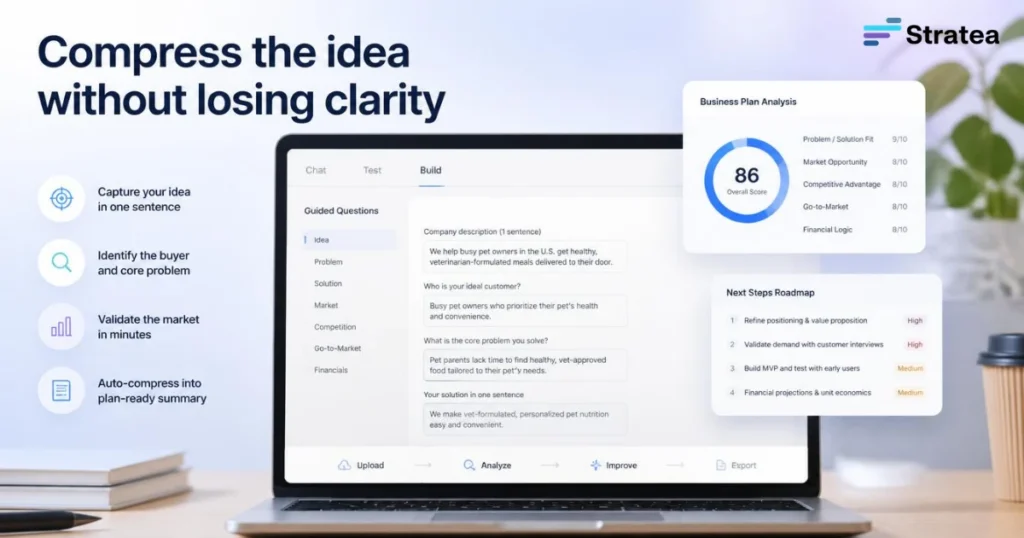
This is two or three sentences: what the business does, who it serves, and the problem it solves that makes someone willing to pay. Skip the mission statement language and write it the way you’d explain it to someone at a dinner table. A contractor’s version might read: “We provide residential HVAC repair and replacement in three counties, focused on same-week scheduling that larger competitors can’t match.”
Market analysis, compressed
You don’t have room for a ten-page market analysis, but you need enough to show the opportunity is real and sized correctly. One or two sentences on who buys, how big that group is, and what’s changing that makes now a reasonable time. Treat any market size figure as a structured estimate to validate with outside sources, not a verified number, especially if you’re pulling it together with AI research tools.
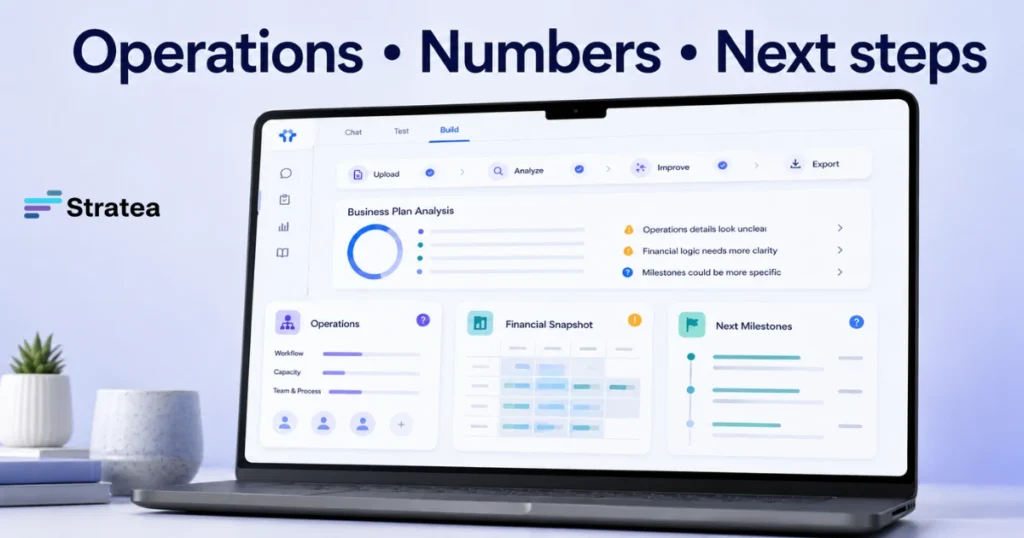
Operations, in one line per function
How the business actually delivers what it sells: production, fulfillment, staffing, or service delivery, stated as facts rather than aspirations. A two-person e-commerce brand might write: “Products are manufactured by a contract partner in Ohio, fulfilled through a 3PL, with customer service handled in-house.” This section is the one founders cut first when space runs short, which is a mistake, because it’s often the first thing an operations-minded reviewer looks for.
Financial plan snapshot
Revenue model, rough startup or operating costs, and a break-even estimate or projected margin. The number matters less than showing your logic: what assumption is the projection built on, and what would have to be true for it to hold. A one line note like “Break-even assumes 40 units per month at current pricing” tells a reviewer more than a bare revenue figure would.
Milestones and what happens next
Three or four concrete milestones with rough timing: what gets built, launched, or hit in the next 6 to 12 months. This section signals that the plan is a working document, not a snapshot frozen in time.
How to Structure a One-Page Plan for Different Decisions
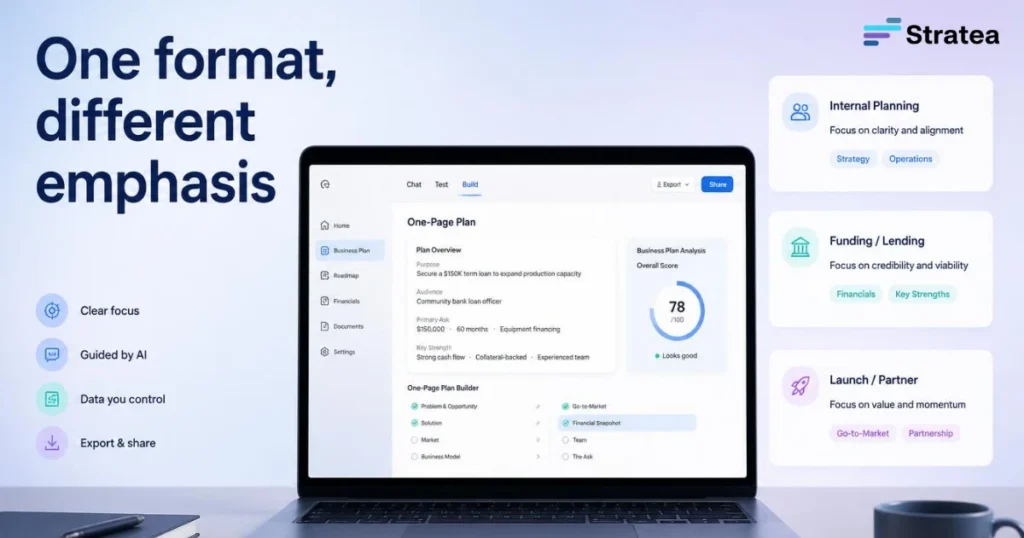
The same six sections show up in most one-pagers, but their weight changes depending on why the plan exists. Writing one version for every audience is the fastest way to get a “can you send more detail” reply. A one-pager built for your own team should read differently from one built for a stranger deciding whether to write you a check or sign a contract.
Internal planning use
When the plan is for your own team or co-founders, milestones and operations usually deserve the most space. The audience already trusts the market opportunity; what they need is clarity on what’s happening next and who owns it. A consultant building a one-pager for a client’s leadership review often leans this direction too: the client already knows their own market, so the document needs to earn its keep by showing sequencing, ownership, and what could slip.
Funding and lending use
For a lender conversation, whether it’s a bank line of credit or, for US-based readers, an SBA-adjacent product, or a BDC or bank facility for Canadian readers, financials and market analysis carry more weight. Lenders are structured to align with what they typically expect to see: assumptions, repayment logic, and a realistic read on the market, not just optimism. A residential HVAC contractor applying for a line of credit, for example, would need to show seasonal cash flow assumptions on the one-pager, not just an average monthly revenue figure that hides the swings.
This is also where soft compatibility language matters. No format guarantees loan approval, and any AI-assisted business plan tool, STRATEA included, should be treated as a preparation aid rather than a promise of funding. A lender will still evaluate credit history, collateral, and cash flow independent of how well the plan reads.
Launch or partner use
Pitching a wholesale partner, a landlord, or a potential collaborator puts the company description and go-to-market angle first. These readers are deciding whether to associate with you, so clarity about who you serve and how you’ll reach them tends to matter more than granular financials at this stage. A small e-commerce brand pitching a wholesale buyer, for instance, gets more mileage from a clear distribution plan and a believable order volume estimate than from a five-year revenue forecast nobody at the meeting will read closely.
If you’re working from an existing draft rather than starting cold, a guided planning workflow like STRATEA’s business plan outline guide can help you see which sections are underdeveloped before you try to compress everything onto one page.
What Reviewers Actually Check vs. What Founders Usually Submit
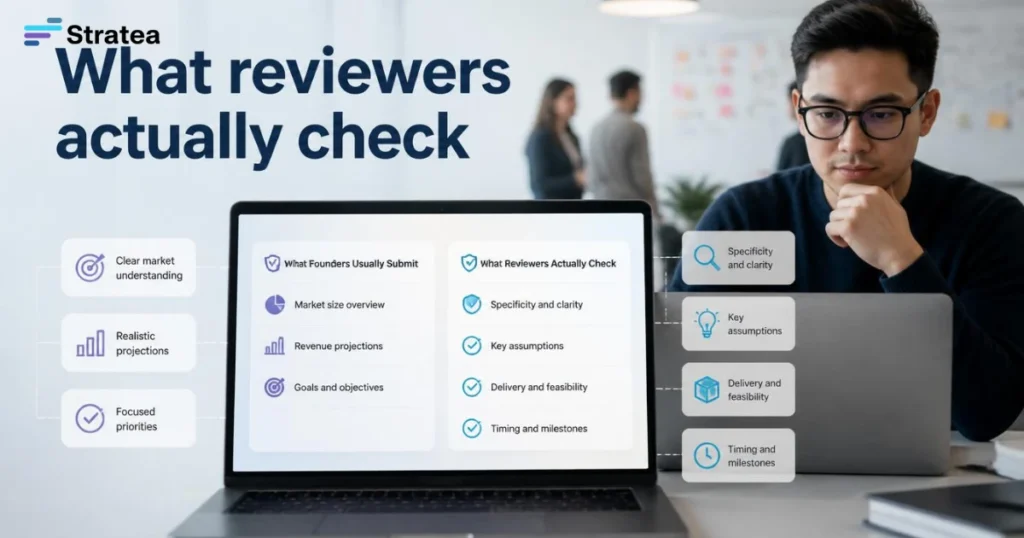
Founders and reviewers often focus on different things, which is part of why a one-pager that feels finished on your end still draws follow-up questions.
| Section | What founders usually submit | What reviewers actually check |
| Market analysis | A market size number, often unsourced | Whether the target buyer is specific and the number is reasonable |
| Financials | A revenue projection | The assumption behind the projection and what could break it |
| Operations | A short list of what the business sells | How the business actually delivers and fulfills at the stated volume |
| Milestones | General goals (“grow the business”) | Specific, time-bound steps that show sequencing and priorities |
| Company description | A mission-style statement | A clear problem-and-buyer pairing that explains why anyone pays |
Where a One-Page Plan Runs Out of Room
A one page business plan is a strong front door, not a complete filing. Detailed financial projections for a business plan, full market research, formation paperwork, and legal structure decisions usually need their own supporting documents. If a lender or investor asks for backup, that’s not a sign your one-pager failed; it’s the expected next step for most funding-related conversations. Business formation and LLC filing services, if you use one, are paid third-party services and shouldn’t be confused with the planning document itself.
For US-based readers, that often means a fuller plan alongside SBA or bank loan paperwork. For Canadian readers, a BDC or bank application typically expects similar depth. Neither program approves a plan because of its format; they evaluate the substance behind it.
The same is true for visa-related business plans, such as those tied to E-2, L-1, or Canada Start-up Visa applications. A one-pager can frame the business concept clearly, but these categories typically require far more detailed documentation, and the underlying content should be reviewed by a qualified immigration attorney or accountant rather than treated as settled once the plan reads well. Market research pulled together with AI tools, including STRATEA, should be treated the same way: a structured starting point to validate against real sources, not a substitute for due diligence a lender, investor, or immigration reviewer will expect to see.
Common Mistakes That Undermine an Otherwise Solid Page
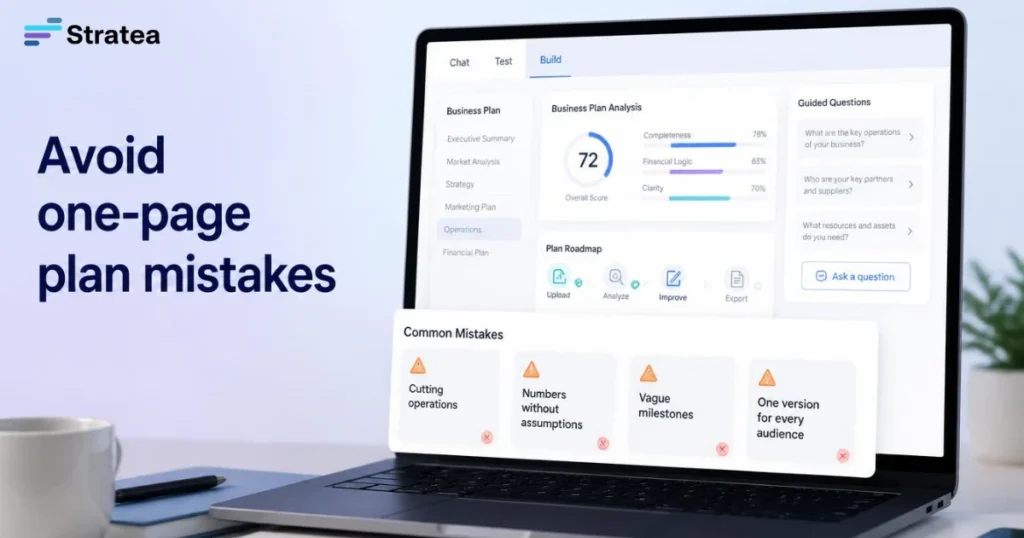
A few patterns show up repeatedly in one-pagers that otherwise look clean:
- Cutting operations to make room for design. A visually polished page with no operational detail reads as unfinished to anyone evaluating feasibility.
- Listing a revenue number with no assumption behind it. A number without logic invites more questions than it answers.
- Treating milestones as marketing language instead of a timeline. “Scale nationally” isn’t a milestone; “open a second location by Q3” is.
- Reusing the same version for every audience. A plan built for an internal team rarely holds up unchanged in a lender meeting.
- Skipping the assumption behind market size. Even a rough, clearly labeled estimate is more defensible than an unsourced round number.
- Writing the financials last and rushing them. Founders often spend most of their time on the company description and market analysis, then squeeze the financial plan into the leftover space. Reviewers tend to read the numbers first.
- Formatting for looks over substance. A dense wall of text is a real problem, but so is a page so sparse it reads as incomplete. Aim for enough white space to be scannable without leaving out the logic behind each claim.
The pattern underneath most of these mistakes is the same: treating the page limit as the hard constraint instead of treating clarity as the hard constraint. A one-pager that’s slightly over a page but answers every likely follow-up question will usually outperform a strictly one-page document that raises three new questions.
Want a faster way to check where your current draft is thin? A quick soft option here: STRATEA’s guided discovery process can review an existing draft and flag which sections need more support before you compress it to one page.
From One Page to a Full Business Plan Outline
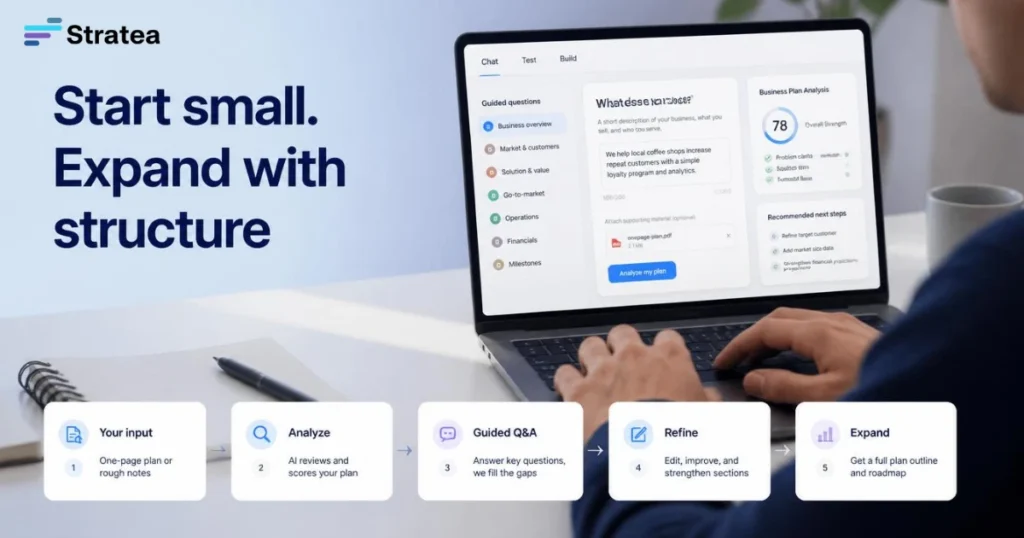
A one-pager and a full business plan format aren’t competing documents, they’re different zoom levels on the same plan. The one-pager is the summary; the full outline, typically covering executive summary, company description, market analysis, operations plan, financial plan, milestones, and appendix, is where the supporting detail lives. Many founders work in the other direction from what you’d expect: instead of writing a long plan and shrinking it, they start with a tight one-pager, get feedback, then expand each section once the core logic holds up.
That sequencing has a practical advantage. Expanding a page you’ve already stress-tested is faster than writing 15 pages cold and hoping the structure holds together, because the hard decisions, what the business does, who buys it, and how the numbers work, are already settled. The expansion work at that point is mostly adding evidence and detail behind conclusions you’ve already reached, not renegotiating the plan’s logic from scratch.
This is where a guided planning workflow earns its keep. Rather than treating the one-pager as a template to fill in once, STRATEA’s Strategic Discovery Process asks the same clarifying questions at both stages, so the full plan that eventually gets built out stays consistent with the one-page version a lender or partner already saw. If you’re moving from a one-pager into a fuller document, STRATEA’s business plan format guide walks through how each section expands without losing the clarity the one-pager forced in the first place.
One-Page Business Plan FAQ
What is a one page business plan used for?
It’s most often used for quick internal alignment, an initial lender or investor conversation, or a launch pitch to a partner. It’s rarely the only document a funding decision gets based on, but it’s frequently the first one a reviewer sees.
Is a one-pager enough for a bank loan or SBA application?
Usually not by itself. Most lenders, including SBA-adjacent programs in the US and BDC or bank facilities in Canada, expect supporting detail beyond a single page, particularly around financials. Treat the one-pager as the summary a fuller application builds on rather than the complete package.
What’s the difference between a one-page plan and an executive summary?
They overlap heavily. An executive summary is usually the front section of a longer plan, written after the rest is done. A standalone one-pager is often built to work on its own, without a longer document behind it, though the two frequently end up looking similar.
How detailed should the financials be on a one-pager?
Detailed enough to show the assumption behind the number, not just the number itself. A break-even estimate with its underlying assumption stated in one line is more useful to a reviewer than a bare revenue projection with no logic attached.
Can I turn a one-pager into a full plan later?
Yes, and it’s a common approach. Founders often start with the one-pager, get feedback from a lender, partner, or advisor, then expand each section into the fuller business plan outline once the core structure has been tested.
Start Strategic Discovery
A one page business plan is only useful if it holds up when someone asks a follow-up question. If you’re not confident yours would, or you’re staring at a blank page and don’t know where to start, STRATEA’s Strategic Discovery Process walks through the same questions a good advisor would ask, then helps you turn the answers into a structured, editable plan. It’s free to start, with more advanced planning tools available as paid capabilities as you go further. Start Strategic Discovery with STRATEA and build a one-pager you can actually defend.