
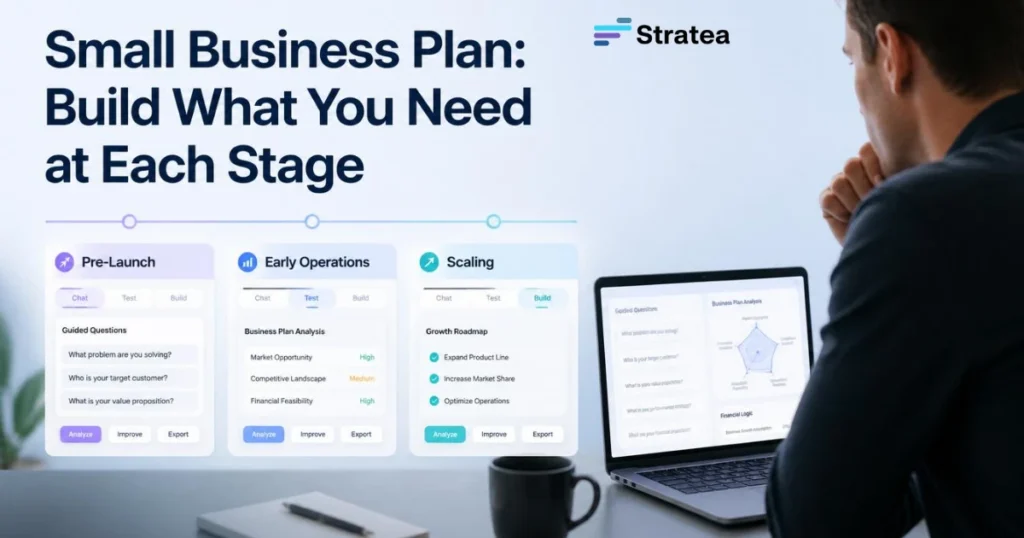
Most founders delay starting a business plan because they think it needs to be comprehensive. It doesn’t. A small business plan is simply a structured way to test your assumptions and make clearer decisions. You don’t write it all at once. Instead, your plan grows with your business, whether you start with a blank page or an AI business plan generator to get the first draft moving.
This guide walks you through which sections matter at each stage of growth, what to focus on first, and how to avoid overbuilding before you’ve validated the core idea.
What a Small Business Plan Actually Does for You
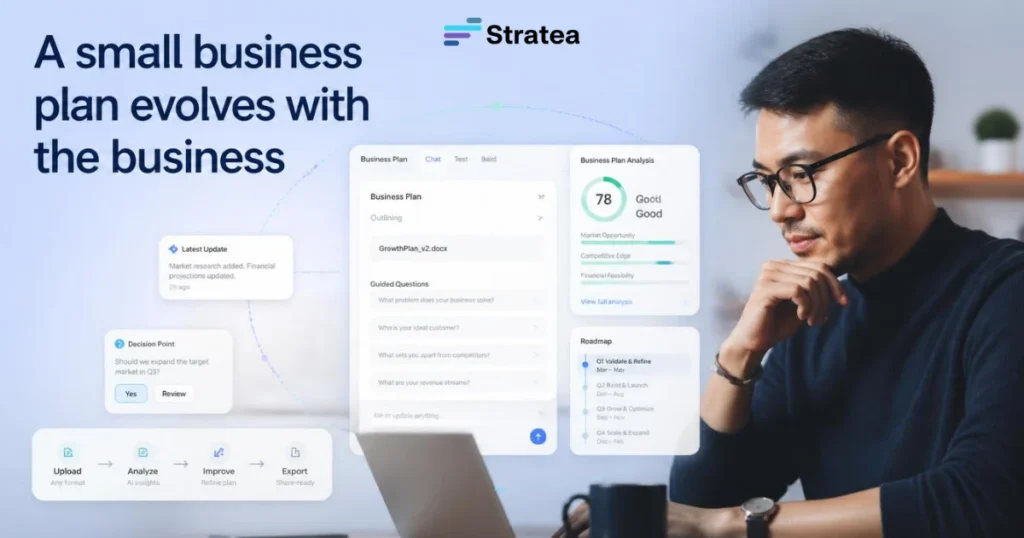
A small business plan is a structured way to test whether your core business assumptions hold up. It’s not primarily about impressing lenders or investors (though it can support that later). It’s about clarifying your own thinking.
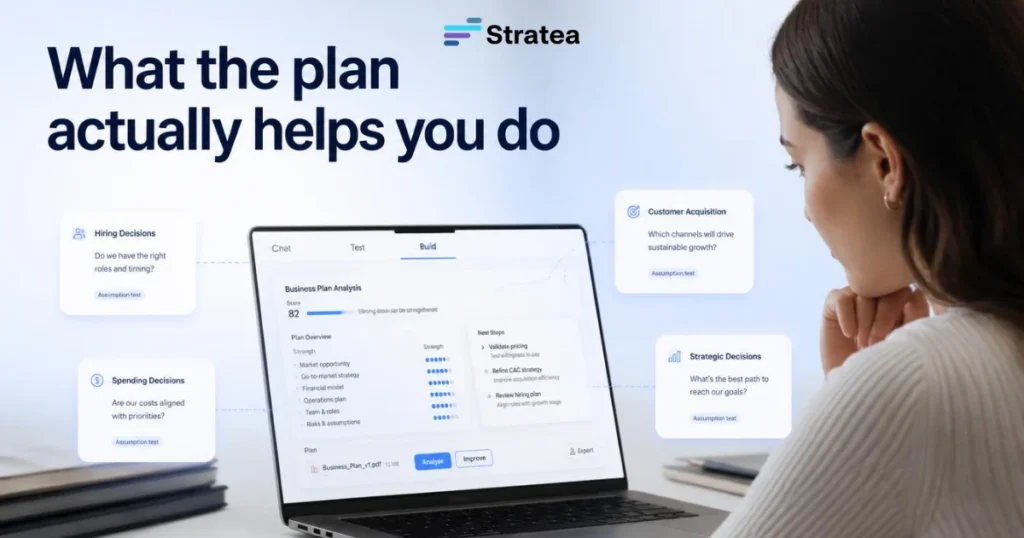
At an early stage, your plan answers questions like:
- Who will actually buy this, and how will they hear about it?
- What are my unit economics, and when do I need to hire?
- What regulatory or operational constraints am I missing?
- How much runway do I have, and what’s my next decision point?
The plan starts simple. As your business grows and becomes more complex, the plan gets deeper. What matters is that each section answers a question you actually need to resolve right now. If it doesn’t, you’re overbuilding.
The Stage-Based Planning Framework: Which Sections Matter When
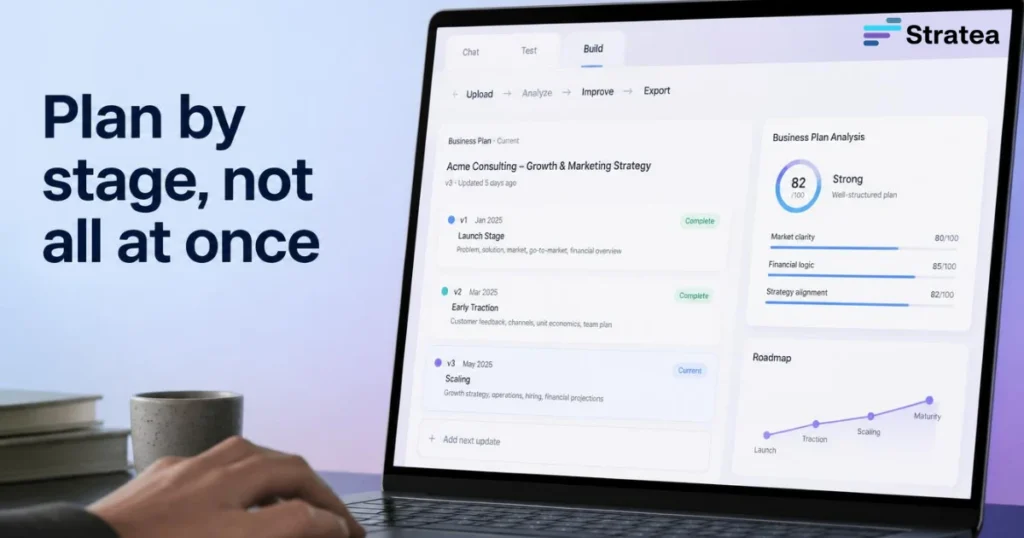
Small business planning isn’t a one-time event. It’s iterative. Your plan evolves as your business moves through distinct phases, and the emphasis shifts as you move from founder solo operation to team to external stakeholders.
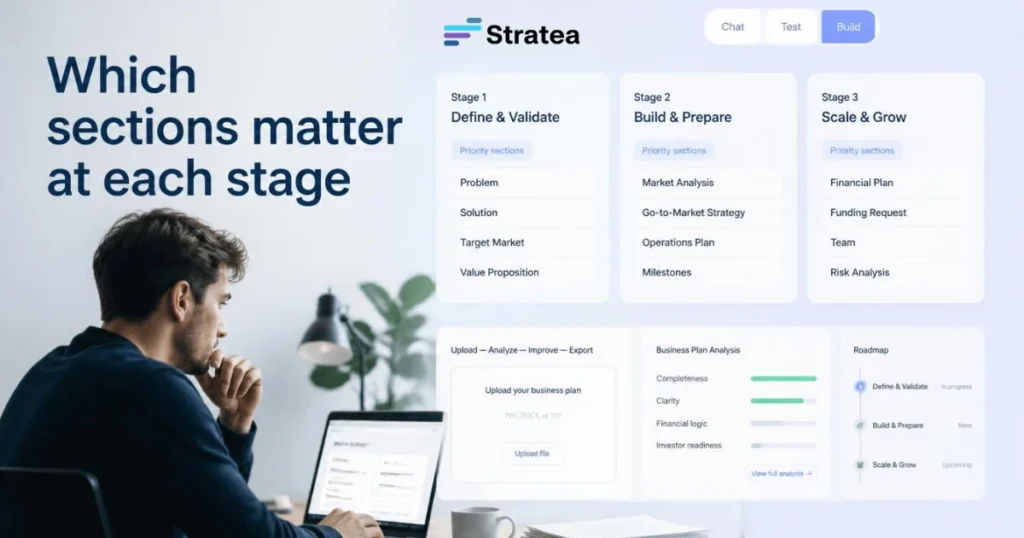
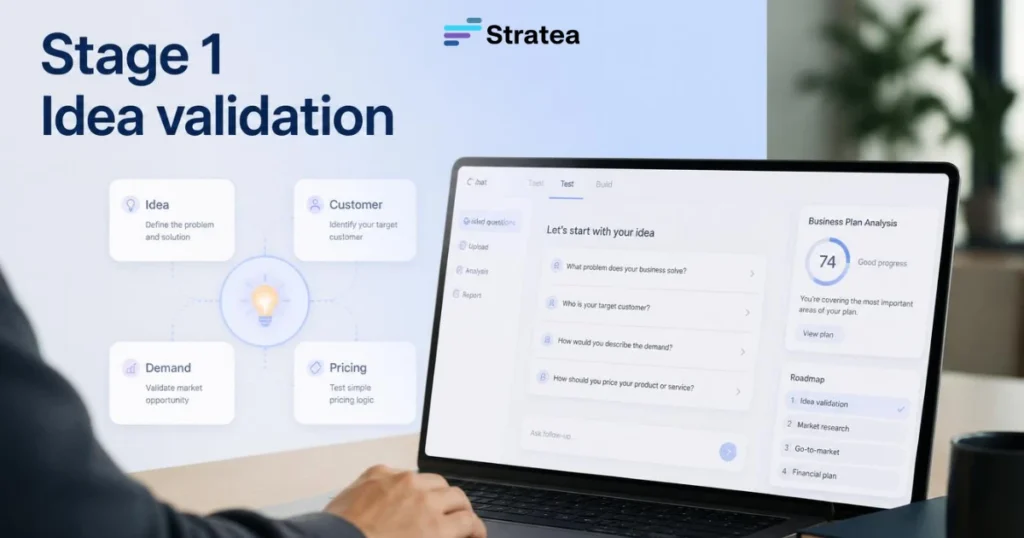
Stage 1: Idea Validation (Pre-Launch)
Before you spend money or hire anyone, you need to answer one question: Will anyone buy this?
At this stage, your plan is lean. You focus on:
- The core offer: What specifically are you selling, and why is it different enough to matter?
- Your target customer: Who is actually going to pay for this? (Not “anyone who needs X,” but a specific segment.)
- Go-to-market proof: How will you reach your first 10 customers? This should be testable and scrappy, not a marketing budget.
- Unit economics sketch: Rough numbers on what it costs you to serve one customer and what they pay. You don’t need projections yet; you need to know the math is plausible.
You skip detailed sections like multi-year financial projections, organizational charts, and regulatory compliance deep-dives. Those come later, after you’ve proven the basic model works.
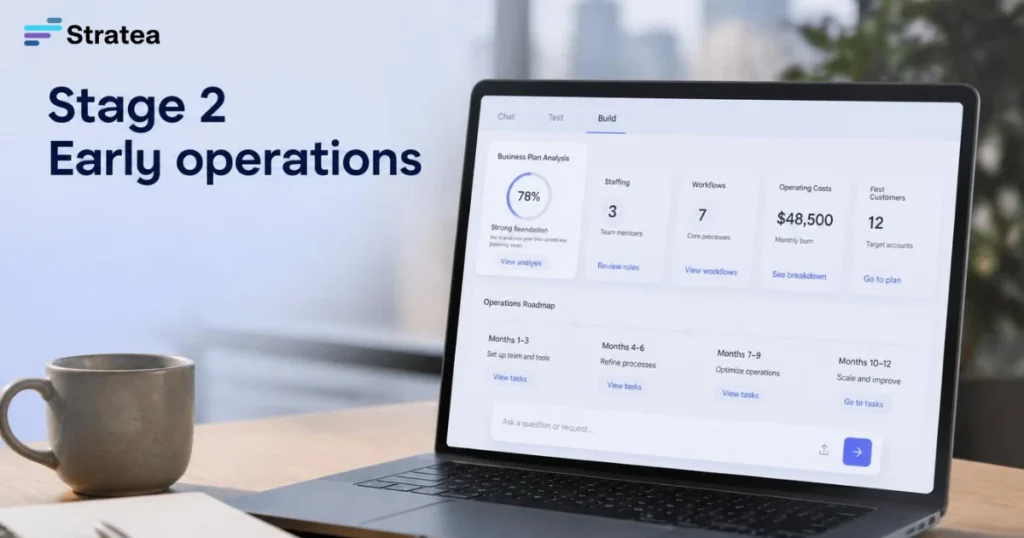
Stage 2: Early Operations (Months 1-12)
Once you have paying customers (or strong early momentum), the plan expands. You’re no longer testing whether the idea works; you’re testing whether you can operationalize it.
Now you add:
- Customer acquisition roadmap: Beyond the first 10, how will you reach 100 customers? What channels work, and what does each channel actually cost?
- Operational constraints: If you’re running a service, when do you need to hire? If you’re selling a product, how does fulfillment scale?
- Cash flow reality: When does money come in vs. when do you have to spend it? Many founders miss this and run out of cash despite being profitable on paper.
- Key hires and roles: Who do you need on the team, and when do you need them?
Financial projections at this stage are 12-month focused, not 5-year. They’re based on actual customer acquisition costs and retention data from the first few months, not guesses.
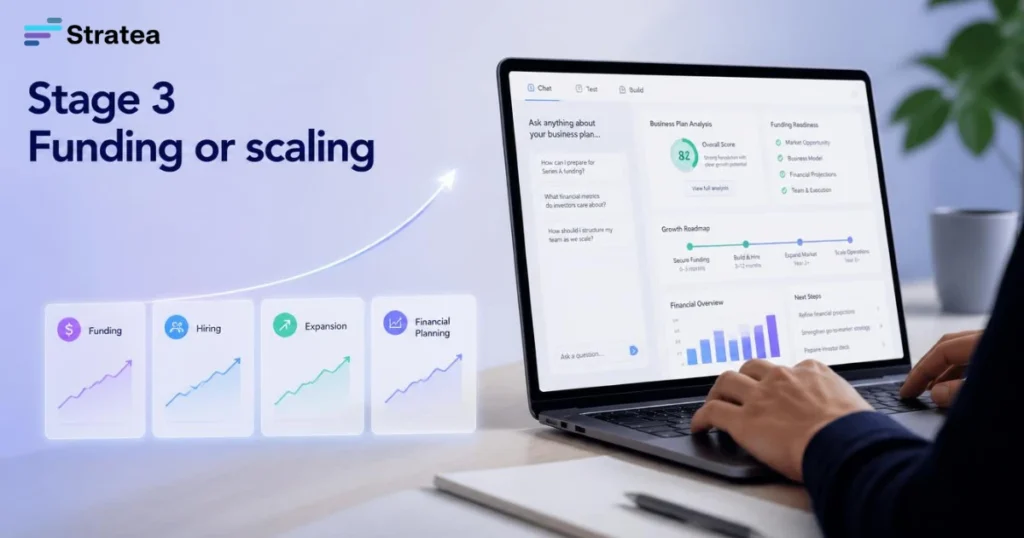
Stage 3: External Funding or Scaling (Year 2+)
If you’re seeking a loan, investment, or scaling significantly, the plan becomes more comprehensive. Now reviewers want to see:
- Market context: How big is the opportunity, and why is it defensible?
- Competitive positioning: Who else does this, and why will customers choose you?
- Detailed financial projections: 3-year minimum, often 5-year, showing path to profitability or return.
- Risk identification and mitigation: What could go wrong, and what have you already done to reduce that risk?
- Governance and team: Who’s accountable for what, and what experience do you bring?
At this stage, you’re typically working with advisors, and the plan is reviewer-ready. But you wouldn’t start here. You’d build this on the foundation of Stage 1 and Stage 2 learning.
Common Mistakes Founders Make When Planning Too Early
Founders often skip Stage 1 and jump straight to writing a “real” business plan. This wastes time and locks you into assumptions you haven’t tested.
- Mistake 1: Writing detailed financial projections before validating the core offer. You can’t forecast Year 3 revenue accurately if you haven’t run Month 1. Start with unit economics and 12-month cash flow, not 5-year projections.
- Mistake 2: Assuming competitors don’t exist or don’t matter. Every business has competition. At Stage 1, acknowledge what exists and explain why your approach is different. At Stage 3, you’ll go deeper into positioning.
- Mistake 3: Treating the plan as a finished document instead of a decision-making tool. A plan that sits in a folder and never gets updated is not helping you. The plan is most useful when you’re actively testing it against reality each month.
- Mistake 4: Overcomplicating operations planning when you’re still solo. If it’s just you, your organizational chart and formal roles don’t matter yet. What matters is knowing when you’ll need help and what the cost will be.
- Mistake 5: Mixing customer validation with operational validation. First prove someone will buy. Then prove you can deliver at scale. Combining these muddles your decision-making.
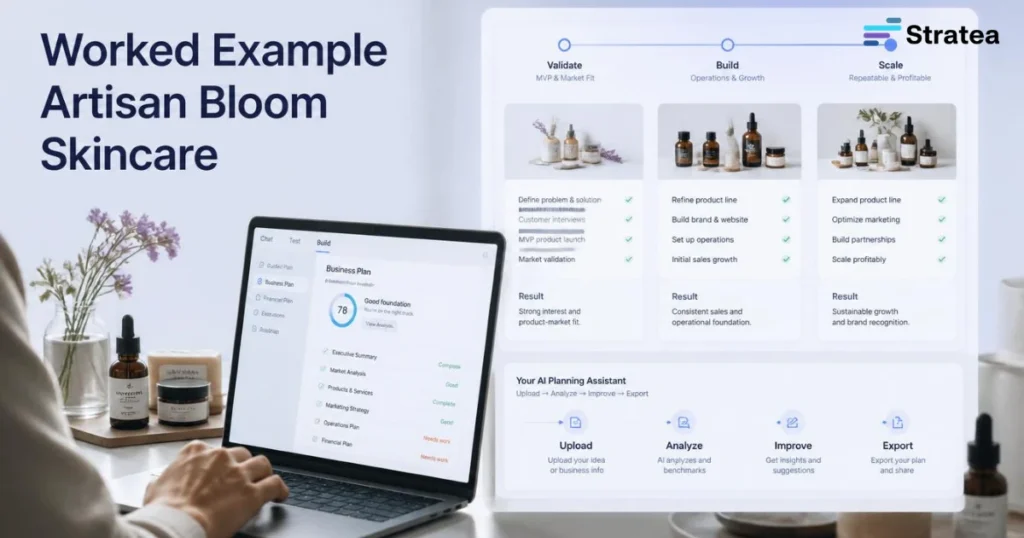
Worked Example: Artisan Bloom Skincare
Let’s walk through how a small-batch skincare founder would approach planning at each stage.
Artisan Bloom is a founder, Alex, who formulates and makes small-batch, natural skincare products. After six months of making products as a hobby, Alex wants to turn it into a business.
Stage 1: What Artisan Bloom Needed to Validate
Alex’s Stage 1 plan was simple:
- Offer: Premium, small-batch skincare formulations made with locally sourced botanicals, sold direct-to-consumer online.
- Customer: Women 25-45 interested in natural skincare, willing to pay $35+ per product.
- Go-to-market: Test sales through Instagram, a simple website, and a local farmers market booth for the first three months.
- Unit economics: Each unit costs $8 to make (materials, packaging, labeling). Alex sells for $35 online and $30 at farmers market. Shopify and payment processing eat ~8% of online revenue.
- Cash required to test: $2,000 to build inventory for three months and set up a basic website.
Alex didn’t write projections or build a team structure. The goal was simple: can we get 50 customers willing to repurchase? If yes, we keep going. If no, we’ve learned cheaply.
By Month 3, Alex had:
- 30 online customers (mostly from Instagram paid ads and word of mouth)
- 15 farmers market customers
- 60% repurchase rate
- Data showing skincare lovers responded better than general “wellness” messaging
This validated the core offer. Now Alex could move to Stage 2.
Stage 2: Operations Planning as They Hit $2k/Month Revenue
Six months in, Artisan Bloom hit $2,000/month revenue (roughly 60 online customers, 20 farmers market regular customers). At this stage, Alex needed to plan differently.
New questions:
- When do I need to hire someone to pack and ship?
- How much will that cost, and what revenue do I need to justify it?
- If I try wholesale accounts (selling to boutiques at 40% discount), how does that change my fulfillment burden?
- Should I stay 100% D2C, or layer in wholesale?
- When should I invest in professional product photography or content?
Alex’s Stage 2 plan included:
- Customer acquisition breakdown: Which channels (Instagram, farmers market, PR mentions, referrals) drove which customers, and what was the true cost per customer for each?
- Fulfillment roadmap: Currently shipping from home. At what revenue level does this require a dedicated packing area or a co-packer? What’s the cost difference?
- Wholesale exploration: Two local boutiques had expressed interest. Wholesale would mean lower margin per unit but higher volume. Alex modeled this as a separate scenario.
- 12-month cash flow: Based on current acquisition costs, when would Alex need to hire help, and what would that cost?
- Hiring plan: If wholesale takes off, Alex would need someone for customer service and packing by Month 9. If D2C only, Month 12 or later.
Alex still didn’t project Year 3 revenue. Instead, the plan tested one big assumption: “Can we grow to $5k/month while staying D2C, or does wholesale unlock a better path?”
Stage 3: Planning for 3PL Fulfillment and Wholesale Growth
By Month 12, Alex had $5,000/month revenue split between D2C and two wholesale accounts. The business was working, but Alex had hit the ceiling of home-based packing and customer service.
At this point, Alex needed a different kind of plan:
- Should I hire in-house, use a co-packer, or move to 3PL (third-party logistics)? Each had different cost structures and risk profiles.
- Wholesale growth strategy: The two current accounts wanted larger orders. What does scaling wholesale look like, and what are the cash flow implications (longer payment terms)?
- Funding: Growing wholesale meant inventory investment and maybe a 3PL setup fee. Alex was exploring a small business loan.
- Market opportunity: How many boutiques exist in the target region, and what’s the realistic penetration rate?
Alex’s Stage 3 plan was comprehensive. It included:
- 3-year financial projections showing path to $50k/month ($600k annual revenue)
- Detailed wholesale unit economics (costs, wholesale pricing, inventory holds, payment terms)
- Fulfillment cost analysis comparing 3PL vs. hiring
- Risk scenarios (wholesale customer cancels, shipping costs spike, competitor enters market)
- Management and advisory team (Alex was bringing on a bookkeeper and a business mentor for guidance)
This plan was lender-ready and enabled Alex to approach banks with confidence. But Alex wouldn’t have written this at Stage 1. Doing so would have wasted time on projections that were completely wrong before any revenue happened.
A Comparison: What Founders Often Skip (and Why It Matters)
| Planning Element | Stage 1 | Stage 2 | Stage 3 |
| Validation of customer demand | Essential | Proven | Contextual (market expansion) |
| Unit economics (cost per customer, margin) | Rough sketch | Actual data | Refined by channel |
| Go-to-market channels | Scrappy, testable | Data-driven, channel-specific | Scalable, with LTV/CAC ratios |
| Operational hiring timeline | Estimated | Based on revenue growth | Tied to funding and scaling plan |
| Financial projections | None (too uncertain) | 12-month cash flow | 3-5 year projections with scenarios |
| Competitive positioning | Acknowledge existence | Understand key competitors | Deep market context and defensibility |
| Regulatory/compliance risk | Identify main risks | Confirm with specialists | Structured compliance roadmap |
| Funding requirement | Not relevant | Maybe (growth capital) | Yes, sized to reach next milestone |
The mistake is writing a Stage 3 plan when you’re in Stage 1. You’ll get the numbers wrong, and you’ll spend time on sections that don’t matter yet. Better to write a Stage 1 plan, test it, update it for Stage 2, then expand it for Stage 3.
How STRATEA Guides You Through Stage-Based Planning
Many founders use generic templates that treat all small businesses the same way. You end up with a 40-page document where only five pages matter to your current situation.
STRATEA’s Strategic Discovery Process works differently. Instead of handing you a template, it asks you questions in sequence, matching your answers to the stage you’re in.
For a pre-revenue founder, STRATEA focuses on: Who are you trying to reach? What’s your offer? How will you validate demand? What are your unit economics?
For an early-revenue founder, STRATEA shifts: What channels are actually working? When do you hire? What’s your 12-month cash flow looking like? What’s slowing you down?
For a founder ready to scale or raise funding, STRATEA builds out: What’s your competitive advantage? How big can this market actually be? What’s your path to profitability? What’s your biggest risk, and how are you mitigating it?
As you answer, STRATEA organizes your assumptions and decisions into a structured plan. You can edit, update, and test scenarios. The plan stays useful because it’s linked to decisions you’re actually making, not filled with generic language about your vision.
FAQ
Do I need to write a business plan before I make my first sale?
Not a comprehensive one. Write enough to test your core assumptions: Who will buy? What will they pay? How will you reach them? Once you have early customers, your plan gets more detailed. You don’t need full projections until you’re ready to scale or fund.
What if my business model changes after I start?
That’s expected and good. Your plan should reflect where you are now, not predictions from six months ago. Review and update your plan quarterly, especially in the first two years. If your customer acquisition cost drops, or a new channel opens up, your plan should capture that.
When should I move from a lean Stage 2 plan to a comprehensive Stage 3 plan?
When you’re ready to hire significantly, take on debt, or raise investment. If you’re operating solo or with one other person, and cash is stable, Stage 2 planning is sufficient. The moment you need to convince external people (lenders, investors, advisors) that your numbers work, move to Stage 3.
Should my small business plan include a vision statement or mission?
Only if it clarifies a decision. If a mission statement helps you stay focused on who you serve and why, include it. If it’s generic inspiration language that doesn’t change how you operate, skip it. Focus on what matters to your next decision.
How detailed should my financial projections be?
At Stage 2, 12 months is enough. Focus on cash flow, not just profit. Show when you spend money (inventory, hiring) and when it comes in (customer payments). At Stage 3, if you’re raising money, lenders and investors typically want 3-5 years, but base those projections on actual Stage 1 and Stage 2 data, not guesses.
Can I use the same plan for a bank loan and internal team alignment?
Not comfortably. A lender’s plan and an internal plan have different emphases. A lender wants risk mitigation, collateral, and proof of repayment. An internal plan emphasizes milestones, decisions, and team roles. If you’re borrowing, use STRATEA to build the core plan, then strengthen the sections lenders care about (financials, collateral, personal background, industry knowledge).
Next Steps
Your small business plan doesn’t need to be perfect, comprehensive, or lengthy. It needs to answer the question you’re trying to resolve right now.
Start by identifying which stage you’re in. If you’re pre-revenue, focus on validating demand and understanding your unit economics. If you’re early revenue, focus on clear cash flow and hiring timelines. If you’re scaling or raising, build the comprehensive plan.
Use STRATEA to guide you through the assumptions and decisions that matter. Start Strategic Discovery free and see how the process helps you organize your thinking. As your business grows, your plan in STRATEA grows with it.
The goal isn’t a beautiful document. It’s clarity about your business, stage by stage.