
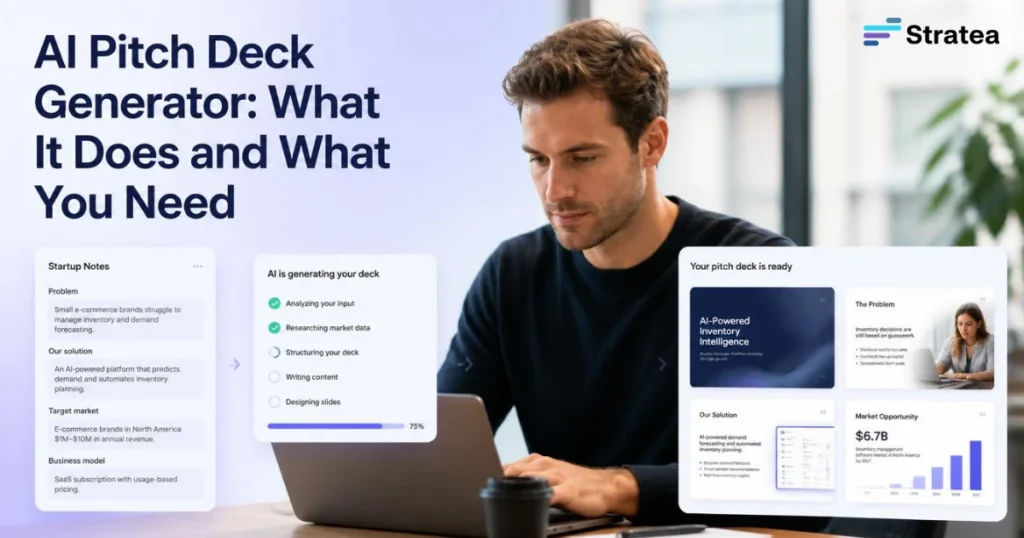
An AI pitch deck generator takes your startup idea and produces a professional-looking 10-20 slide presentation in minutes. You input basic details, the tool applies a template with investor-standard slide types, and you get something that looks ready to present. For a founder on a tight fundraising timeline, that’s appealing. For a founder who’s never pitched to investors, it provides structure and confidence.
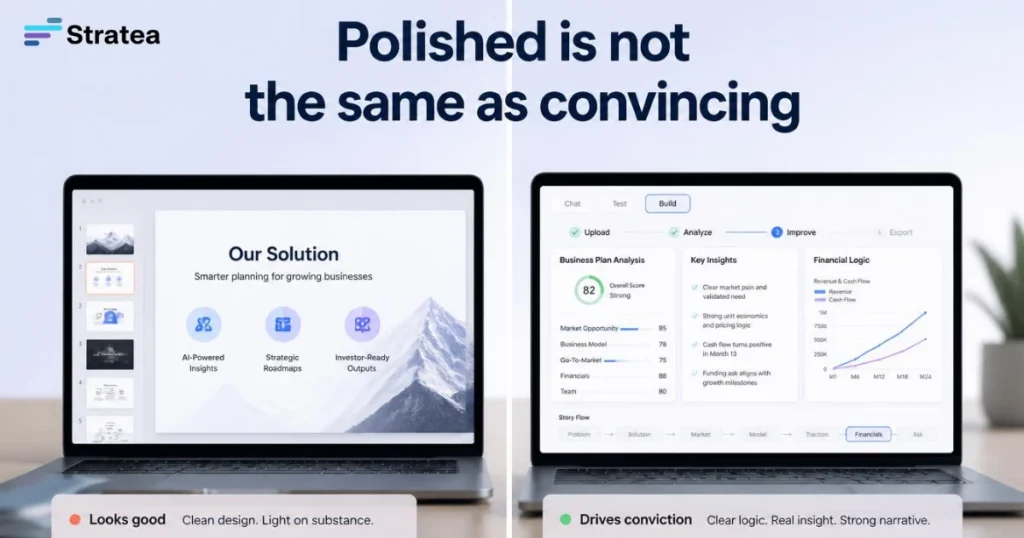
The catch: a polished-looking deck isn’t the same as a convincing pitch. A pitch is a founder communication tool, not just a visual document. An AI business plan can format slides and enforce design consistency. It can’t decide your core narrative, choose which story to lead with, or adapt in real time when an investor asks a hard question.
What an AI Pitch Deck Generator Actually Creates
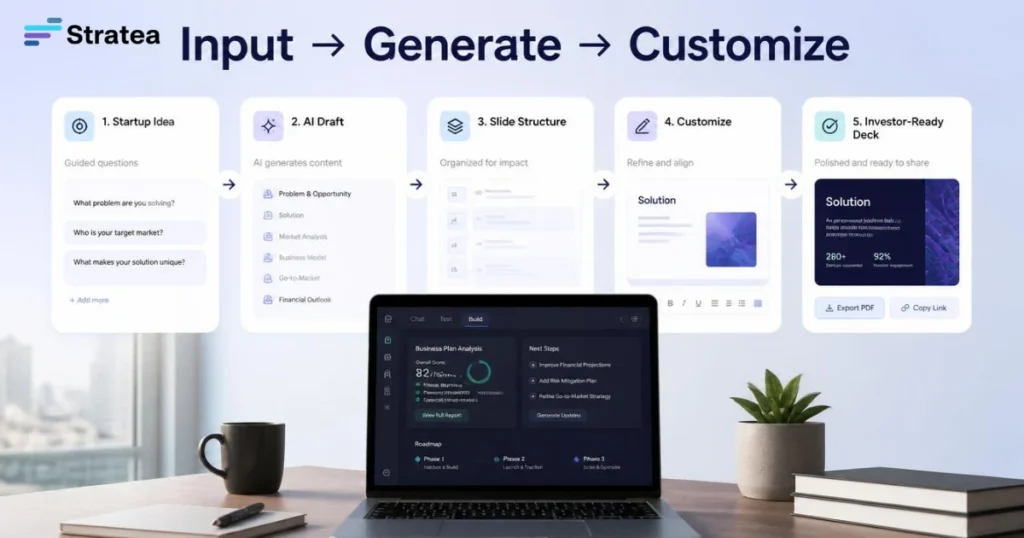
An AI pitch deck generator typically asks you for a few key inputs: company name, what your business does, target market, business model, funding stage, and funding goal. From that, it generates a deck with standard investor slides.
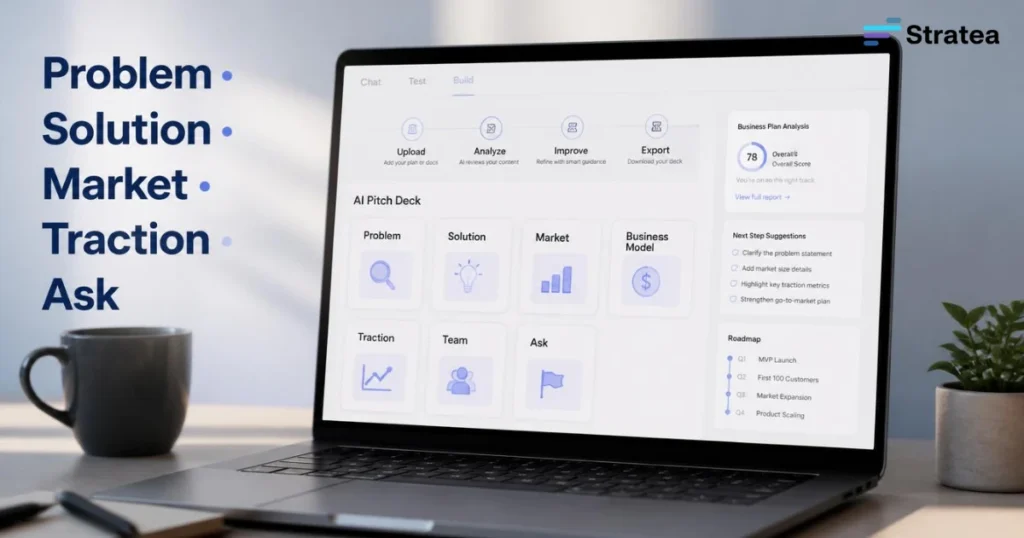
Most generators produce decks organized around these sections: problem, solution, market size, business model, traction or team, go-to-market strategy, financial projections, use of funds, and closing. The tool fills in placeholder text based on your inputs, applies a consistent design template, and produces a downloadable PowerPoint or PDF. You can usually customize colors, add company logo, and edit text.
The quality varies. Some generators produce generic placeholder text that reads like a template. Others apply slightly more sophistication, adjusting language based on your business type or stage. Some let you upload images, add videos, or customize slide order.
What they all have in common: they start with structure and visual consistency, not with narrative insight.
The Difference Between a Polished Deck and a Convincing Pitch
A polished deck looks professional. The slides are well-formatted, the color scheme is consistent, the investor-expected sections are all there. An investor can flip through it in five minutes and understand what your company does.
A convincing pitch is different. It makes an investor curious about your specific insight, confident in your ability to execute, and motivated to continue the conversation. It’s not just information. It’s a founder telling a story in a way that lands.
Here’s where generators and designers differ from pitch coaching. A designer makes your deck look polished. A generator does that quickly and cheaply. A pitch coach helps you understand what story to tell and how to tell it in a way that investors actually respond to.
An AI generator can produce a polished deck with all the right sections. But it can’t know that the real insight in your business isn’t “we’re solving X problem” but “we’re solving X problem in a way nobody else can for Y reason.” It can’t know that you should lead with your co-founder’s domain expertise instead of market size. It can’t know that the investor sitting across from you came from a company that competed with your customer, so you need to address that specific concern.
A convincing pitch requires founder judgment. A polished deck is a useful container for that judgment, but it’s not a substitute for it.
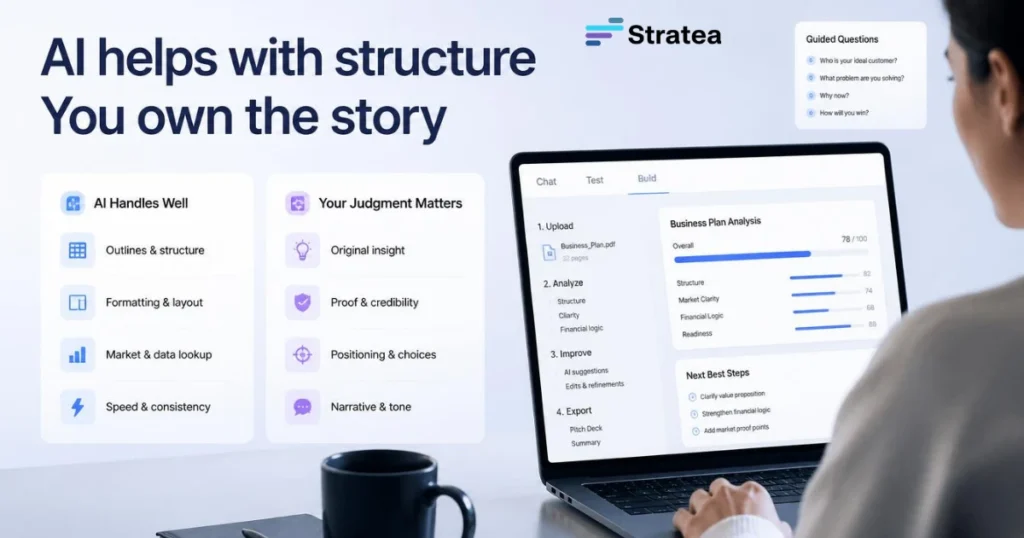
What AI Handles Well (And What Requires Your Judgment)
An AI pitch deck generator has clear strengths and clear limits.
What Generators Do Well
Visual consistency. A generator applies the same color palette, typography, and formatting to every slide. You don’t end up with a deck where three slides are Helvetica and two are Comic Sans. That consistency matters. It signals competence.
Structure. Generators enforce a standard pitch sequence that investors expect. Problem, solution, market, business model, traction, team, go-to-market, financials, ask, closing. That structure works. An investor knows what to expect. You’re not reinventing the wheel.
Time savings. Creating a pitch deck from scratch, design included, takes a founder or a small team days or weeks. A generator produces a working draft in hours. If you’re on a tight fundraising timeline, that’s material.
Completeness. A generator pushes you to think through sections you might otherwise skip. A team slide. A use of funds slide. A market analysis slide. Those aren’t optional if you’re pitching to serious investors.
What Still Needs Your Expertise
Narrative clarity. Why should an investor care about your company specifically? That’s not a slide template. That’s a choice you make. A generator produces a problem statement. You need to make that problem felt. You need to show why this problem matters to investors, not just to users.
Positioning against alternatives. Investors assume you have competitors or alternatives. The slide deck can show you’ve thought about it. But the conviction comes from the founder understanding deeply why investors should bet on your approach, not the competitor’s. A generator can prompt you to list competitors. You need to own the reasoning.
Traction narrative. If you have early users, customers, or partners, how do you frame what that means? Is it proof of product-market fit? Proof of founder credibility? Proof that the market wants this? A generator can say “traction” on a slide. You need to interpret what your traction actually signals.
Go-to-market specificity. A generator can list marketing channels: content marketing, paid ads, partnerships, direct sales. You need to know which channel you’re actually going to deploy in the first three months, how much it will cost, and why you think it will work better for your company than it does for your competitors.
Investor psychology. Different investors have different concerns based on stage, industry, and history. A seed investor focuses on founder credibility and market fit. A Series A investor focuses on unit economics and team depth. A generator doesn’t customize for the investor sitting across from you. You do.
Real-time adaptation. The best pitches aren’t deck recitations. They’re conversations. An investor interrupts with a question, and you skip ahead, or you circle back and clarify. A generator can’t teach you how to read an investor and adapt. Only practice and feedback can.
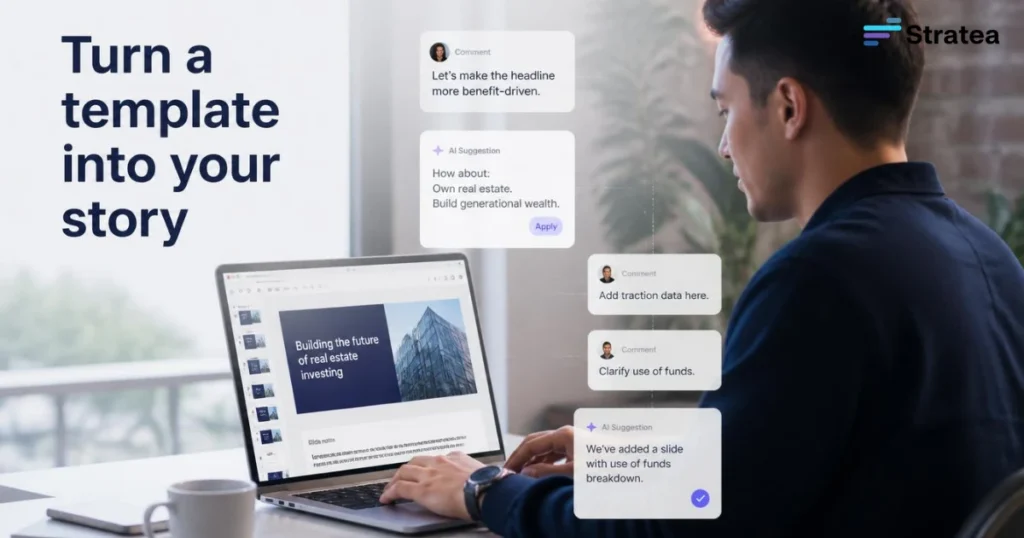
Customization: From Template to Your Story
An AI pitch deck generator gives you a starting point, not a finished product. The question is how much customization you need to do for your specific situation.
If you’re pitching the exact business model the generator assumes you have, the changes might be minimal. You swap out generic placeholder text for your specific numbers, add your logo, maybe adjust the slide order.
If your business is unconventional, the generator’s assumptions might not fit. You might need to rethink several slides or reorder them to tell your story in a way that makes sense.
Most founders fall somewhere in the middle. The generator gives them structure and visual polish. They customize about 40-60% of the content to make it specific to their company and their investor audience.
Here’s what most founders customize:
The problem slide. Generators describe problems generically. You customize it to show that you’ve experienced this problem specifically, or that you’ve identified a problem nobody else has noticed yet. You make it feel real, not theoretical.
The solution slide. Generators describe solutions as features. You customize it to explain why your approach is different. What’s the insight that makes your solution better?
The market size. Generators pull market size from data reports. You customize it to show that you understand the specific, addressable market you’re going after. Not the total market size, but the market you can actually win.
The business model. Generators show you how you’ll make money. You customize it to show the unit economics you’ve validated. How much does customer acquisition cost? What’s the customer lifetime value? How long does it take to reach profitability per customer?
The team slide. Generators ask for names and titles. You customize it to highlight why your team is credible for this specific problem. What relevant experience does each founder bring?
The use of funds. Generators show typical allocations for your stage. You customize it to show exactly how this specific funding round will accelerate your business. Hiring? Product development? Sales team? Be specific.
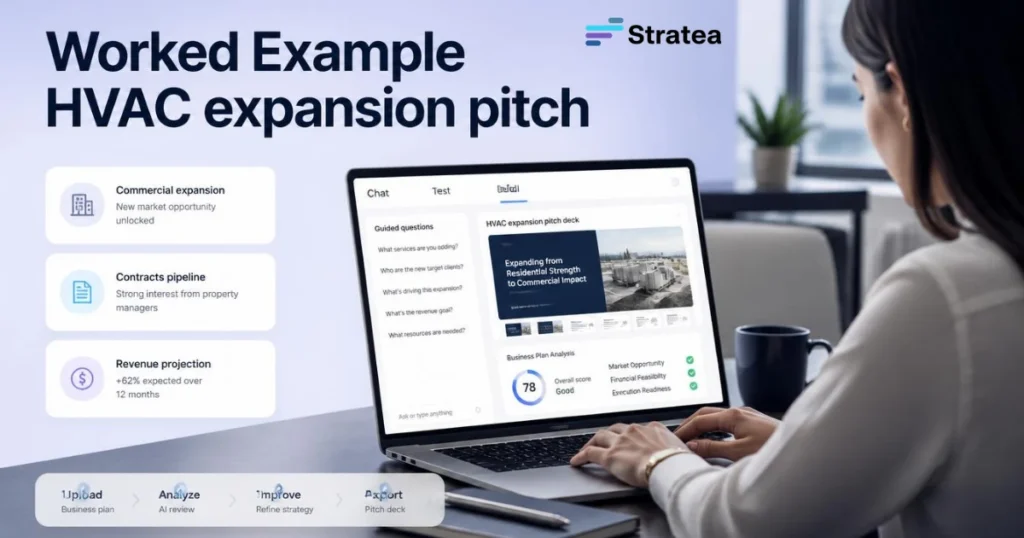
Worked Example: HVAC Contractor Scaling to Commercial Services
The Situation
Marcus runs a successful residential HVAC business in Denver with four full-time technicians and about $400,000 annual revenue. He’s identified an opportunity in commercial HVAC service contracts for mid-size office buildings. He’s landed his first three pilot clients and has interest from five more. To scale, he needs to hire a sales lead and a dispatcher, and buy two new service vans. The cost is $120,000. He’s decided to approach a local bank for a small business loan.
Marcus needs a pitch deck to present to the bank, and he has eight weeks. He’s never created a formal business plan or pitch before. A designer would cost $2,000 and take three weeks. A pitch coach would cost $150/hour and require time he doesn’t have while managing his existing business.
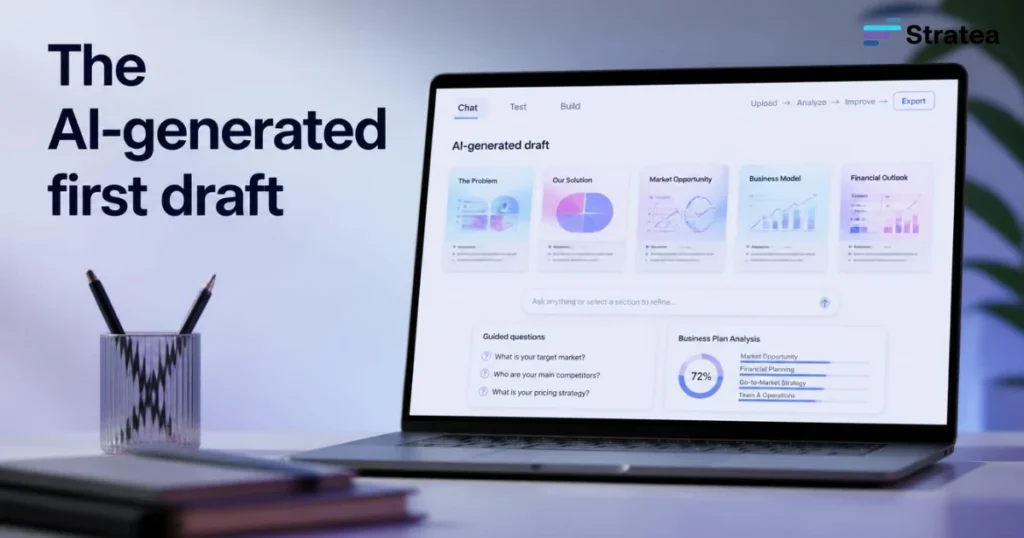
What the AI Generator Created
Marcus used an AI pitch deck generator, filling in company name, business type (HVAC services), current revenue, target market (commercial office buildings), expansion goal (hire two people, buy two vans), and funding amount ($120,000).
The generator produced a 15-slide deck: company overview, market opportunity, current business traction, expansion plan, financial projections, team, funding use, and next steps. Each slide had placeholder text that Marcus could customize.
The slides looked professional. The template enforced consistent branding. The structure was logical and followed what lenders expect to see.
But the deck had generic language. The market opportunity slide pulled data about the commercial HVAC services industry in the US (a $45 billion market). That’s not relevant. Marcus isn’t going after the whole $45 billion market. He’s going after mid-size office buildings in the Denver metro area, and he’s already validated that he can win three pilot contracts.
The expansion plan slide described adding staff and vehicles generically, without the specific numbers Marcus knew. Cost per new hire, training timeline, how many service calls per van per month, pricing per call, margin per call.
The team slide had Marcus’s name and title. It didn’t say anything about his fifteen years of HVAC experience, his reputation in the Denver market, or his pilot customer relationships.
How She Customized It
Marcus spent one week customizing the deck. Here’s what he changed.
First, the market opportunity slide. Instead of “the commercial HVAC market is $45 billion,” he wrote: “The Denver metro area has approximately 850 mid-size office buildings with 50-200 employees. Office buildings require quarterly HVAC maintenance and emergency service calls. We’re initially targeting 50 buildings in the Cherry Creek and Tech Center corridors we already service residentially. At average annual value of $3,000 per building, addressable market is $150,000 recurring annual revenue.”
Second, the expansion plan slide. He broke down the unit economics: “Each new service van can handle 12-15 service calls per week. At $250-400 per call, each van generates $4,000-6,000 weekly revenue. Cost per call: technician labor (2 hours), parts, dispatch overhead. Margin per call is approximately $800-1,200 at scale. Two vans = $80,000-120,000 monthly revenue at full capacity.”
Third, the team slide. Instead of just his name and title, he added: “Marcus founded the business fifteen years ago. He’s completed over 5,000 residential and commercial HVAC jobs in Denver. Three of our five target commercial customers for expansion knew Marcus before we pitched them.”
Fourth, he added a traction slide that lenders actually wanted: “Current pilot customers: Johnson Financial (140 employees), Westside Architecture (85 employees), Pinnacle Consulting (200 employees). Service agreement value: $500/month per customer. Current revenue run rate: $1,500/month. Projected run rate after expansion: $15,000-20,000/month within 18 months.”
By the end, Marcus had a deck that lenders could understand. It still had the professional look the generator provided. But it now told his specific story: a founder with deep HVAC experience, a validated market in his backyard, early customer traction, clear unit economics, and a specific expansion plan.
He presented the deck to his bank and got the $120,000 line of credit.

When to Use an AI Generator vs. Hiring a Designer or Coach
Different approaches make sense in different situations.
Use an AI generator if: You have a tight timeline, a limited budget, and moderate clarity about your pitch. You want professional visual consistency and structure. You’re comfortable customizing 40-60% of the content yourself. You don’t need to impress with custom design—you need to communicate clearly and quickly.
Hire a designer if: Visual differentiation matters. You’re pitching investors in a crowded space where design is part of your brand. You want custom illustrations or photography. You have time (three to five weeks) and budget ($2,000 to $10,000). You’ve already settled on your pitch narrative, and you just need it to look amazing.
Work with a pitch coach if: You’re unclear about your narrative. You’ve never pitched before. You want feedback on what’s working and what isn’t. You need to practice and build confidence. Cost is $150-$300/hour, and you’ll likely need 5-10 hours. Timeline is two to four weeks.
Combine approaches if: You use an AI generator for structure and visual consistency, then hire a pitch coach to review your narrative and help you practice. Or you use a generator to create the working draft, then hire a designer to polish specific slides. Or you work with a coach to clarify your story, then use a generator to structure it into slides.
Most funded founders fall into the “combine approaches” category. They don’t do purely DIY or purely hire someone else. They decide which parts they handle and which parts they outsource based on their strengths and constraints.
FAQ
Q: How customizable is an AI-generated pitch deck?
A: Most generators let you edit text on every slide, change colors and fonts, add your logo, reorder slides, and sometimes delete or add slides. Some are more restrictive and let you only edit text. Others have more advanced customization including custom slide design. Check the tool’s documentation, but assume you can customize 40-60% of content to make it your own. Visual design is usually locked to the template, so if you want custom illustrations or photography, that requires more work or hiring a designer.
Q: Does a generated pitch deck look like everyone else’s?
A: Pitch decks generated by the same tool will have similar structure and design. But that’s also true of decks made by designers using the same template. The difference comes from your customization: your specific numbers, your specific story, your specific positioning. If you customize heavily, it won’t feel generic, even if the underlying template is the same.
Q: What if an investor asks me a question I can’t answer from the deck?
A: That’s normal and expected. Investors always ask questions. Your job is to know the answer or to say “I don’t know, but here’s how I’ll find out.” A good pitch isn’t about memorizing the deck. It’s about being able to discuss the business intelligently and adapt based on what the investor cares about. If you’re not confident answering questions about your business, a pitch coach is more valuable than a polished deck.
Q: Should I use an AI generator for investor pitches or for internal presentations?
A: AI generators work well for investor pitches because investors expect a certain format and structure. Internal presentations can be more flexible and less formal. The real question is whether you need the professional polish and standard format a generator provides, or whether a simpler format works for your audience.
Q: Can I use an AI-generated pitch deck for a bank loan?
A: Yes, if you customize it appropriately. Banks care about clarity, specific numbers, unit economics, and evidence of traction. They care less about design polish than venture investors do. An AI-generated deck with good customization (specific numbers, traction data, loan use details) can work well for a bank. Marcus’s HVAC example shows this working effectively.
Q: How much time should I spend customizing an AI-generated deck?
A: Plan for 5-10 hours if you’re making significant changes (40-60% customization). If you’re only adding your logo and tweaking numbers, it might take 2-3 hours. If you’re rebuilding several slides to tell your story differently, it might take 15-20 hours. The time depends on how different your actual story is from what the generator assumes.
Next Steps
An AI pitch deck generator is useful if you need structure, polish, and speed. What it doesn’t do is build your narrative confidence or investor psychology. That comes from you understanding your business deeply and practicing your pitch.
If you’re raising capital and you need a deck fast, a generator gives you a solid starting point. If you’re unclear about your core pitch narrative, a pitch coach will give you better return on time investment than a polished deck.
Start Strategic Discovery with STRATEA if you’re building the business plan and assumptions that your pitch will be based on. Clarity about your business logic, your unit economics, your market strategy, and your defensibility will make your pitch more convincing than any visual polish.
STRATEA is free to start. Use it to work through the thinking that an investor will actually ask you about.