
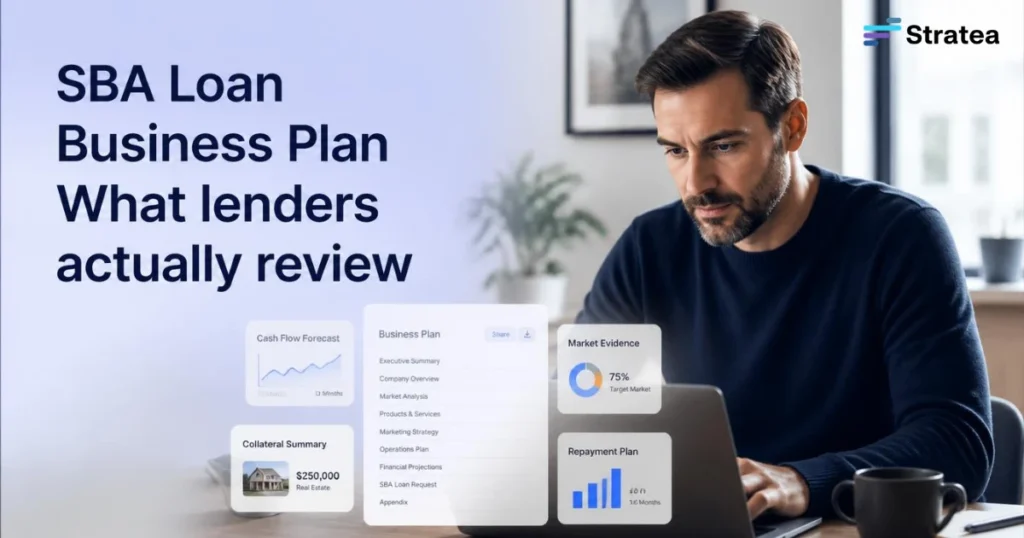
An SBA loan business plan isn’t written to clarify your thinking or impress investors. It’s written for a lender to evaluate whether you can repay the loan. An SBA loan officer reads it with one specific question in mind: does this owner understand their business well enough that I’m confident they’ll generate the cash to repay this loan?
That changes what matters in the plan. It’s not about market size estimates or competitive positioning. It’s about monthly cash flow, collateral, repayment timeline, and whether your assumptions are grounded in real business data rather than guesses. This is exactly where a generic AI business plan falls short: a tool that outputs polished narrative sections and generic projections in minutes can’t stress-test whether your repayment assumptions actually hold up under a lender’s scrutiny. What an SBA reviewer needs to see is a plan built through documented reasoning, not just generated text, with cash flow numbers a loan officer can trace back to real inputs.
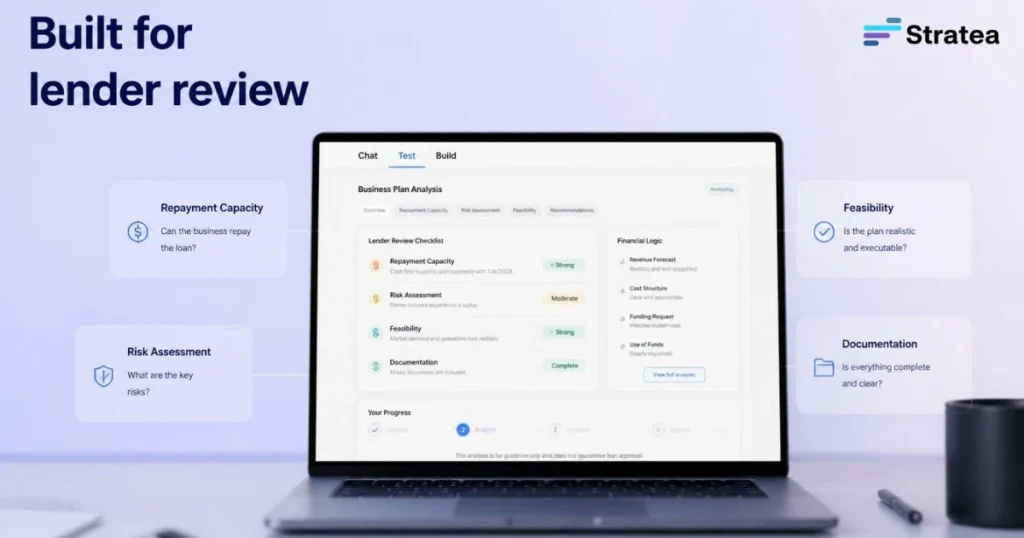
What an SBA Loan Officer Actually Evaluates
An SBA loan officer has a checklist. They work through it methodically, looking for red flags.
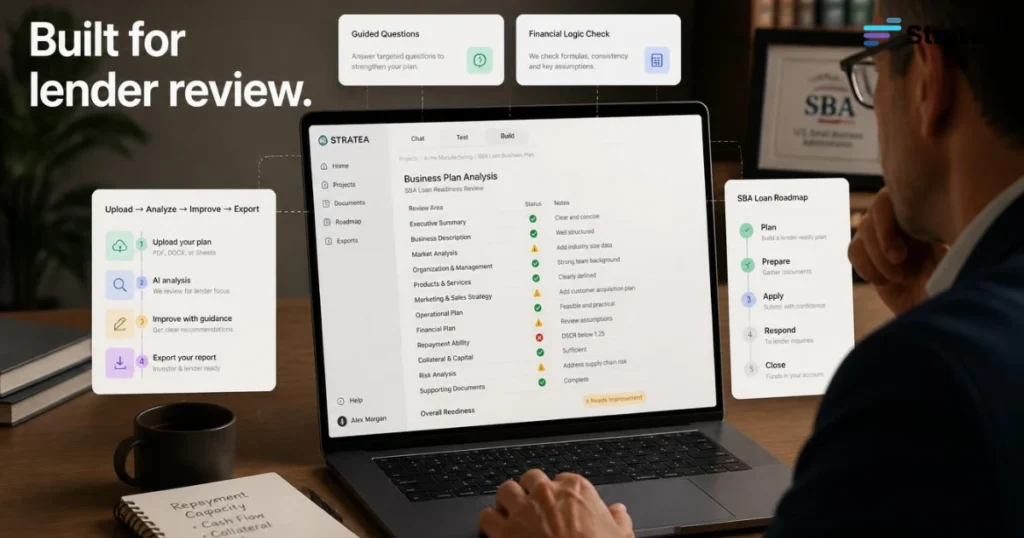
Repayment Capacity and Cash Flow
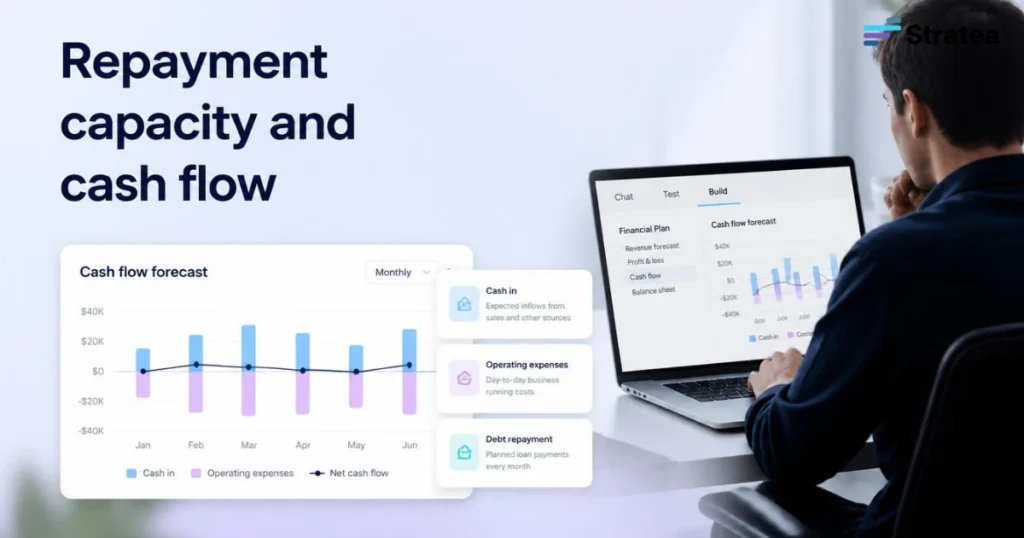
The first item is repayment capacity. Can your business generate enough monthly cash to service the loan payment plus operating expenses plus living expenses? A $50,000 loan over five years costs approximately $950 per month. If your business produces $1,000 monthly profit, that loan payment is 95% of your profit. That’s a problem. Most lenders want the loan payment to be 20-30% of monthly profit, not 95%.
The cash flow section of your plan must show monthly or quarterly projections for the first two to three years. More importantly, it must show how you arrived at those numbers. If you project 20 new customers per month, what’s your evidence? Did you test acquisition channels? Do you have early customers confirming demand? Or is 20 customers per month a guess based on the size of your market?
Lenders are skeptical of guesses. They’ve seen thousands of business plans. They know which assumptions tend to be optimistic and which tend to be realistic.
Collateral and Personal Credit
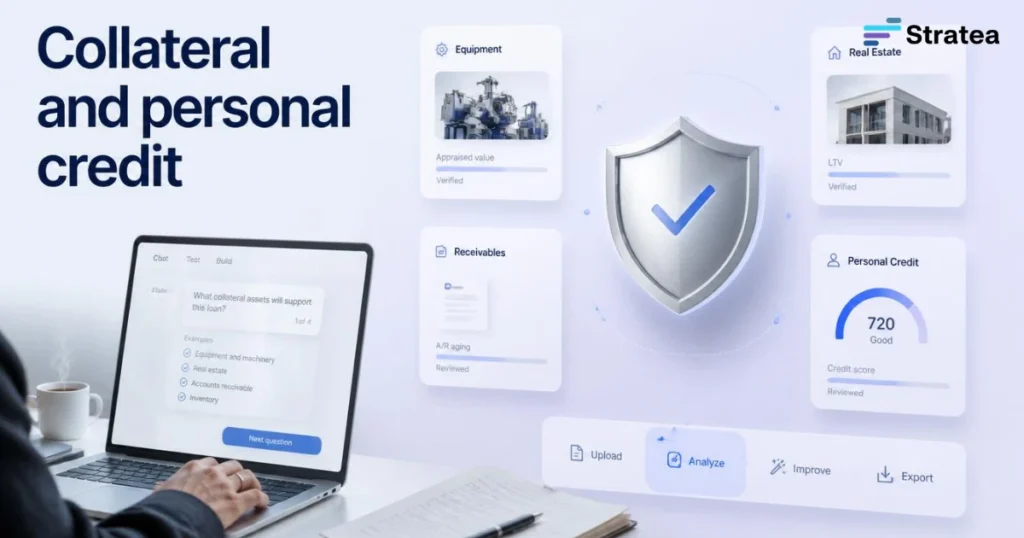
The second item is collateral. What are you putting up to secure the loan? Equipment, inventory, real estate, accounts receivable? The SBA wants collateral that covers at least 100% of the loan amount. If you’re borrowing $50,000 for equipment, that equipment should appraise for at least $50,000. If you’re borrowing for working capital, lenders look to real estate or personal guarantees.
Personal credit and guarantees matter. Most SBA loans require personal guarantees from the owner. The lender runs your credit report. A credit score of 650 or above is generally acceptable. If your score is lower, the loan is harder to get and terms are worse.
Market Evidence and Business Viability
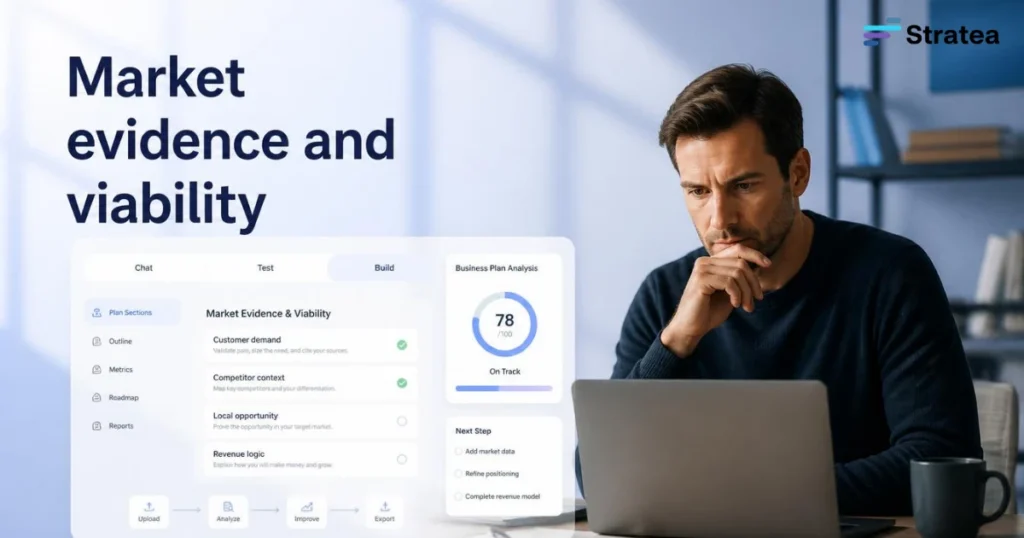
The third item is market viability. Does this business actually work? If you’re a startup, do you have pre-orders, pilot customers, or letters of intent? If you’re an existing business, do you have customer contracts or consistent revenue history?
Lenders want evidence that your business model actually converts. An existing business with revenue and profit history is far easier to finance than a startup idea that “will” work.
Owner Background and Industry Experience
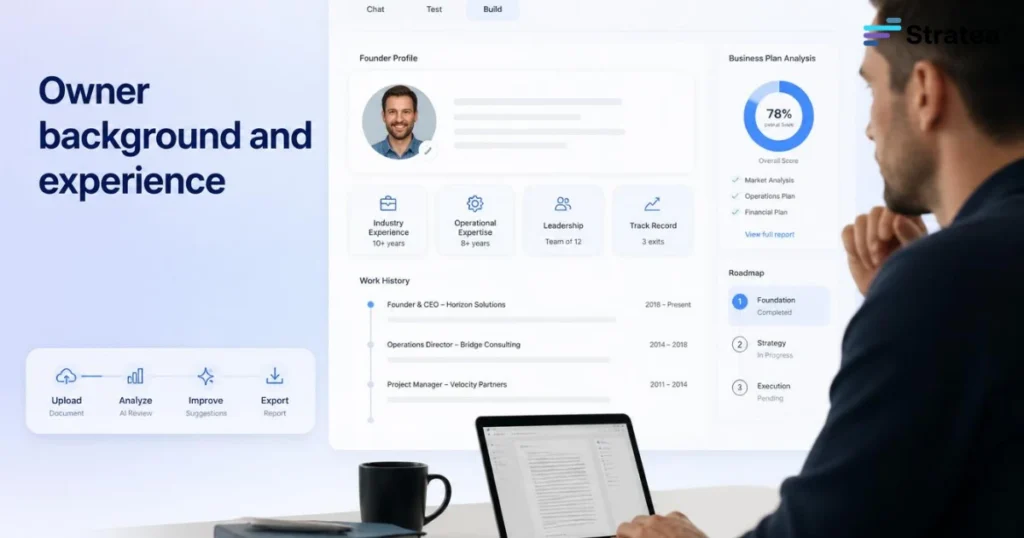
The fourth item is you. Do you have relevant industry experience? Have you run a business before? Do you understand the industry well enough to have realistic assumptions? An owner with ten years of restaurant experience applying for a restaurant loan is lower risk than someone with zero food service background.
Lenders look for founder credibility. It doesn’t have to be experience in your exact industry, but it should be relevant. Retail experience helps a retail founder. Manufacturing experience helps a manufacturing founder.
How to Structure an SBA Loan Business Plan
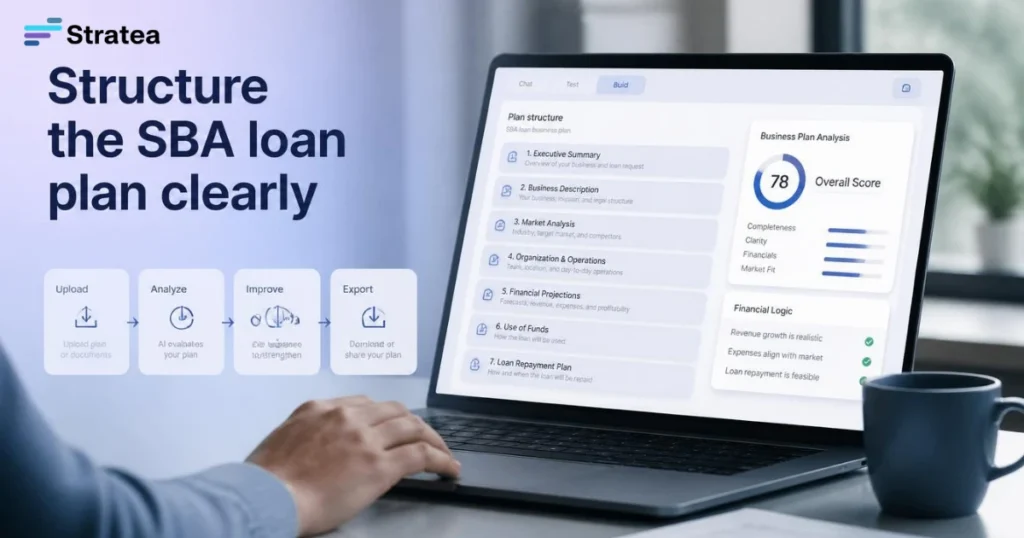
An SBA loan business plan has specific sections a lender will look for.
Executive Summary. One page overview of the business, the loan request, and use of funds. A lender should understand the business in 30 seconds.
Business Description. What does your company do? Who are the customers? How long have you been operating? If you’re a startup, what’s your background that makes you credible to do this?
Market Analysis. Not a giant TAM (total addressable market) estimate, but a realistic breakdown of who you’ll actually serve. If you’re a landscaping company, don’t estimate the entire US landscaping market. Estimate how many potential customers are within your service area, what percentage you can realistically reach, and at what price.
Organization and Management. Who’s running the business? What’s your background? Are you hiring staff? Who will be responsible for what?
Service or Product Description. Specifically, what are you selling? What’s the pricing? What’s your profit margin per unit?
Marketing and Sales Strategy. How will you acquire customers? What’s your customer acquisition cost? How long is your sales cycle? Be specific, not generic.
Financial Projections. Monthly or quarterly cash flow projections for two to three years. Balance sheet and income statement projections. Break-even analysis.
Use of Funds. Exactly how will you use the loan money? If it’s $50,000, break it down: $30,000 for equipment, $10,000 for inventory, $5,000 for working capital, $5,000 for marketing. Lenders want specificity.
Repayment Plan. How will the loan be repaid from monthly cash flow? Show the math: monthly profit minus loan payment, and what’s left for operating expenses and owner draw.
The Evidence Behind Your Numbers
Here’s where most business plans fail. A founder projects 20 new customers per month, $3,000 revenue per customer, and $1,500 gross margin per customer. The math works. But where does the 20 customers per month number come from?
If you’re an existing business, this is easier. You have historical data. You’ve been operating for two years and acquire an average of 18 customers per month. A 10% growth to 20 customers per month is reasonable. You can justify it: you’re adding a sales person, increasing marketing budget, or expanding service area.
If you’re a startup, you need other evidence. Have you talked to 50 potential customers and asked if they’d buy at your price? Did they say yes? How many? That’s your evidence. Did you run a test campaign and measure customer acquisition cost? That’s evidence.
Without evidence, lenders assume your projections are optimistic.
Worked Example: Landscaping Company Equipment Expansion Loan
The Business and Loan Request
Marcus runs a residential landscaping company in Austin. He’s been operating for four years with $350,000 annual revenue and $80,000 profit. He has five full-time employees and a one-truck operation. He’s realized he’s turning away work because he can’t handle the volume. He wants to buy a second truck and hire one more crew lead. The equipment costs $45,000. He’s requesting a $45,000 SBA loan.
What the Lender Evaluated
The SBA lender starts with the basic question: “Can this business generate $900 per month cash flow to service a $45,000 loan at reasonable terms?” (Five-year term, roughly 7% interest is typical).
Marcus’s current profit is $80,000 annually, or $6,700 monthly. Loan payment is about $900. That leaves $5,800 monthly, which should cover operating expenses and owner draw. That’s healthy. Repayment capacity looks good.
Next, the lender checks collateral. The truck and equipment is worth $45,000. That covers the loan 100%. Collateral is sufficient.
The lender reviews Marcus’s credit. His score is 710. That’s good. Personal credit supports approval.
The lender then evaluates Marcus’s market and business viability. He has four years of operating history. Revenue and profit are documented. He has recurring customers (most jobs are seasonal or quarterly maintenance). He’s not a startup with untested assumptions. This is an existing business with proof of concept.
The lender checks Marcus’s background. He’s worked in landscaping for twelve years, including as a crew lead before starting his own company. He understands the business, costs, and customer expectations. That’s credible.
How the Plan Addressed Lender Concerns
Marcus’s business plan addressed these questions directly.
For repayment capacity, his plan showed monthly cash flow projections for the next three years. Year one assumed he’d bring in the new crew and new truck by month three, then gradually fill it with jobs. He projected revenue growth from $350,000 to $420,000 by year three (a moderate 20% growth over three years). His profit projections showed the business generating enough cash to cover the $900 monthly loan payment plus all operating expenses.
For collateral, his plan itemized the equipment purchase: truck ($35,000), trailer ($5,000), landscaping equipment ($5,000). These items secured the loan fully.
For market viability, Marcus documented the demand. He had a waitlist of 20+ customer requests he’d turned down in the previous year due to capacity. These weren’t hypothetical customers. They were real requests from existing customers requesting additional services. That’s strong market evidence.
For his background, Marcus included a one-paragraph summary of his twelve years in landscaping, his progression from crew member to owner, and his knowledge of crew management and customer expectations.
The SBA approved the loan. The business is now using the new truck and crew to serve the pent-up demand. Year one after the loan showed revenue of $420,000 and profit of $100,000, slightly ahead of projections.
Common Weaknesses SBA Lenders Spot Quickly
Weak cash flow assumptions. “We’ll acquire 100 customers by year two” without any evidence. Lenders see this and immediately lower the assumptions by 50% in their own analysis. Then your plan doesn’t show repayment capacity at realistic numbers.
Outdated or missing financial history. You’re an existing business but only provide one year of tax returns. Lenders want to see two to three years to spot trends. Inconsistent revenue or profit that you don’t explain raises red flags.
Vague use of funds. “Loan proceeds will be used for business growth and expansion.” Lenders want specifics. Equipment list with appraisals. Inventory needs with supplier quotes. Working capital broken down by expense category.
No market evidence. You’re a startup and your market analysis is “the US market for widgets is $10 billion, and if we capture 0.1%, we’ll have $10 million revenue.” That math is correct, but it doesn’t prove customers will actually buy from you. Lenders want evidence: customer interviews, pilot results, pre-orders, letters of intent.
Personal credit problems unaddressed. You have a bankruptcy or foreclosure in your past, and your plan doesn’t acknowledge it or explain what’s changed. Lenders view silence as a red flag.
Inconsistent numbers. Your cash flow projection shows $500,000 revenue, but your market analysis assumes you’ll serve 100 customers at $3,000 each, which is only $300,000. These don’t match. A lender will flag the inconsistency and ask you to explain.
FAQ
Q: Does my business plan guarantee SBA loan approval?
A: No. A well-structured plan improves your odds by demonstrating clear thinking and defensible assumptions. But lender decisions also depend on personal credit, collateral, industry conditions, and the specific bank’s appetite for your industry. A plan is necessary but not sufficient for approval.
Q: How detailed should my financial projections be?
A: For an SBA loan, monthly or quarterly projections for at least two to three years. Lenders want to see that you understand your business cycle and cash flow timing. General annual projections aren’t detailed enough to evaluate repayment capacity in months when cash might be low.
Q: What if my business is brand new and I have no revenue history?
A: You’ll need strong evidence of market viability. Pre-orders, letters of intent, pilot results, or customer research showing demand. You’ll also need relevant industry experience. Startups are riskier, so lenders will scrutinize your background and market evidence more closely.
Q: Should I include worst-case financial scenarios?
A: Many lenders appreciate conservative or stress-test scenarios. Show what happens if customer acquisition is 20% slower than projected, or if pricing pressure reduces your margin. This demonstrates you’ve thought about risks and can still repay the loan under less-than-ideal conditions.
Q: How important is the personal guarantee for an SBA loan?
A: Very important. Most SBA loans require personal guarantees from the owner or co-owners. This means your personal credit, assets, and guarantees back the loan. A poor personal credit score or lack of personal collateral makes approval harder.
Q: What if I’m expanding an existing business?
A: Document your current revenue and profitability. Show your track record. Then clearly project how the loan will drive incremental growth. Lenders prefer expanding existing businesses (lower risk) to startups. Your historical data is your strongest evidence.
Professional Disclaimer and Next Steps
Professional Disclaimer: This article provides educational information about SBA loan business planning. It is not legal or financial advice. SBA loan approval depends on many factors including credit, collateral, industry conditions, and individual lender criteria. We strongly recommend consulting with an SBA-approved lender, accountant, or business advisor before applying for an SBA loan. Loan approval is not guaranteed by any plan or preparation process.
Canadian Note: The SBA (Small Business Administration) is a US government agency. Canadian entrepreneurs should consult with their provincial business development resources and the Business Development Bank of Canada (BDC) for equivalent loan programs and planning requirements.
Building a strong SBA loan business plan starts with understanding what a lender actually evaluates: repayment capacity, collateral, market viability, and your credibility as an operator. The plan should demonstrate you’ve thought through your business defensibly, not just optimistically.
Start Strategic Discovery with STRATEA to organize your thinking before you approach a lender. Work through structured questions that surface assumptions, identify evidence gaps, and help you build a plan that stands up to scrutiny.
STRATEA is free to start. Use it to prepare the thinking—not the guessing—that an SBA lender will actually evaluate.