
An SBA loan business plan isn’t written to clarify your thinking or impress investors. It’s written for a lender to evaluate whether you can repay the loan. An SBA loan officer reads it with one specific question in mind: does this owner understand their business well enough that I’m confident they’ll generate the cash to repay this loan?
That changes what matters in the plan. It’s not about market size estimates or competitive positioning. It’s about monthly cash flow, collateral, repayment timeline, and whether your assumptions are grounded in real business data rather than guesses. This is exactly where a generic ai business plan generator falls short: a tool that outputs polished narrative sections and generic projections in minutes can’t stress-test whether your repayment assumptions actually hold up under a lender’s scrutiny. What an SBA reviewer needs to see is a plan built through documented reasoning, not just generated text, with cash flow numbers a loan officer can trace back to real inputs.
Note: This content is for informational purposes and does not constitute financial, legal, or lending advice. SBA loan requirements vary by lender and program; consult your lender or an SBA-approved advisor for guidance specific to your application.
What a Consular Officer Actually Checks in an E-2 Plan
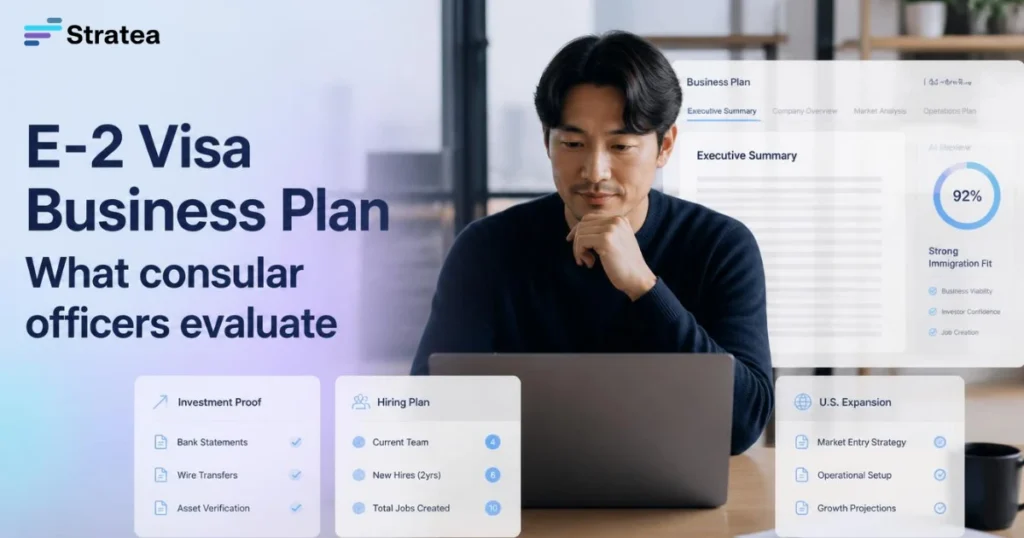
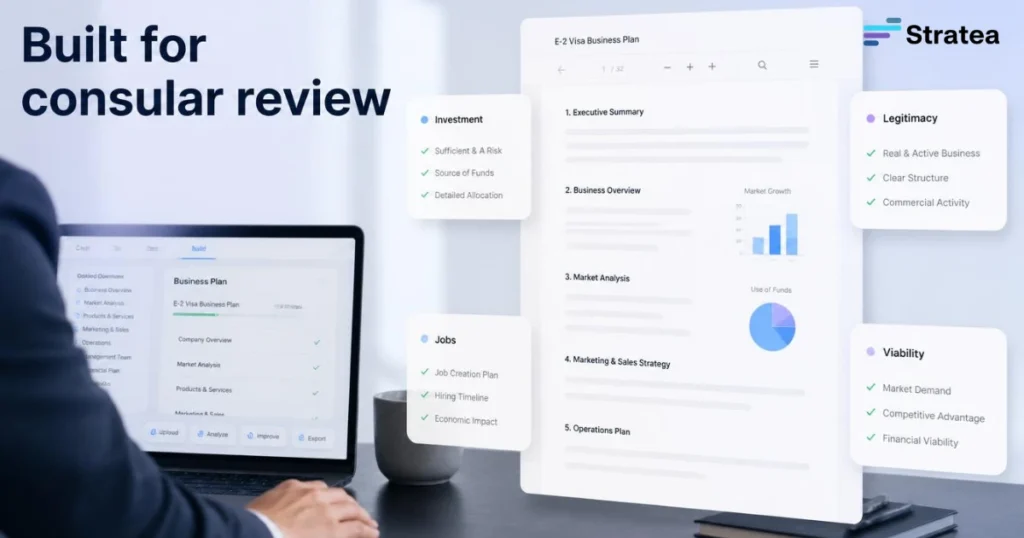
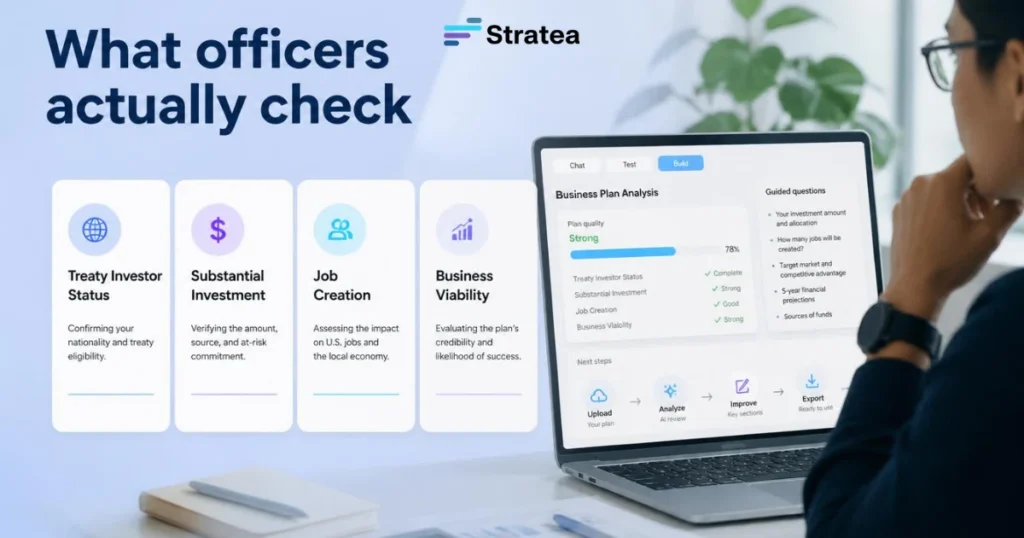
A consular officer reviews an E-2 petition with specific criteria in mind. Understanding these helps you structure a plan that addresses their concerns directly.
Treaty Investor Status and Investment Legitimacy
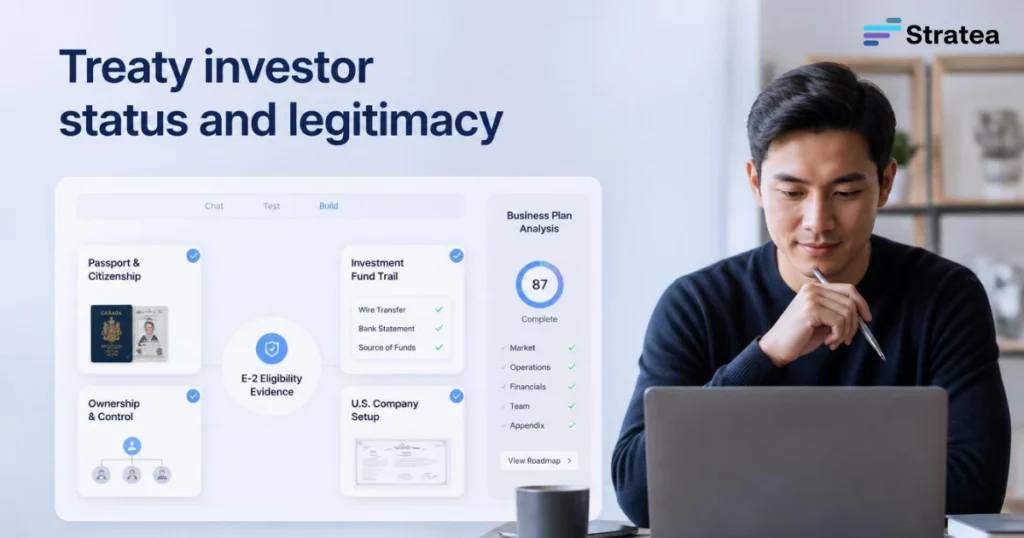
The first criterion is treaty investor status. You must be a citizen of a country with which the US has a treaty of commerce and navigation. There are over 80 treaty countries, but not all countries qualify. The consular officer verifies your citizenship and treaty eligibility.
Beyond citizenship, the officer evaluates whether you’re making the investment of your own accord. Are you a principal investor, or are you acting as a proxy for someone else? E-2 visas are designed for actual investors who control the business and make operational decisions, not for people hired to manage someone else’s investment.
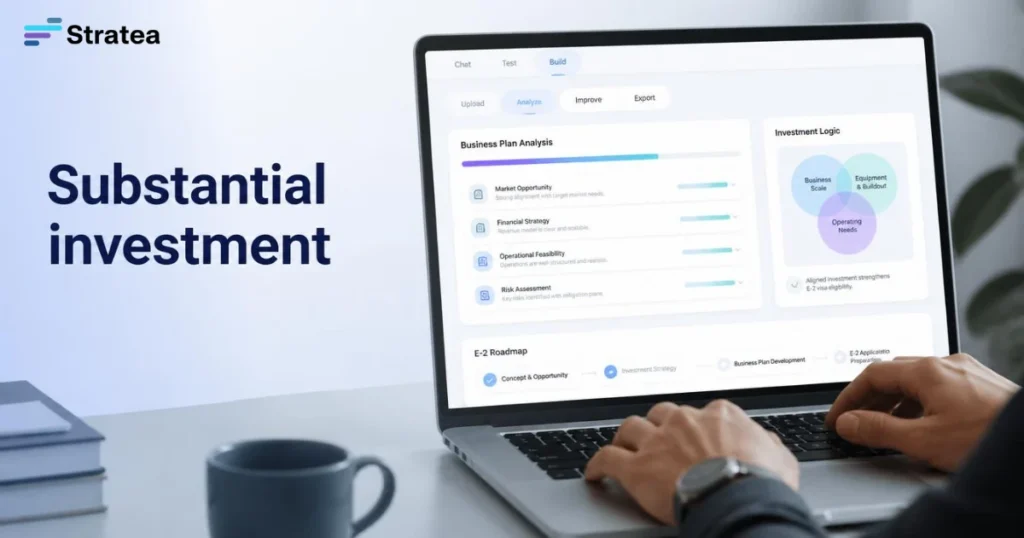
Substantial Investment Amount
E-2 visa law doesn’t specify a minimum dollar amount. Instead, courts and immigration authorities use the term “substantial,” which is interpreted in context. What’s substantial for opening a small service business might be $50,000. What’s substantial for opening a manufacturing operation might be $500,000.
Consular officers look for three things. First, is the investment amount meaningful relative to the business you’re starting? If you’re starting a consulting practice, a $10,000 investment might be substantial. If you’re opening a restaurant, it’s not.
Second, is the investment amount at real risk? You need to demonstrate that you’re committing your own capital, not borrowed money or money that will be repaid to you by the business. The investment should be lost if the business fails.
Third, does the investment amount align with your business plan? If your financial projections show you need $100,000 to launch and operate for the first year, but you’ve only invested $20,000, consular officers will question whether the plan is realistic.
Job Creation for US Workers
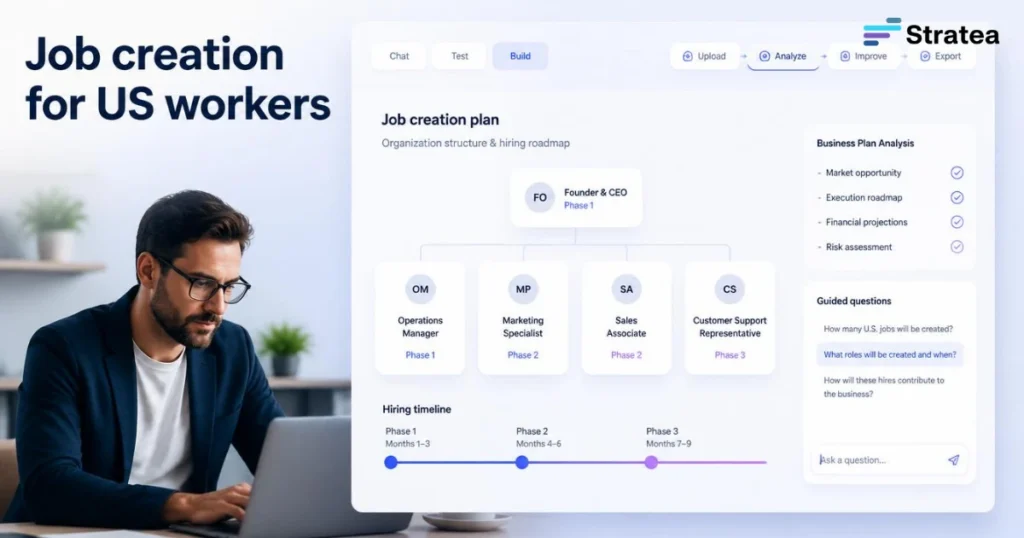
E-2 visas are designed to benefit US workers and the US economy. The business should create employment for US citizens or permanent residents. A business that provides only work for the treaty investor and their family doesn’t meet the spirit of the visa.
Consular officers look at whether the business plan shows realistic job creation. Will you hire employees in the first year? If so, how many, at what wage level, and what positions? Can the business cash flow support those salaries from projected revenue?
A business plan that projects you as the only worker initially is fine. But if your plan extends to year two or three, consular officers expect to see employee hires and US job creation.
Business Viability and Profit Potential
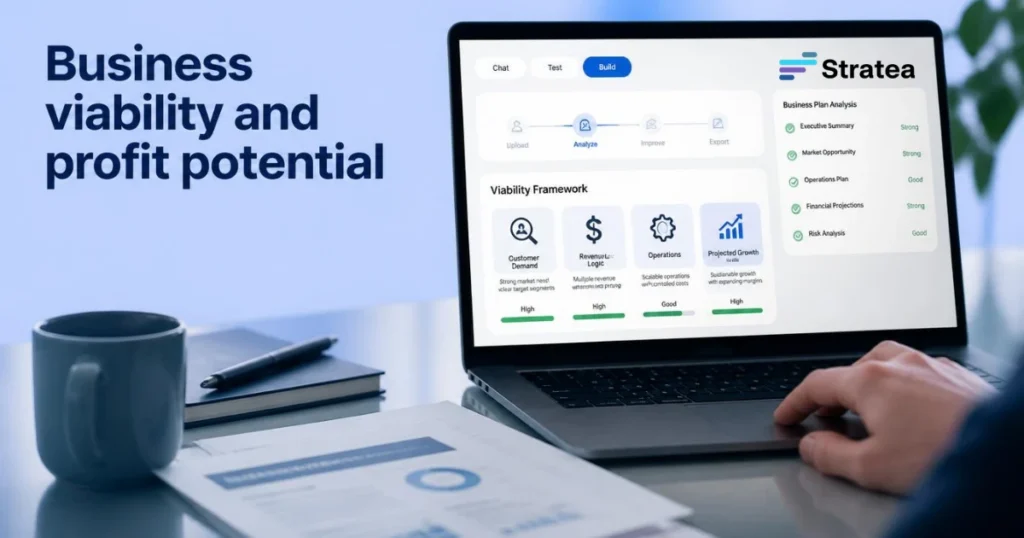
Finally, consular officers evaluate whether the business is viable and capable of generating profit. This is where your business plan does similar work to a lender’s evaluation, though with different emphasis.
The officer wants to see that you understand the business, that you have relevant experience, and that your financial projections are realistic. They’re not looking for guaranteed success, but they are looking for evidence you’ve thought through the business seriously.
How to Structure an E-2 Visa Business Plan
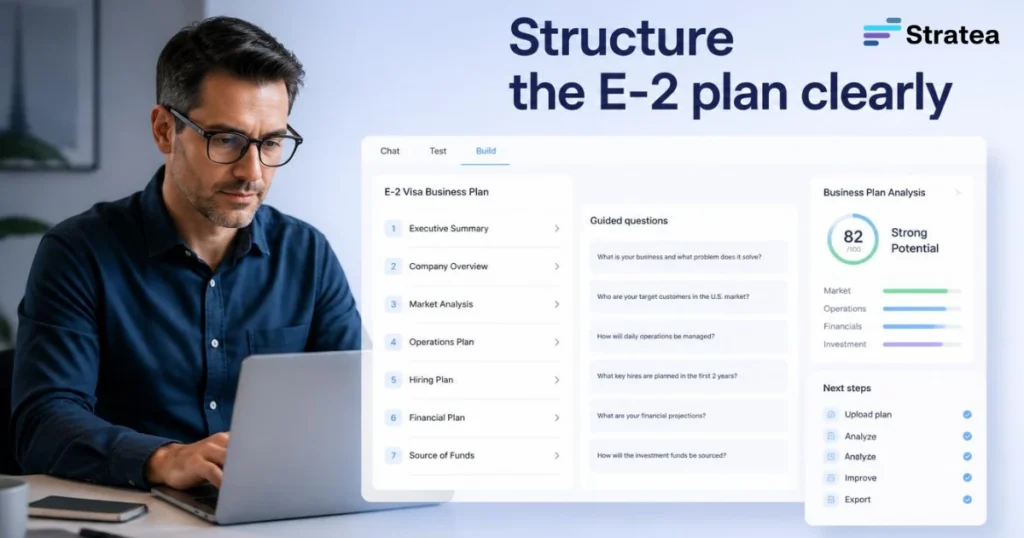
An E-2 business plan has specific sections that address visa criteria.
Executive Summary. Summarize the business, your investment amount, job creation plans, and why you’re the right person to lead it. Consular officers should understand the core petition in two minutes.
Investor Background and Treaty Status. Confirm your citizenship in a treaty country. Include your relevant business experience, education, and language skills. Explain why you’re qualified to run this business.
Investment Capitalization. Document your total investment amount. Show how much you’ve invested to date and how much you’re committing going forward. Break down capital allocation: equipment, inventory, working capital, and other startup costs.
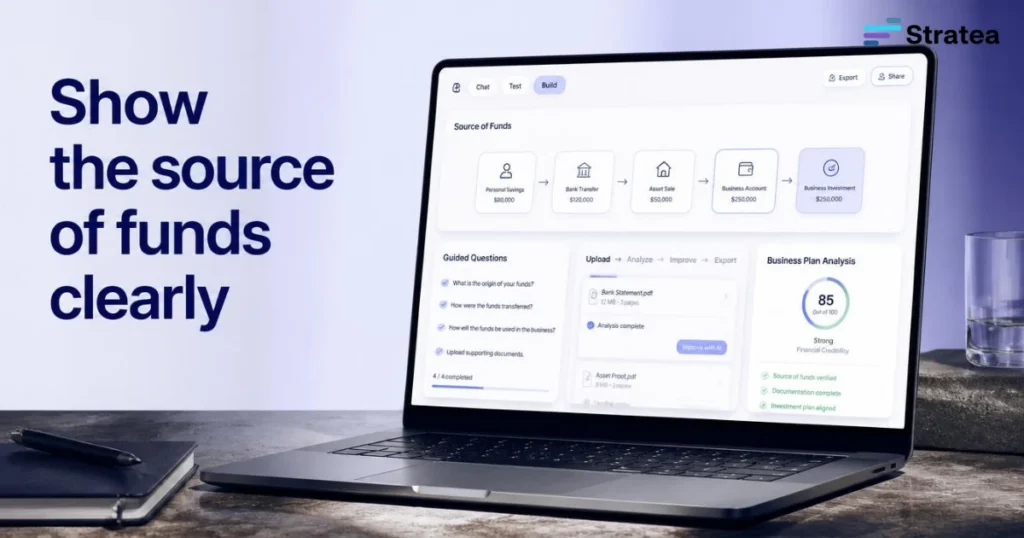
Source of Funds Documentation. This is critical for E-2. You must show where your investment capital comes from. Bank statements, business sale proceeds, inheritance documentation, or family loans (if documented) are typical sources. Consular officers need evidence that funds are legitimate and lawfully obtained.
Business Description. What does your business do? Who are the customers? What’s your competitive advantage?
Market Analysis. Provide evidence of market demand. Not a huge TAM estimate, but specific evidence that customers exist and will pay for your services or products.
Organization and Management. Who will manage the business? What roles will employees fill? What US jobs will you create?
Financial Projections. Three-year financial projections showing how the business will operate, generate revenue, cover expenses, and produce profit. Include monthly projections for year one and quarterly thereafter.
Job Creation Plan. Explicitly document what US jobs the business will create, when, and at what wages. This directly addresses visa criteria.
Business Experience and Qualifications. Explain your relevant experience running similar businesses or in this industry. Consular officers want to see that you’re not gambling on an unfamiliar business.
Demonstrating Source of Funds and Investment Legitimacy
This is where many E-2 petitions encounter problems. Consular officers scrutinize source of funds carefully. They want to ensure investment capital isn’t from undisclosed loans, unlawful sources, or money laundering.
Document every source. If capital comes from personal savings, provide bank statements showing the account history. If it comes from a business sale, provide sale documentation. If it comes from family, provide documentation of the gift or loan, along with a statement from the family member explaining the source of their funds.
If investment capital is a mix of sources (some personal savings, some from a family loan, some from a previous business sale), document each source separately. Consular officers expect to trace the money.
Never use vague language like “investment funds from international sources” or “family support.” Be specific. Document thoroughly. The more transparent you are about where capital comes from, the more credible your petition is.
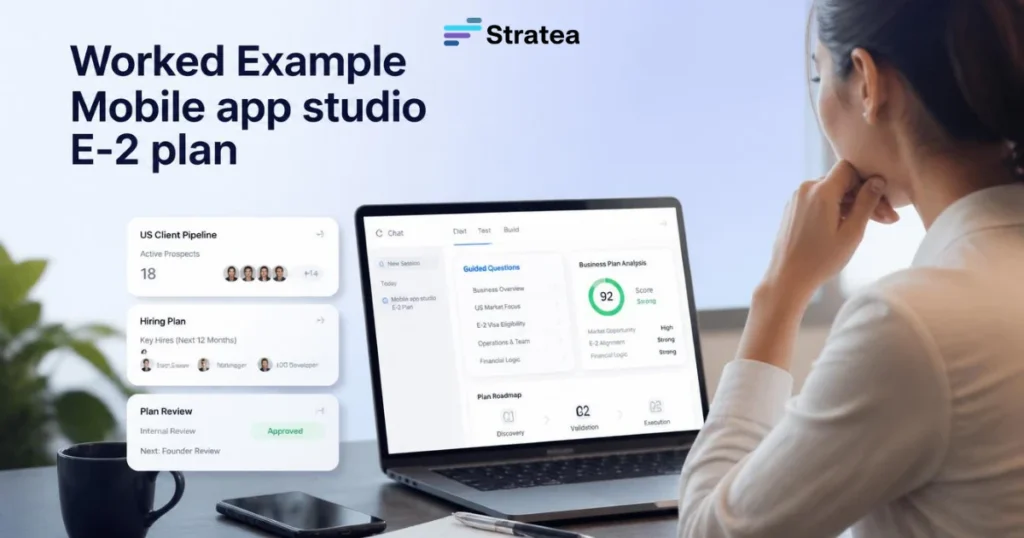
Worked Example: Mobile App Studio Pivoting to US Client Services
The Business and Visa Petition
Dmitri is a software engineer and entrepreneur based in Ukraine, a treaty country. He founded a mobile app development studio five years ago. His studio has 12 employees and generates €400,000 annual revenue serving European clients.
He’s decided to pivot into US market. He’ll establish a US entity and expand his Ukraine-based studio into US client development work. He’s committing $150,000 personal capital to the US venture. He plans to hire 2-3 US-based developers in the first year and grow to 6-8 US employees by year three.
He needs an E-2 visa to lead the US operation.
What the Consular Officer Evaluated
The officer starts with treaty status. Dmitri is a Ukrainian citizen. Ukraine is a treaty country. Status confirmed.
Next, substantial investment. Dmitri is investing $150,000 USD personal capital. For a software development studio in the US market, $150,000 is substantial but not excessive. It covers initial equipment, office setup, hiring costs for first employees, and operating runway. Reasonable for the business.
The officer verifies investment legitimacy. Dmitri shows bank statements from his Ukraine business account documenting business profits over five years. He documented a $150,000 transfer from his personal business account to a new US business account. The source is legitimate business income, not a loan.
Job creation. Dmitri’s plan projects hiring 2 US developers in month three, another developer in month eight, and two additional staff by year two. His financial projections show revenue growing from $200,000 in year one to $600,000 by year three, with profit margins sufficient to support these US salaries. The officer sees realistic job creation for US workers.
Business viability. Dmitri has five years of experience running a software development studio. He has developed technology and client relationships in Europe. He’s pivoting that expertise to the US market. The officer sees someone with relevant experience, not a first-time founder.
How the Plan Addressed Visa Concerns
Dmitri’s business plan addressed visa criteria directly.
For investment legitimacy, he provided five years of Ukraine business financial statements, bank statements showing capital accumulation, and documentation of the transfer to his US business account. The officer traced the capital back to business income, not suspicious sources.
For substantial investment, his plan showed the $150,000 capital was allocated to: $40,000 for office setup and equipment, $60,000 for six-month operating runway, and $50,000 for initial hiring and team building. These numbers were realistic for his business type.
For job creation, his plan included a staffing timeline with specific job titles (senior developer, mid-level developer, US operations manager), salary expectations ($80,000-$130,000 annually), and hiring months. His financial model showed revenue sufficient to support these salaries by the projected hiring dates.
For business experience, he included his Ukraine company background, descriptions of projects delivered to European clients, and letters of recommendation from major clients confirming his technical expertise and business acumen.
The consular officer approved the E-2 petition. Dmitri moved to the US, established his business, and within 18 months had hired three US developers as planned.
Common Weaknesses Consular Officers Flag
Unclear investment legitimacy. You say the investment comes from “family sources” without documentation. Consular officers see this and request further evidence. If you can’t provide it, the petition stalls or gets denied.
Investment amount too low for business type. You’re opening a restaurant and investing $25,000. Consular officers will question whether that’s sufficient and realistic. If your financial projections show you need $100,000 to launch properly, committing only $25,000 raises credibility questions.
Business plan shows investor working alone indefinitely. “For the first five years, I will be the only employee.” Consular officers want to see job creation. A business that never creates US employment isn’t aligned with E-2 visa intent.
Vague business experience. “I’ve worked in business for many years” without specific details. Consular officers want to know what businesses you’ve run, what roles you held, what you succeeded or failed at. Generic experience statements raise red flags.
Financial projections that don’t support the business. Projections show the business will lose money in year one but you’re not budgeting for that loss. Or projections show revenue insufficient to cover salaries you promised but you haven’t revised the plan. Consular officers see the math doesn’t work.
No clear job creation timeline. “I will create jobs as the business grows” without specifics. Consular officers want to see when, how many, and at what salary levels.
FAQ
Q: What’s the minimum investment amount for an E-2 visa?
A: There’s no statutory minimum. Immigration law requires “substantial” investment, which is assessed in context of the business type, market, and industry norms. A $25,000 investment might be substantial for a consulting practice but not for a restaurant. Consular officers evaluate whether the amount is meaningful relative to the business you’re starting.
Q: Do I have to be from a treaty country to get an E-2 visa?
A: Yes. Your country must have a treaty of commerce and navigation with the United States. There are over 80 treaty countries, but not all. Check the State Department website for the current list. If your country isn’t on it, E-2 isn’t available to you.
Q: Can a family member’s investment count toward my substantial investment?
A: Yes, if properly documented. If a parent or spouse invests capital and it’s legally at their risk, it can count as substantial investment. However, the investment must be thoroughly documented with loan agreements, gift letters, or ownership documentation showing the family member’s stake.
Q: How important is job creation for E-2 visa approval?
A: Very important. E-2 visas are issued to benefit the US economy. A business that creates no US employment is working against the purpose of the visa. Your business plan should show realistic job creation by year two or three, with specific job titles and salary expectations.
Q: Can I be the only employee of my E-2 business?
A: Initially, yes. Many E-2 visas are approved for businesses where the investor is the sole worker in year one. But consular officers expect to see job creation plans in your forward projections. A business that shows no employee hiring in any of its three-year projections is weaker.
Q: How do I prove my investment capital is legitimate?
A: Through documentation. Bank statements showing you’ve saved the capital. Business sale documents if the capital comes from selling a previous business. Tax returns showing income you’ve accumulated. Gift letters from family members and their bank statements if family members contributed. Consular officers want to trace the money back to legitimate, lawful sources.
Professional Disclaimer and Next Steps
IMPORTANT DISCLAIMER: This article provides educational information about E-2 visa business planning. It is not legal or immigration advice. E-2 visa approval depends on many factors including treaty country status, investment amount sufficiency, business viability, job creation realism, and individual consular officer assessment.
You must consult with a qualified immigration attorney before filing an E-2 visa petition. Immigration law is complex and changes frequently. An attorney can review your specific circumstances, advise on visa strategy, and ensure your petition complies with current USCIS and State Department requirements.
This article is not a substitute for legal counsel. Visa approval is not guaranteed by any plan or preparation process.
An E-2 visa business plan must demonstrate treaty investor legitimacy, substantial capital investment, business viability, and job creation for US workers. The plan should show that you’ve thought through your business seriously, with realistic financial assumptions, documented source of funds, and evidence of your business experience.
Before submitting an E-2 visa petition, prepare your thinking thoroughly. Consular officers are looking for evidence that you’re a legitimate investor with realistic plans, not just a document that looks professional.
Start Strategic Discovery with STRATEA to organize your business planning before you engage with an immigration attorney. Work through the assumptions about market demand, financial viability, investment allocation, and job creation that a visa officer will scrutinize.
STRATEA is free to start. Use it to prepare the evidence and planning logic that will support your E-2 petition.