
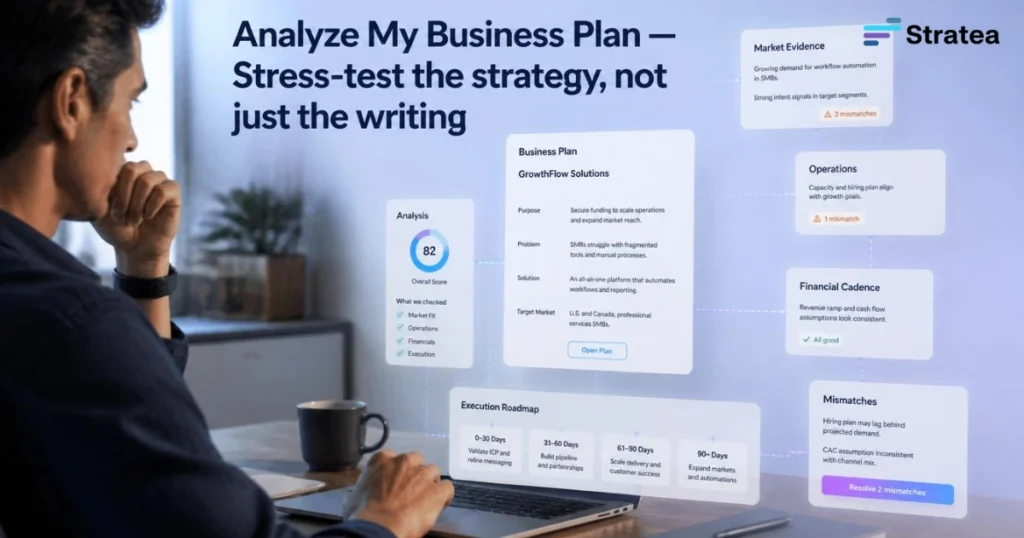
When you search for a way to analyze your business plan, you are usually looking for a deeper diagnostic check than a standard text editor can provide. A polished presentation matters, but external reviewers like bank managers, angel investors, or regional economic development agencies rarely reject a plan because of a misplaced comma. They reject it because the operational timeline fails to match the capital expenditure schedule, or because the target market definition shifts between the executive summary and the marketing section.
To analyze your business plan effectively, you must treat your draft as an interconnected financial and operational engine. If you alter a single component, the remaining pieces of your strategy must adjust to maintain alignment. This is where even a well-structured ai generated business plan can fall short if it was never stress-tested for these cross-section dependencies, since surface-level polish does not guarantee that the pieces still line up once you dig into the numbers. Running a diagnostic pass over your draft can help surface these inconsistencies quickly, but the judgment calls on what to fix still belong to you. This guide outlines how to audit your draft for structural consistency, verify your operational dependencies, and organize your core strategy into a defensible document.
Why Most Plan Reviews Focus on the Wrong Details
When founders review their own business plans, they often spend hours refining their executive summaries or polishing their formatting. While clarity is important, focusing entirely on presentation can obscure critical structural flaws that can undermine your credibility during an external review.
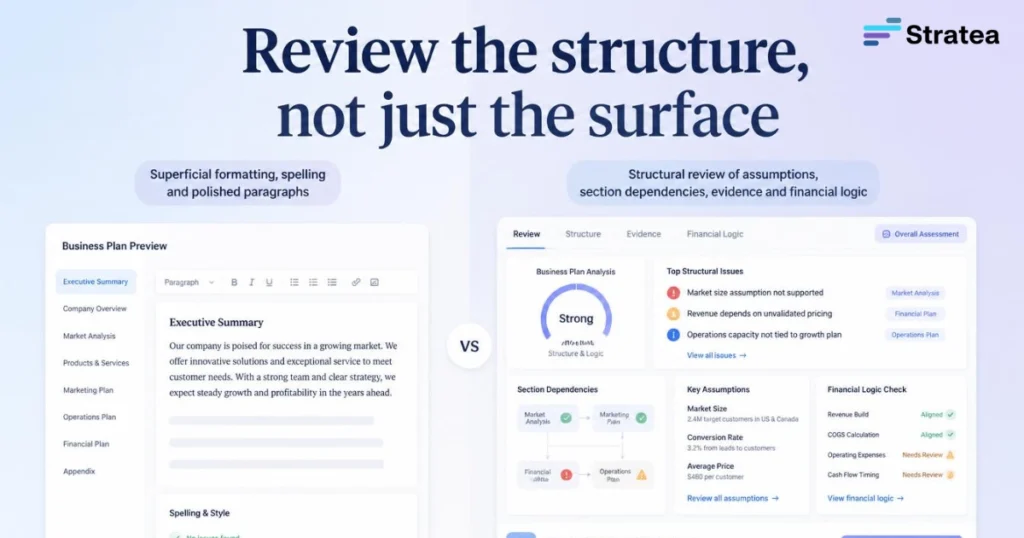
The Difference Between Text Formatting and Structural Review
A clean, well formatted document looks professional, but it does not guarantee your business model is sound. A thorough structural review examines how your choices affect your overall plan. For example, if your marketing section lists a high touch sales process but your financial plan assigns no budget for travel or enterprise sales professionals, your document contains a structural conflict. Reviewers look for these specific logical connections immediately.
The Risk of Hidden Section Mismatches
Section mismatches usually occur when different parts of a plan are written at different times without cross validation. You might update your target customer segment in your market analysis after reviewing new demographic data, but forget to update your customer acquisition cost estimates in your financial model. These hidden disconnects make a plan difficult to defend when a lender asks how your operational budget supports your customer growth goals.
How to Analyze My Business Plan for Structural Integrity
To thoroughly analyze my business plan, you should move systematically through your document to check how your strategic choices depend on one another. Use this three part framework to identify gaps in logic, evidence, and timing.
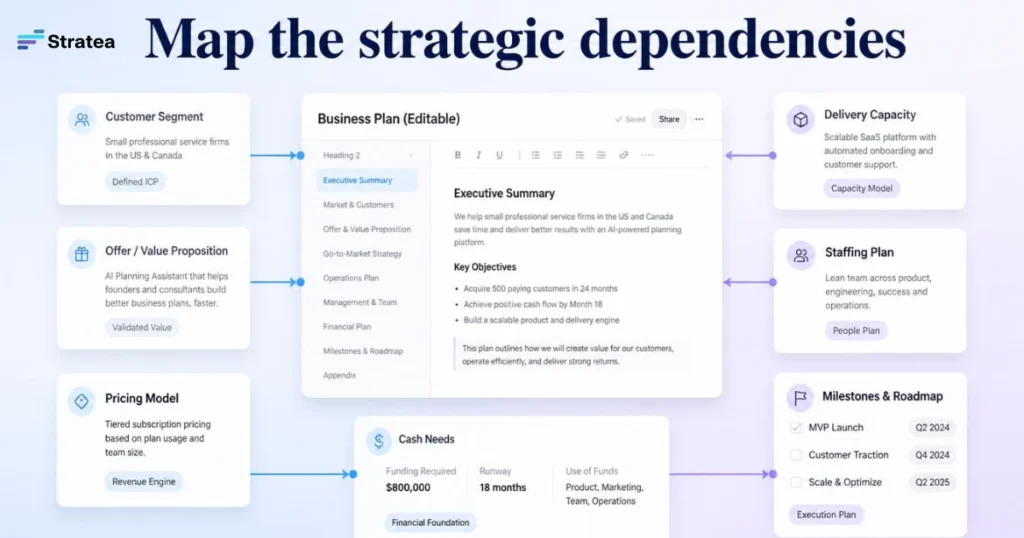
Mapping Your Strategic Section Dependencies
Every business choice creates a cascading effect across your entire strategy. If you alter your product delivery method, you simultaneously shift your delivery costs, your customer support needs, and your team structure.
| Primary Business Module | Directly Influences | Final Financial Impact |
| Pricing & Revenue Model | Marketing & Sales Strategy | Cash Flow Projections |
| Marketing & Sales Strategy | Staffing & Payroll | Cash Flow Projections |
| Staffing & Payroll | Operational Overheads | Cash Flow Projections |
When evaluating your current draft, look closely at these key connection points:
- The Customer Revenue Connection: Does your marketing section describe an online self service model while your sales section outlines a manual account management process?
- The Operational Staffing Connection: Does your growth roadmap require launching three new locations in twelve months while your payroll plan shows only two administrative hires?
- The Capital Asset Connection: If your production goals depend on specialized equipment, does your initial funding request explicitly cover the acquisition, installation, and maintenance costs of that hardware?
Evaluating the Weight of Your Market Evidence
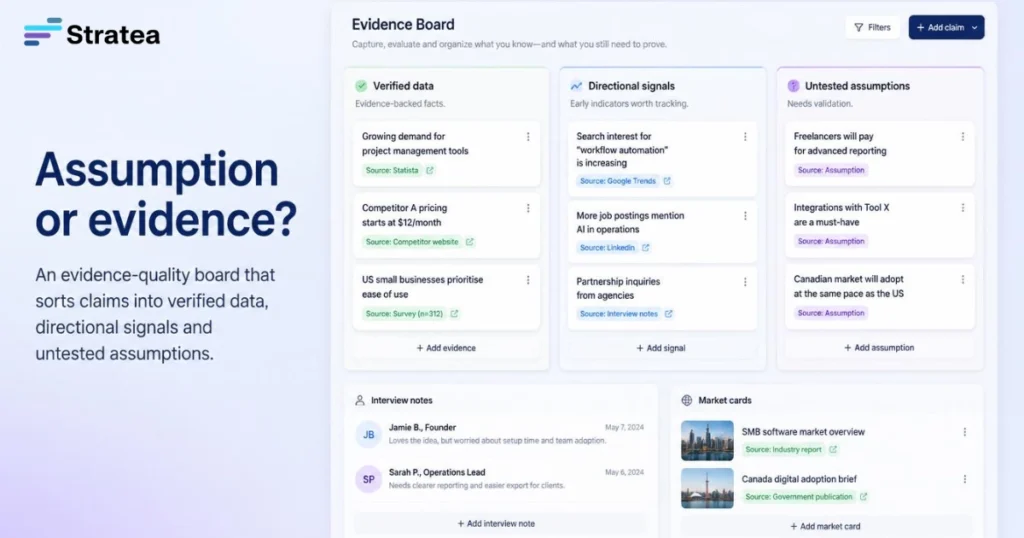
A defensible business plan separates unverified assumptions from documented market facts. Reviewers expect you to back up your growth targets with local or industry specific data rather than generic assertions.
When you analyze your market analysis section, categorize your data points by their source and reliability. Third party census data, local real estate reports, and published regional industry averages carry significant weight. Generic statements about broad market trends add little value. If your plan states that your business will capture a specific share of the local market, you must show the physical capacity, marketing budget, and staff headcount required to handle that volume.
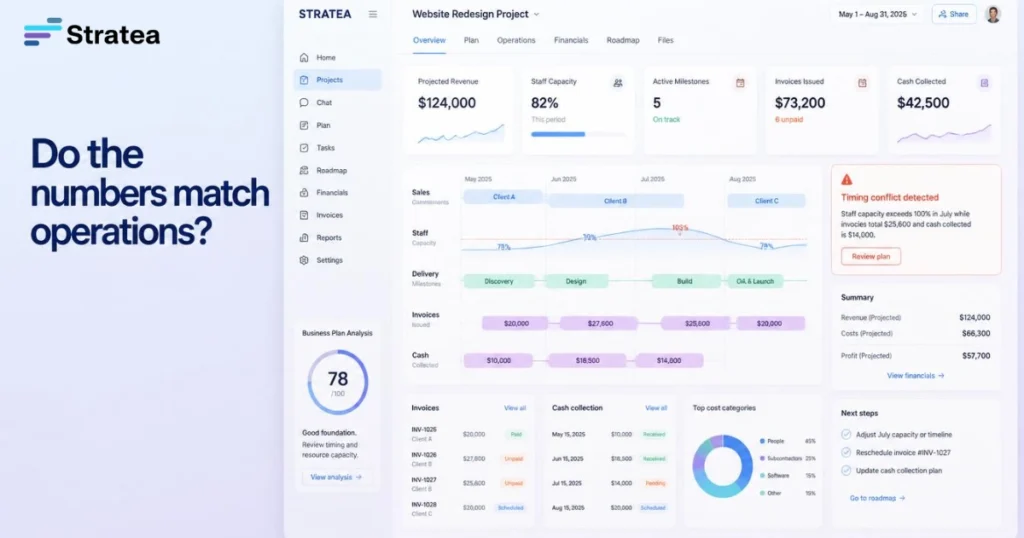
Validating the Financial Cadence Against Operations
Your financial projections should serve as a numeric reflection of your operational plan. The timing of your projected revenue must match the reality of your day to day business lifecycle.
If you are opening a location based business, ensure your plan accounts for the weeks or months required for permitting, renovations, and staff onboarding before your doors open for customers. During this pre revenue window, your cash flow statement must show capital flowing out for lease deposits, utility setups, and initial marketing campaigns without any matching income. Misaligning these timelines is one of the most common reasons lenders ask founders to revise and resubmit their documents.
A Structural Matrix for Analyzing a Business Plan Draft
The following matrix helps you track how a change in one primary planning area requires immediate updates across your remaining sections.
| If you modify this section… | Check for conflicts in this section… | What to look for and update… |
| Pricing Strategy | Market Analysis & GTM | Confirm your price matches your target customer’s spending power and your chosen sales channels. |
| Pricing Strategy | Financial Projections | Adjust your gross margin expectations, break even calculations, and working capital needs. |
| Target Customer Segment | Go-To-Market Strategy | Ensure your chosen marketing channels actually reach this specific group. |
| Target Customer Segment | Operations & Staffing | Add specialized personnel if your new target audience requires dedicated account management or technical support. |
| Growth & Expansion Timeline | Financial Projections | Verify that cash reserves are available to fund expansions before new revenue begins to arrive. |
| Growth & Expansion Timeline | Staffing & Payroll | Adjust your hiring schedule so new team members are onboarded and trained ahead of peak demand. |
| Operational Workflow | Capital Requirements | Link every major operational milestone directly to specific line items in your uses of funds table. |
Worked Example: Stress Testing a Pivot from Product to Agency Work
To see how these structural dependencies work in practice, let us look at a real planning scenario.
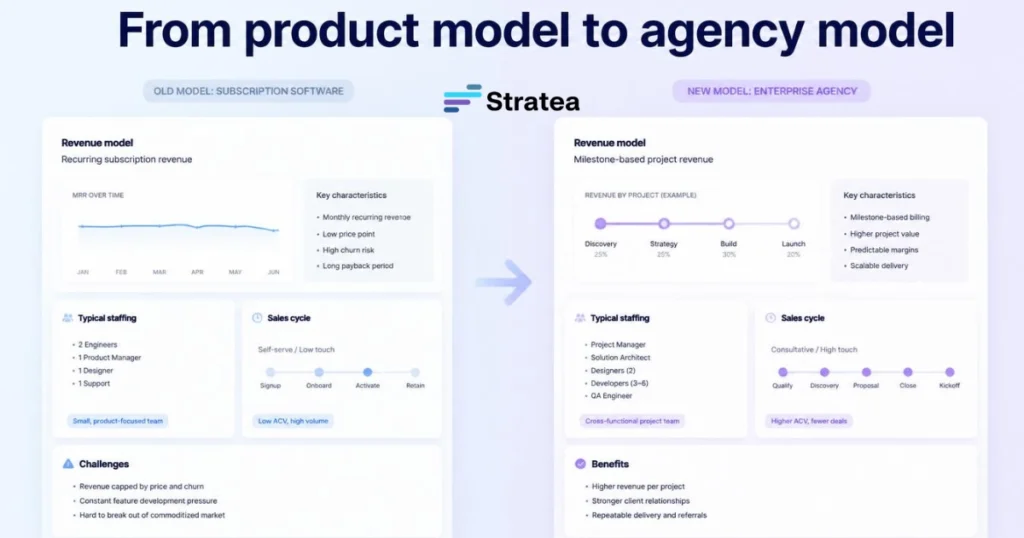
The Scenario: Shift Digital App Studio
An established digital studio named Shift Digital App Studio spent two years building proprietary mobile productivity tools. Due to shifts in the digital marketplace, the founders decided to pivot. Their new plan focuses on providing high touch, custom enterprise software development services directly to regional logistics firms in the US Midwest.
The founders updated their executive summary and market analysis to reflect this change, then used a structured planning framework to evaluate the rest of their draft.
The Dependency Conflict Identified
During the review, the founders discovered several structural mismatches caused by their new business model:
The Original Plan: The original draft described a digital subscription model with automated user acquisition, low support costs, and immediate credit card payments.
The Real Dependency: An enterprise service model requires milestone based billing, where clients pay 30 or 60 days after a project phase is approved. This change significantly alters the company’s cash flow needs.
While the market analysis section clearly explained the massive demand for logistics software, the operational and financial sections still reflected the quick cash cycles of a digital app store model. The plan showed revenue arriving instantly upon contract signing, which rarely happens with enterprise B2B accounts.
The Strategic Resolution
To fix these conflicts and create a plan they could confidently show to a commercial lender, the founders made three key structural adjustments:
- Updated the Capital Cadence: They extended their working capital runway in the financial section, ensuring they had enough cash to cover payroll during the initial 60 day client onboarding and billing cycles.
- Aligned the Staffing Timeline: They added roles for technical project managers and enterprise sales professionals to replace their previous digital marketing allocations.
- Documented Local Demand Evidence: Instead of citing global IT spending statistics, they added data on the concentration of logistics firms within a 200 mile shipping corridor and included letters of interest from two regional freight companies.
By identifying these interconnected dependencies early, Shift Digital App Studio turned a disconnected draft into a cohesive strategy structured to align with what lenders typically expect.
When to Use an AI Planning Assistant for Strategy Audits
Reviewing a complex document by manually jumping between spreadsheets and text files can make it easy to miss formatting errors or logic gaps. A dedicated AI Planning Assistant can help streamline this diagnostic process.
The Limits of Standard Document Editors
Standard word processors and generic chatbots are designed primarily to process text sequentially. They excel at rewriting sentences, fixing grammar, or changing the tone of a paragraph, but they do not understand the underlying business logic connecting your operational choices to your financial charts.
If you ask a standard document editor to review your plan, it will verify that your writing is clear, but it will not notice if your staffing plan fails to support your production goals.
How Human Judgment Evaluates Local Execution
While an AI tool can highlight structural inconsistencies and find missing information, it cannot replace your local knowledge and human judgment. You must still verify that your real world execution plan makes sense for your specific location.
For instance, an AI assistant can point out that you need to include a specific licensing cost in your operational budget. However, you are the one who must contact your local municipal office to confirm local compliance requirements, speak with regional suppliers to secure accurate quotes, and build relationships with early local clients.
How STRATEA Diagnoses and Enhances Your Existing Strategy
STRATEA functions as an AI Planning Assistant designed around strategic consistency rather than simple text generation. Instead of just rewriting your paragraphs or filling out a generic template, STRATEA acts like an active thinking partner to help you stress test your business logic.
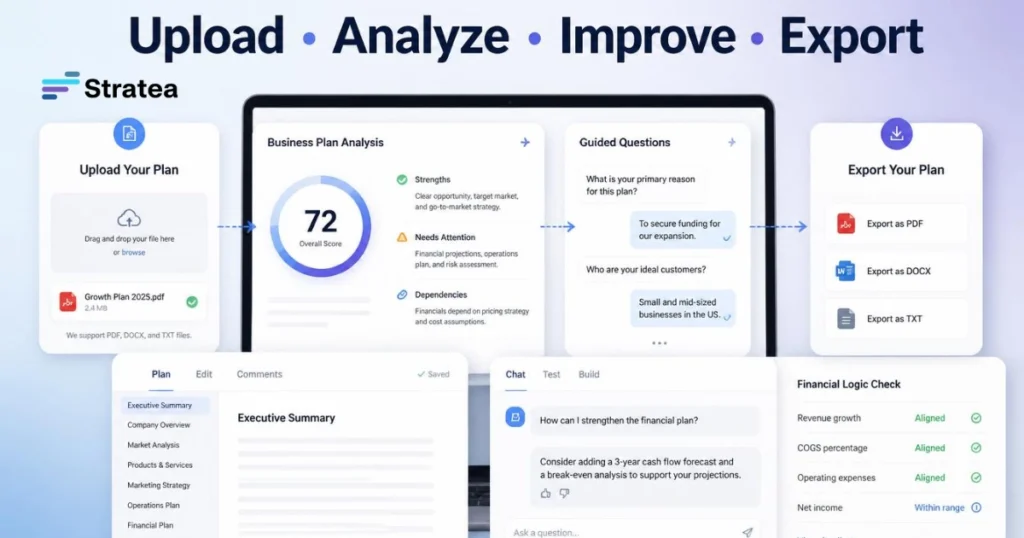
[Your Existing Draft] ──> [STRATEA Guided Discovery] ──> [Identified Logic Gaps] ──> [Defensible Final Plan]
If you have an existing draft, you can bring your notes, outlines, or sections into the STRATEA platform. Rather than running a simple spell check, the platform uses a structured workflow to analyze your inputs and ask the targeted questions a professional advisor would ask.
If your marketing section claims you will acquire hundreds of clients in your first month, the system will guide you through questions about your customer acquisition channels and your operational capacity to support that volume. This process transforms unclear draft text into actionable planning decisions.
STRATEA uses a transparent freemium model. It is free to start your planning journey, allowing you to experience our guided discovery workflow firsthand, while advanced strategic analysis and full project refinement options are available on our paid plans.
If you are preparing a plan for an unexpected business pivot, a commercial bank loan, or an internal strategy review, you can use STRATEA to analyze your structure before you finalize your document.
If you need to ensure your strategy is fully aligned, you can use the STRATEA business plan reviewer features to check your core logic. If you are starting with fragmented notes, exploring the AI business plan generator workspace can help you organize your initial thoughts into a clear, editable structure.
Frequently Asked Questions
What should a thorough business plan analysis look for?
An effective analysis checks for structural alignment across your entire document. It ensures your marketing budget can realistically support your revenue goals, your staffing timeline matches your growth milestones, and your initial funding request covers your pre revenue operational expenses.
How do I know if my market analysis section is strong enough?
A strong market analysis avoids generic national statistics and focuses instead on your specific target market. It should include local demographic trends, direct competitor evaluations, and verified evidence of demand, such as local industry benchmarks or pilot program results.
Can a business plan editor fix a flawed business model?
No. An editor can make your writing clearer and more professional, but it cannot fix an underlying strategic problem, such as an unrealistic pricing model or a lack of real market demand. You must resolve those core structural dependencies before finalizing your document.
How do I check the financial logic of my plan?
Verify that your financial projections match your operational timeline line by line. Your cash flow statement must show cash going out for startup costs, leases, and initial hiring before you record your first customer payment.
Why do lenders reject plans that look professional?
Lenders typically reject professional looking plans because of unrealistic timing assumptions or unverified financial claims. If a plan shows rapid growth without a matching marketing budget or a realistic hiring schedule, the document lacks the strategic credibility required for loan approval.
Build a Defensible Strategy for Your Next Milestone
A great business plan is more than just a collection of polished paragraphs. It is a live blueprint where your marketing choices, operational timelines, and financial realities all work together to support a central strategy.
Instead of spending hours manually cross checking your files or relying on basic text tools that only fix your grammar, bring your current draft into a system built for deep strategic clarity. Bring your draft into STRATEA and turn unclear sections into planning decisions. Let STRATEA help you clarify what needs proof before your plan reaches a reviewer.
Start Strategic Discovery with STRATEA today and build a structured, cohesive business plan you can confidently defend.