
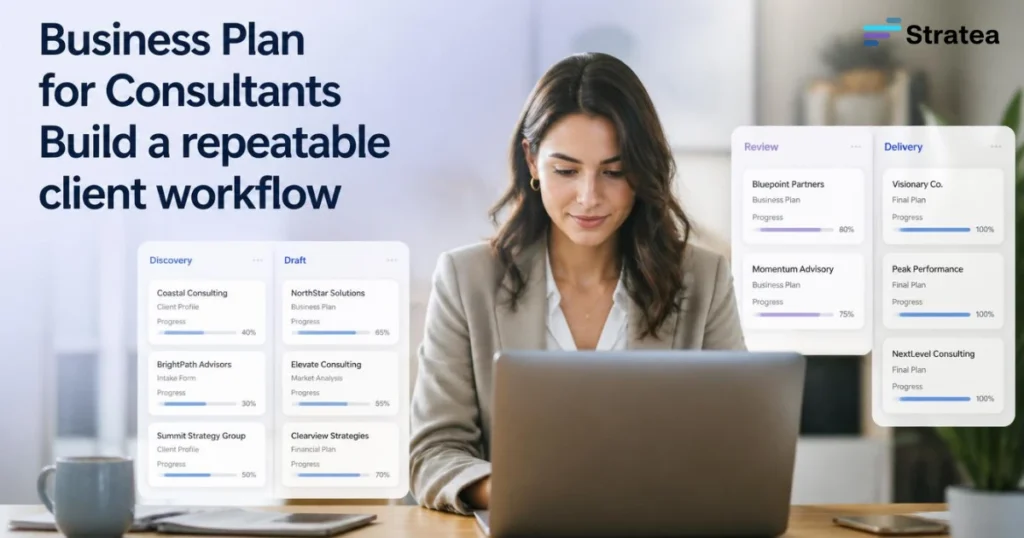
A business plan for consultants isn’t about writing a single document. It’s about building a repeatable, quality-controlled service that scales across multiple clients, industries, and plan types. A consultant creating business plans for clients needs standardized intake, organized assumption tracking, clear review protocols, and delivery workflows that produce defensible plans clients can confidently present to lenders, investors, or partners.
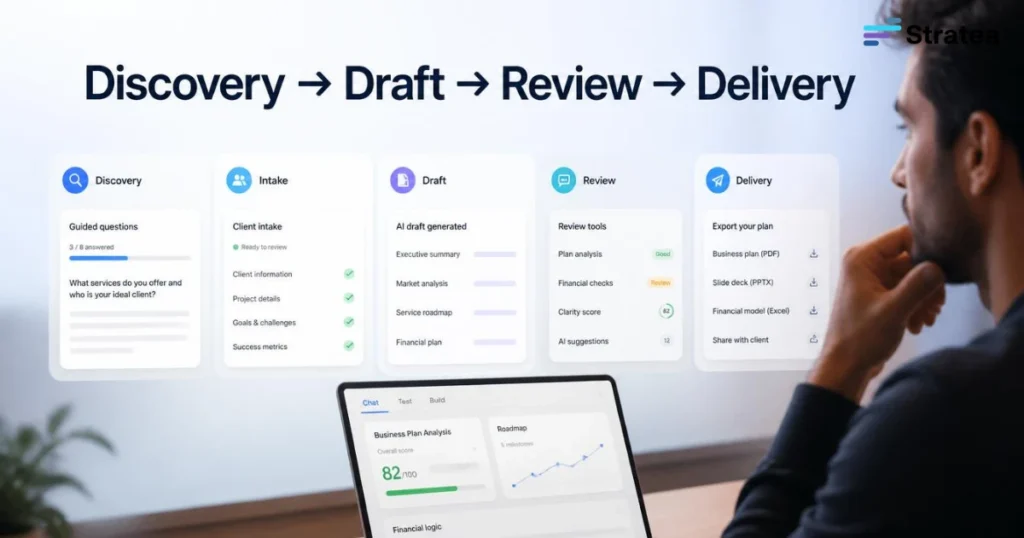
Most consultants start out managing one or two business plan clients, often adapting a template or rebuilding from scratch for each engagement. As the practice grows, that approach breaks down. Each client requires discovery conversations, assumption documentation, section-by-section reviews, iteration cycles, and final delivery, and without a system in place, consultant time balloons, quality varies, and scaling becomes impossible. This is where pairing structured intake with an AI business plan changes the economics of the practice: instead of rebuilding financial models and narrative sections from scratch for every engagement, consultants can standardize the first draft while still guiding clients through the assumption-building conversations that make a plan defensible, not just generated.
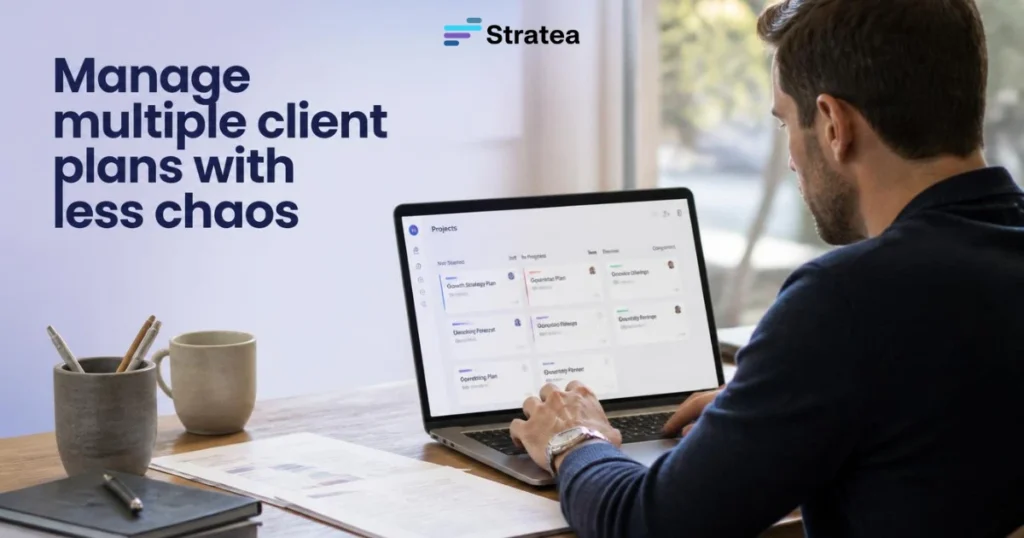
Why Consultants Need More Than One-Off Plans
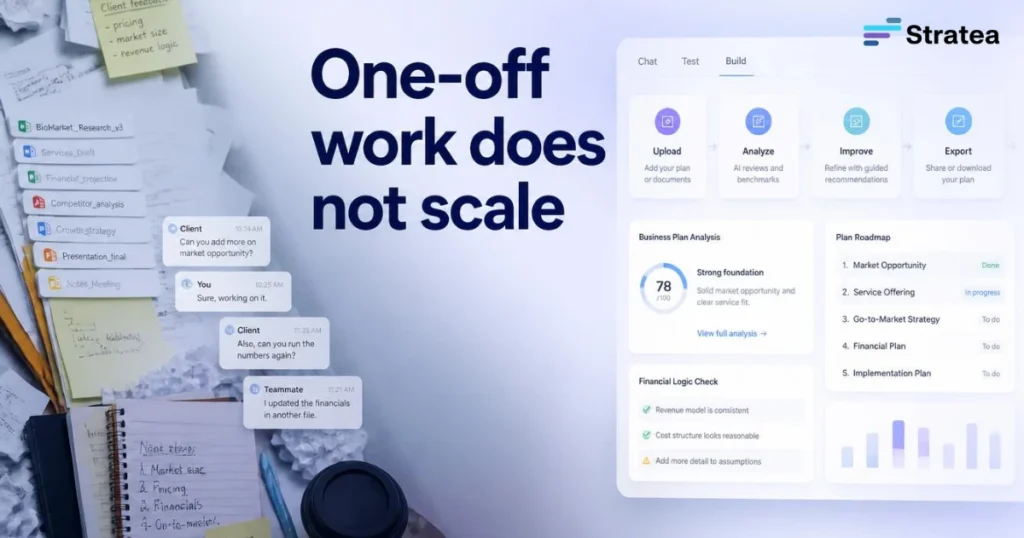
Many consultants start with a single client business plan. They conduct discovery conversations, organize findings into a draft, iterate with the client, and deliver a finished plan. It works. The client is satisfied. Then a second client comes in, and the consultant repeats the process.
This works fine for a one or two clients per year. It breaks down when you’re managing five, eight, or ten concurrent client engagements.
Here’s what happens. Each client comes with different assumptions, different industries, different funding needs (SBA loan vs venture vs commercial credit vs E-2 visa). Without a system, the consultant is starting from scratch each time. Different spreadsheets for financials. Different organizational schemes for assumptions. Different review checklists. Different client communication workflows.
Time compounds. A client calls with a question about market size assumptions. The consultant has to find that assumption in the client’s discovery notes or the draft. A client wants to revise the go-to-market strategy. The consultant has to rework that section and check for downstream dependencies. An investor asks for three alternative scenarios. The consultant has to rebuild the financial model three ways.
None of this is insurmountable for one client. For ten clients across concurrent engagements, it becomes unsustainable.
A repeatable business plan process solves this. Standardized intake means every client goes through the same discovery questions in roughly the same order. Organized assumptions mean you know exactly where each assumption lives and which sections depend on it. Clear review protocols mean you catch gaps before the client sees them. Documented client communication workflows mean you don’t repeat the same feedback loop five times.
Scaling isn’t just about doing more work. It’s about doing the same work consistently.
The Core Elements of a Consultant-Ready Business Plan
A consultant-ready business plan has specific characteristics that make it easy to review, improve, and deliver.
Clear assumption documentation. Every number in the plan traces back to a specific assumption. Customer acquisition cost comes from a validated number, not a guess. Market size is the addressable market the consultant and client agreed on, not an industry report. Revenue projections come from unit economics the client has tested, not an AI-generated curve. When a client says “defend that number,” the consultant can point to the documented assumption.
Organized section structure. Standard sections in a logical order means the consultant can apply the same review process across different clients. Executive summary, problem, solution, market opportunity, business model, traction, go-to-market, financial projections, team, funding ask, appendix. This order works for SBA loans, venture pitches, visa applications, and partnership proposals. The consultant knows where to look for each type of information.
Editable, not static. The plan should be a working document, not a finalized output. The consultant and client iterate. Market sizing changes based on new research. Go-to-market strategy shifts after client conversations. Financial projections update as the business evolves. A consultant-ready plan allows edits without losing structure, assumptions, or reference information.
Traceability and versioning. When a client says “remember when we discussed pricing strategy three weeks ago?”, the consultant needs to find that conversation. Version control means you know what changed between draft one and draft two. Comments or notes preserve the reasoning behind each assumption. This is especially important for compliance-sensitive plans (E-2 visa, SBA loan) where reviewers need to understand not just the numbers but the logic behind them.
Client-ready formatting. The consultant needs to export the plan in formats clients will actually use: Word documents for loan applications, PDFs for investor presentations, sometimes slides or spreadsheet breakdowns for specific reviews. The formatting should be professional without requiring the consultant to spend hours reformatting.
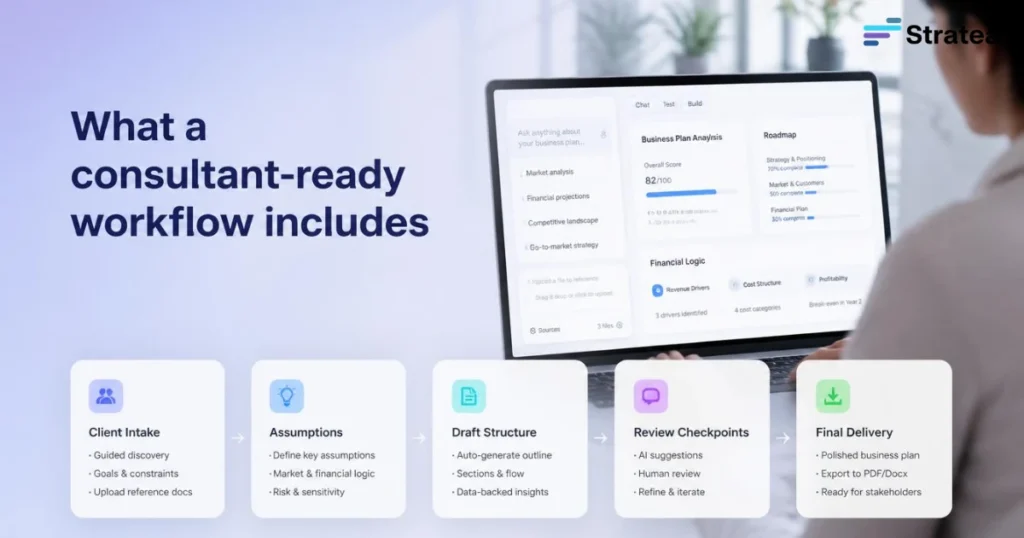
Building a Repeatable Discovery and Intake Process
The discovery phase sets the foundation for everything that follows. Structured discovery means the consultant asks the right questions, the client gives consistent answers, and the consultant captures assumptions in a format that feeds directly into the plan.
Standardized Client Intake
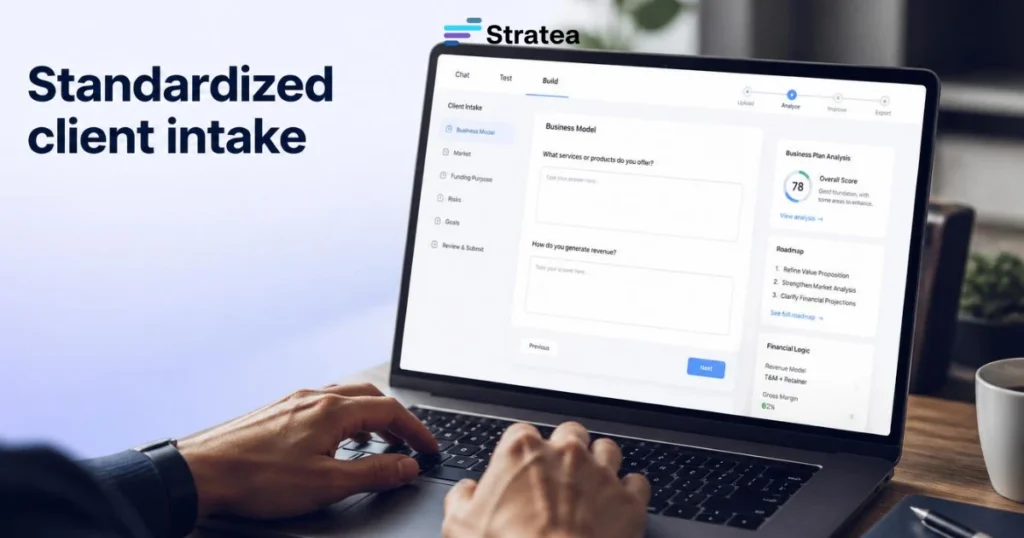
Every new client should answer a standard set of intake questions. Business description, founder background, target market, initial traction or evidence, funding needs, timeline, and reviewer expectations. This takes 30-60 minutes and produces consistent information the consultant can organize.
A consultant running multiple concurrent clients needs consistency. Client A says their target market is “small businesses.” Client B says “mid-market manufacturers in the Southeast.” Standardized questions elicit specificity. Instead of “who is your target customer?”, ask “describe the three ideal customers you’d like to land in the first year. What do they do, what’s their size, what problem are they willing to pay to solve?”
Intake should also surface reviewer expectations early. Is this for a bank? An investor? A visa application? A potential business partner? Different reviewers care about different things. A bank wants unit economics and collateral. An investor wants market size and growth potential. A visa officer wants employment numbers and realistic feasibility. A consultant who knows this upfront can tailor the plan from discovery forward.
Organized Assumption Documentation
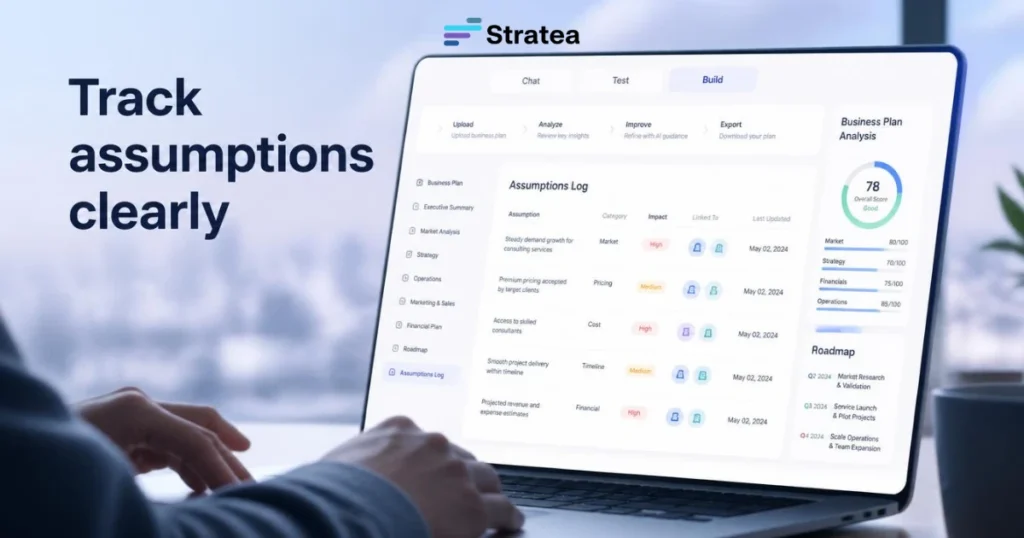
As the consultant and client have discovery conversations, assumptions need to be captured in a structured format. Not buried in meeting notes. Organized in a way the consultant can reference, verify, and trace into the plan.
A simple format works: Assumption name, source/evidence, value, confidence level, dependencies. For example:
- Assumption: Average customer acquisition cost for B2B is $500
- Source: Two pilot customers cost $400 and $600 to acquire; average is $500
- Value: $500
- Confidence: Medium (based on two data points, not dozens)
- Dependencies: Monthly revenue projection (if CAC changes to $750, revenue timeline shifts by 3 months)
This format means the consultant can see exactly where each number comes from, how confident the client should be, and what downstream implications it has. When a client says “we’re too conservative on CAC,” the consultant can discuss raising it from $500 to $600 and show the client what that means for the financial timeline.
Structured Conversation Guides
Rather than free-form notes, the consultant should have conversation guides for different sections. One guide for business model conversations (unit economics, pricing, customer lifetime value). One for go-to-market (customer acquisition channels, conversion rates, sales cycle). One for team and execution (founder background, key hires, organizational structure).
These guides ensure the consultant asks the same foundational questions for every client. The client gets to answer in their own way, but the consultant captures comparable information. This makes the review process faster and the plan more consistent.

Quality Control and Review Checkpoints
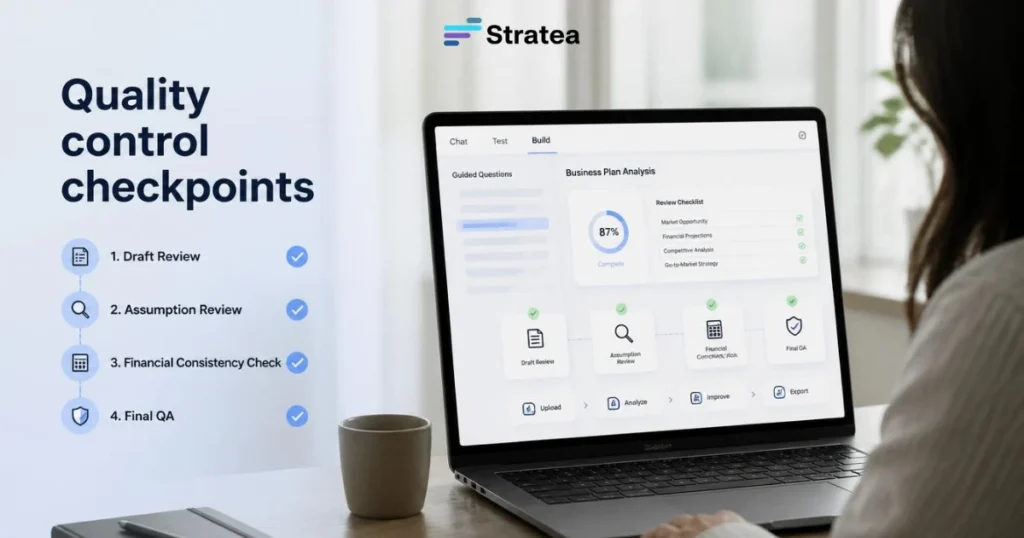
A repeatable business plan process has built-in review checkpoints. These catch gaps before the client sees them and ensure every plan meets the same quality bar.
Internal consistency check. Do all the assumptions connect logically? If the client says they’ll acquire 100 customers in year one at $500 CAC, that’s $50,000 in customer acquisition spending. Is that in the budget? If the market is only 500 customers total, is year-two growth realistic? A checklist of logical dependencies catches these mismatches.
Completeness check. Does the plan include all sections a reviewer would expect? Is financial data realistic and detailed? Is traction documented with specific numbers? Is the go-to-market strategy concrete or generic? A consultant reviewing 10 concurrent plans needs a standard checklist, not subjective judgment each time.
Assumption confidence check. Are assumptions validated or guesses? Is the client claiming 50% market penetration without explaining why competitors won’t prevent it? Did they test pricing with real customers or estimate it? The consultant’s job is to push on weak assumptions before a reviewer does.
External readiness check. Who will review this plan? A bank has different concerns than an investor. A visa officer has different concerns than a business partner. The consultant should tailor the plan and level of detail based on the reviewer. A bank wants detailed operating costs and cash flow. An investor wants market opportunity and competitive positioning. A visa officer wants job creation projections and founder background.
Worked Example: Bookstore Consultant Managing Online Expansion
The Client Situation
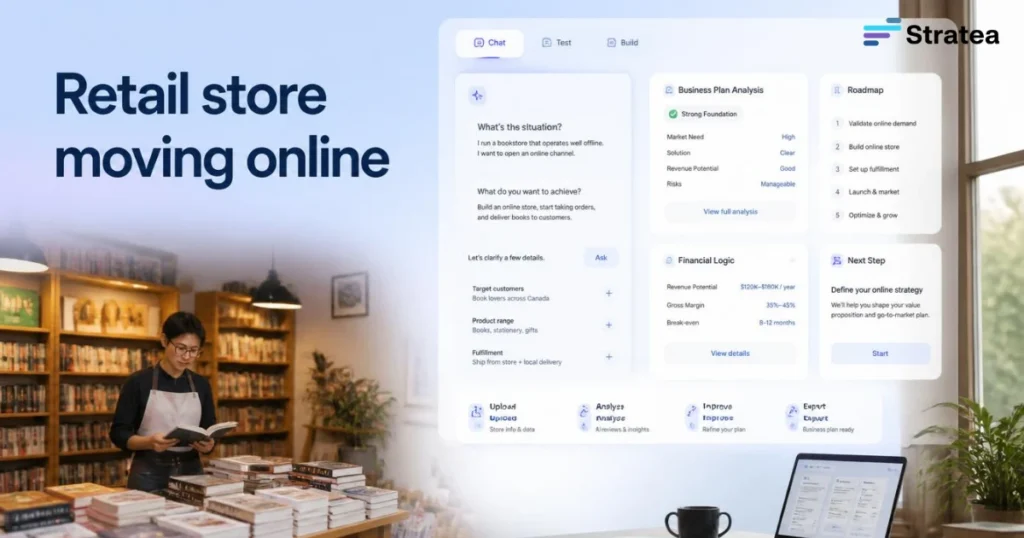
Sarah runs an independent bookstore in Portland. She’s been profitable for seven years with $500,000 annual revenue from foot traffic and local events. She wants to add online sales to reach national customers. She’s also looking for a small business loan to fund inventory expansion and a website upgrade. She needs a business plan for the bank application, and she’s never written one before.
She found a business planning consultant, Yuki, who specializes in retail and e-commerce. Yuki manages about eight concurrent client plans at various stages, ranging from loan applications to investment pitches to franchise documentation.
The Consultant’s Process
Yuki’s first step is intake. She spends 45 minutes with Sarah, asking standardized questions about business model, current traction, expansion goals, target market, and funding timeline. Sarah says she wants to be generating $100,000 annual revenue from online sales by the end of year two, with a $40,000 loan to fund the expansion.
Yuki recognizes that a $40,000 loan to generate $100,000 revenue requires specific unit economics. She asks: “What’s your gross margin on a book sold online? What percentage of visitors to your website will buy? What will your marketing spend be?” Sarah doesn’t have exact numbers yet. That’s fine. That’s what discovery is for.
Yuki schedules three follow-up conversations: one on financial model (CAC, conversion rates, shipping costs, margin), one on go-to-market (website, email, social, paid ads, content), and one on execution (hiring, partnerships, timeline).
During the financial conversation, Yuki walks Sarah through unit economics. An online book sale generates similar margin to in-store (around 40%, or about $6 per book). To hit $100,000 revenue in year two, Sarah needs to sell about 2,800 books online (assuming $35 average sale). That’s about 230 books per month by year two. With 3% conversion rate on website visits, she needs about 7,700 monthly visits by year two. She’s currently getting 200 monthly visits to her website (mostly from local search). She needs to grow traffic by 38x.
That’s not impossible, but it’s ambitious. Yuki documents this assumption: “Year two online revenue target of $100,000 assumes 230 monthly sales, 40% margin, $35 average sale, and 3% conversion rate.” This becomes a line-item assumption Yuki can stress-test.
In the go-to-market conversation, Sarah says she’ll use email (she has 3,000 email subscribers from in-store events), paid social ads ($500/month budget), and partnerships with book clubs and online communities. Yuki asks her to estimate customer acquisition cost from each channel. Email is nearly free (existing audience). Paid ads might cost $20-30 per customer. Partnerships might be free initially but slow to ramp. Yuki documents these assumptions too.
After three conversations, Yuki has structured information about Sarah’s business model, expansion strategy, unit economics, and go-to-market approach. She also has concrete assumptions documented: CAC by channel, conversion rates, shipping costs, timeline milestones.
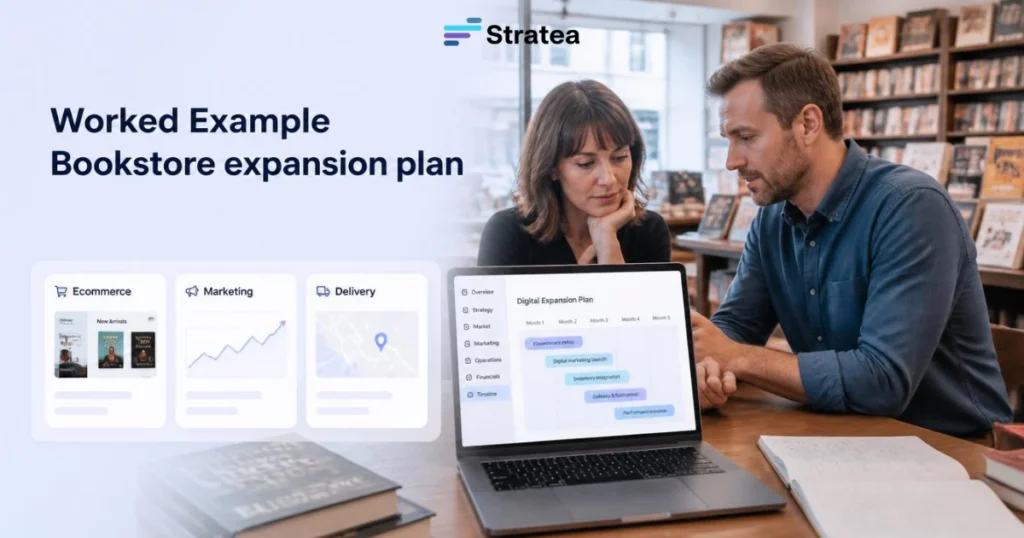
Yuki then drafts the plan. She uses her standard structure: executive summary, current business overview, expansion opportunity, financial model (with detailed assumptions), go-to-market strategy, team and execution, use of funds, and appendix with supporting data.
For the financial projections, Yuki builds conservative scenarios. Base case (Sarah hits targets), pessimistic case (she gets 70% of target traffic), and optimistic case (she exceeds expectations). The bank wants to see that Sarah can service the loan even if growth is slower than projected. Yuki’s base case shows profitability in year two. Her pessimistic case shows profitability in year three. She documents the difference: “The pessimistic case assumes $1,000/month marketing spend instead of $500, requiring an additional six months to reach profitability.”
Delivering a Client-Ready Plan
Yuki sends Sarah a draft for review. Sarah reads it, notices that Yuki used “book lovers” as a market description, and asks: “Can you be more specific about who’s actually buying from independent bookstores online?”
Yuki revises. She and Sarah discuss the specific customer segments: college students, book club members, authors’ family networks, specialty readers (sci-fi, romance, rare books). Yuki updates the market opportunity section to reflect this more specific positioning.
Sarah also realizes she understated her inventory expansion need. Her loan request was $40,000, but after reviewing the financial model, she sees she actually needs $55,000 to hit her targets without depleting cash flow. Yuki updates the use of funds section and the financial model, showing month-by-month cash position with a $55,000 loan. This is important—the bank needs to see that Sarah isn’t underestimating her capital needs.
Two weeks later, Yuki delivers the final plan: a 15-page Word document with executive summary, detailed sections on current business and expansion strategy, a two-year financial model with assumptions clearly documented, go-to-market timeline with specific action items, team information, use of funds, and a detailed appendix with market sizing calculations and supporting documentation.
Sarah presents this to her bank. The loan officer reviews it, sees clear financial assumptions, unit economics that make sense, and a realistic timeline. She approves the $55,000 line of credit.
Scaling: From One-Off Engagements to Repeatable Service
A consultant managing one business plan engagement per month can do it ad hoc. A consultant managing eight concurrent engagements needs systems.
Scaling requires three things: standardized intake so every client goes through the same discovery process, organized assumptions so information is accessible and traceable, and repeatable review so every plan meets the same quality bar.
It also requires managing concurrent workflows. When you have eight clients at different stages (one in discovery, three being drafted, two in revision, one ready to deliver, one pending client feedback), you need clear project management. Who’s waiting on what? Which client needs a follow-up conversation? Which draft is due for review? Spreadsheets work, but project management software helps.
The scaling question consultants often ask is: do I hire a team, use software, or both? Hiring a junior consultant can work if you have enough volume and training capacity. Software helps standardize and organize regardless of team size. A consultant managing eight clients benefits from both, but software solves the scalability problem more directly than hiring.
FAQ
Q: How do I standardize my business plan process without losing flexibility for different industries?
A: Use standardized intake and discovery questions, but let client answers vary. Ask “What is your customer acquisition cost for your primary channel?” rather than “How much will customer acquisition cost?” Every business needs CAC. The answer is different for B2B services, e-commerce, local services, and SaaS. The question standardizes the thinking. The client’s answer provides flexibility.
Q: What review checkpoints should I use for every client plan?
A: At minimum, check three things: (1) Are assumptions internally consistent? (2) Are they grounded in evidence or just guesses? (3) Does the plan include what the reviewer (banker, investor, visa officer) will actually ask about? A standard checklist for each review type (SBA loan, venture pitch, E-2 visa) helps you maintain quality across clients.
Q: Should I include financial scenarios (pessimistic, base, optimistic) for all plans?
A: It depends on the reviewer and client sophistication. Banks appreciate conservative scenarios because they want to see the loan gets repaid even if growth is slower. Investors want to see upside scenarios. Visa officers want realistic feasibility. Ask yourself: what will the reviewer want to see? Then include the scenarios that matter.
Q: How do I handle a client who disagrees with my assumptions?
A: That’s a discovery conversation, not a sign you’re wrong. Ask: Where did you get that number? What evidence supports it? Have you tested it? If the client’s number is higher than your estimate, ask them to explain the reasoning. If it’s grounded in evidence, use their number. If it’s a guess, document it as such. Either way, you’re building transparency that a reviewer will appreciate.
Q: Can I use STRATEA to manage multiple client plans at once?
A: STRATEA is designed for one plan at a time (one user, one business plan). For managing multiple concurrent client engagements, you’d use STRATEA for each client separately, then use your own project management system to track which clients are in discovery, which need review, which are ready for delivery. This is common for consultants managing 5-10 concurrent plans.
Q: What should I do if a client wants to skip the discovery process and just use a template?
A: Explain why discovery matters. A template without discovery produces generic assumptions that don’t reflect the client’s specific business. A reviewer will ask questions the template doesn’t answer. Discovery is where you ensure the plan is realistic and defensible. If a client is really constrained on time or budget, do a shortened discovery (key questions only) rather than none. But skipping discovery creates risk.
Next Steps
Building a consultant business around business planning requires more than a good template. It requires a repeatable discovery process, organized assumption tracking, clear review protocols, and client collaboration workflows.
STRATEA’s guided discovery process is built for exactly this. Rather than asking you to fill in a template, it guides you and your client through structured questions, captures assumptions in an organized way, and produces a plan that’s editable and defensible across your concurrent client engagements.
Start Strategic Discovery with STRATEA to build the foundation for your consulting practice. Use it to scale from one-off plans to a repeatable service that maintains quality and consistency as your client base grows.
STRATEA is free to start. Bring your first client and test the process. See how structured discovery compares to your current approach.