
You already have a business plan. The problem is, it doesn’t feel ready, and “improve my business plan” is sitting near the top of your to-do list.
Maybe a generator produced a clean draft in two minutes, and now you’re staring at confident-sounding paragraphs you couldn’t defend if someone pushed back. Maybe you wrote it yourself months ago and the business has moved on. Or maybe a lender, an investor, or a potential partner read it and came away unconvinced, and you’re not entirely sure why.
Improving a business plan is a different job from writing one. You’re not filling a blank page; you’re finding the weak joints in something that already exists, and then making the logic hold up under scrutiny. That means deciding which sections are actually load-bearing, where your assumptions are quietly invented, plus whether the numbers trace back to something real.
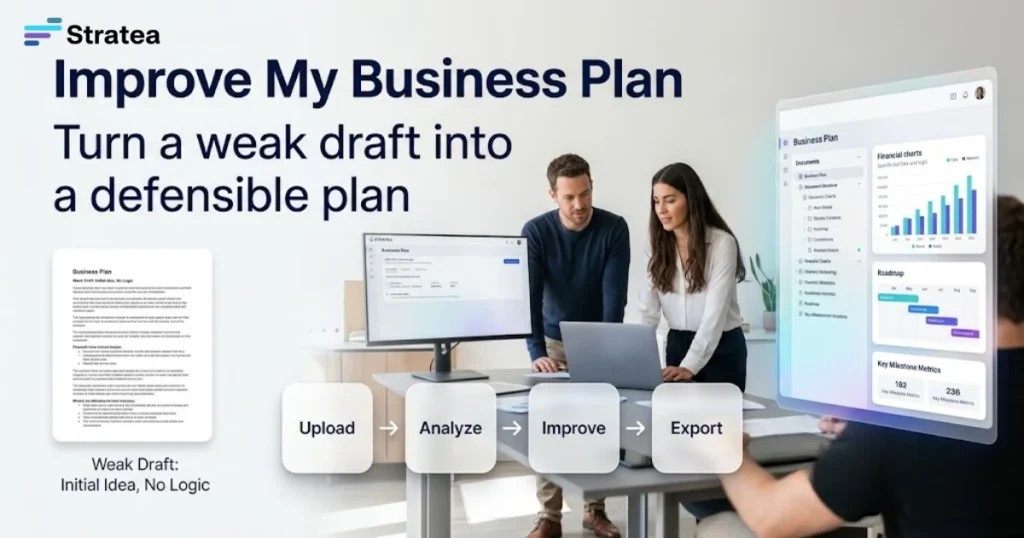
This guide walks through how to audit your current plan, fix the sections that fail under questioning, and tighten the financials, with a worked example. An AI business plan generator like STRATEA can accelerate the heavy lifting, but the decisions that make a plan defensible still come from you.
What it really means when you say “improve my business plan”
Most people think “improve” means “add more.” More pages, more market data, more polished language. In practice, the opposite is usually true. A strong plan is not the longest one; it’s the one where every claim can survive a hard question.
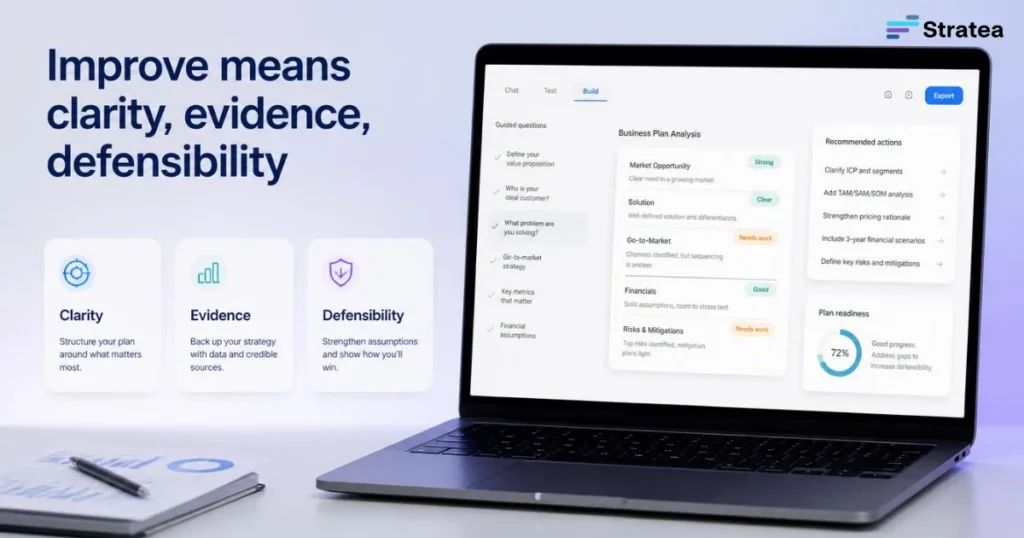
When founders say “improve my business plan,” it usually comes down to three things:
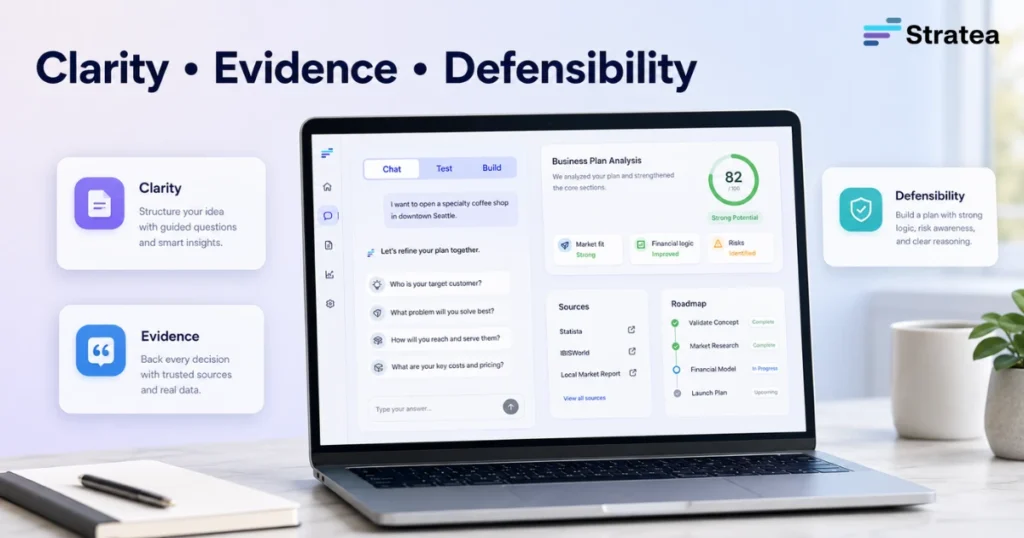
- Clarity. Can a stranger read it and understand who you serve, how you make money, and why now, without you in the room to explain?
- Evidence. Does each major claim connect to something real: a customer conversation, a pricing check, a competitor’s actual behavior?
- Defensibility. When someone challenges your pricing, your customer acquisition cost, or your revenue projection, can you trace the answer back to a visible assumption?
A plan that reads well but collapses under the first tough question isn’t improved by better adjectives. It’s improved by better decisions made visible.
Step 1: Diagnose what’s actually wrong
Before you touch a single section, read your plan the way a skeptical lender or investor would, someone with no reason to believe you and a stack of other plans on their desk. The goal is to find where it loses credibility, not to admire what’s already there.
Most weak plans fail in a predictable set of places. Score yours honestly against each one:
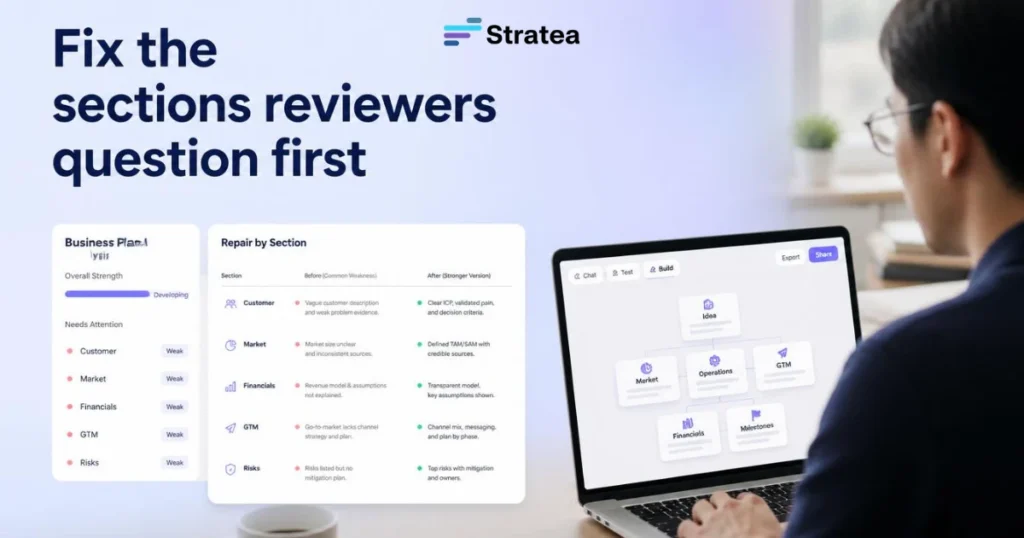
- The customer is too broad. If your plan says you serve “small businesses” or “anyone who needs consulting,” you don’t have a market, you have a wish. Vague customers produce vague everything else.
- The market section is borrowed, not relevant. A huge industry statistic pasted from a report proves nothing about whether your specific buyer will pay you. Big-market claims are the most common filler in AI-generated drafts.
- The financials don’t trace to anything. If the plan states a revenue figure but you can’t break it into price × volume × conversion, the number is decoration.
- The go-to-market is a list of channels, not a strategy. “Social media, SEO, and partnerships” names categories. It doesn’t explain how a real customer finds you and decides to buy.
- Risks are missing. A plan with no acknowledged risks doesn’t look confident. It looks unfinished, or naïve.
Write down which of these apply to your draft. That list is your improvement roadmap. Everything that follows is about closing those specific gaps.
Step 2: Strengthen the sections that fail under questioning
Once you know where the plan is weak, fix the load-bearing sections in order of how much damage they do. These are the ones reviewers probe first.
Sharpen the customer and the problem
Start here, because almost every other section inherits this decision. Replace any broad audience with a specific first customer and the exact problem you solve for them. “We help businesses grow” becomes “We help independent dental practices fill last-minute cancellations through automated waitlist booking.” The narrower version makes your pricing, marketing, and operations suddenly easy to write.
Connect the market section to your actual buyer
Cut industry statistics that don’t change a decision. Replace them with evidence tied to your specific customer: what they use today, what it costs them, what they complain about, and how your direct and indirect competitors price. If a competitor charges $180 and you plan to charge $95, the improved plan explains exactly how your margins survive. It doesn’t hope no one notices.
Rebuild the financials from behavior, not from a target
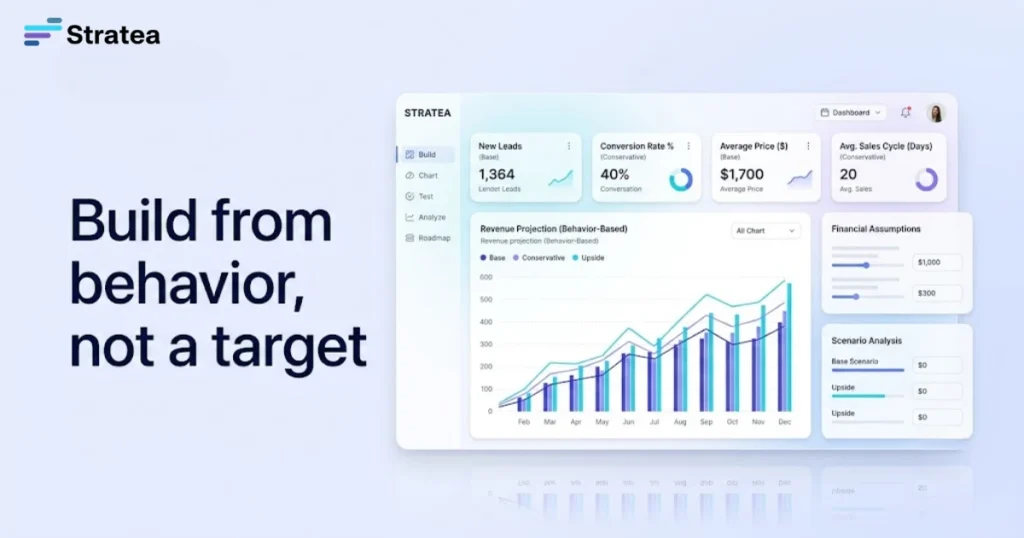
Weak plans start at a desired number ($50K/month) and reverse-engineer backward. Strong plans build up from behavior: how many leads you can realistically reach, your conversion rate, your price, and your sales cycle. When the math is built bottom-up, every figure traces to an assumption you can name and defend, which is the entire point.
Turn the go-to-market into a real path
Replace the channel list with a sequence a customer actually travels: how they discover you, what makes them trust you, and what triggers the purchase. If you rely on paid acquisition, put a customer acquisition cost assumption in writing. A reviewer trusts a specific, even imperfect, path far more than a confident buzzword.
Name your risks before someone names them for you
Add a short, honest section on what could go wrong and how you’d respond: competition, slow sales cycles, key-person dependence, and cash timing. Naming a risk and your mitigation reads as maturity, while pretending none exist reads as a gap the reviewer will happily fill in for you.
A worked example: improving the Urban Brew plan
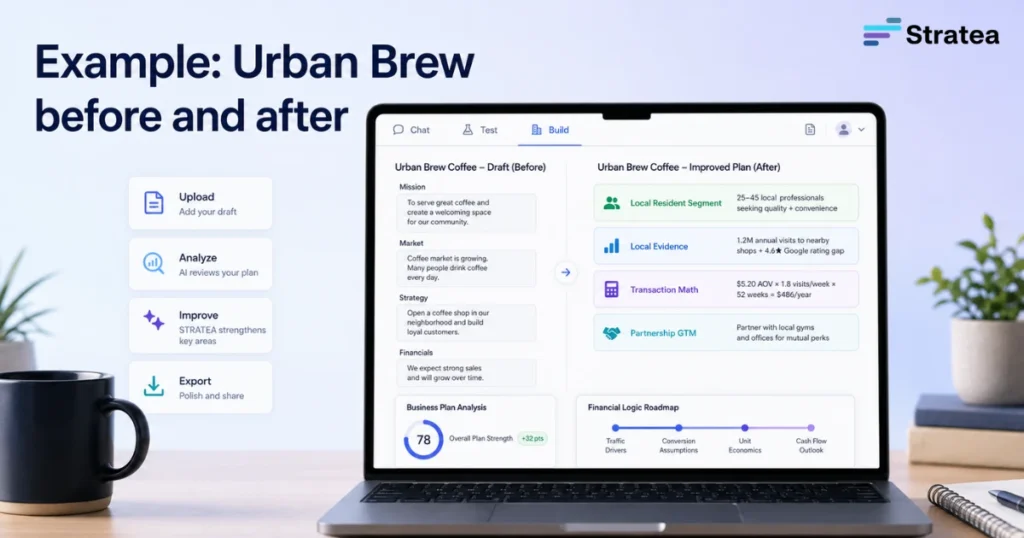
Here’s how this looks in practice. Imagine a first draft for Urban Brew, a neighborhood coffee shop, generated in a couple of minutes. The original reads cleanly but defends nothing:
“Urban Brew will serve high-quality coffee to the local community. The global coffee market is worth over $100 billion and growing. We will use social media to attract customers and expect to reach $40,000 in monthly revenue within the first year.”
Every sentence is the kind of thing a banker has read a hundred times. Now improve it section by section:
- Customer. Not “the local community,” but remote workers and students within a four-block radius who currently leave the area to find reliable wifi and a quiet seat between 9am and 2pm.
- Market. Drop the $100 billion figure entirely. Replace it with three real data points: 1,200 apartments within walking distance, two competitors that both close their seating at noon, and a six-month wait for the nearest co-working space.
- Financials. Not “$40,000/month” pulled from the air, but a build-up: 130 transactions a day × $9 average ticket × 26 trading days ≈ $30,400, with the assumptions stated so a lender can pressure-test each one.
- Go-to-market. Not “social media,” but a partnership with three nearby apartment buildings to include a first-week voucher in move-in packets, plus a midday loyalty offer aimed squarely at the wifi-seeking worker.
Same business, same length. The difference is that the second version can be defended line by line, which is exactly what “improved” means.
Editing yourself vs. a chatbot vs. an AI Planning Assistant
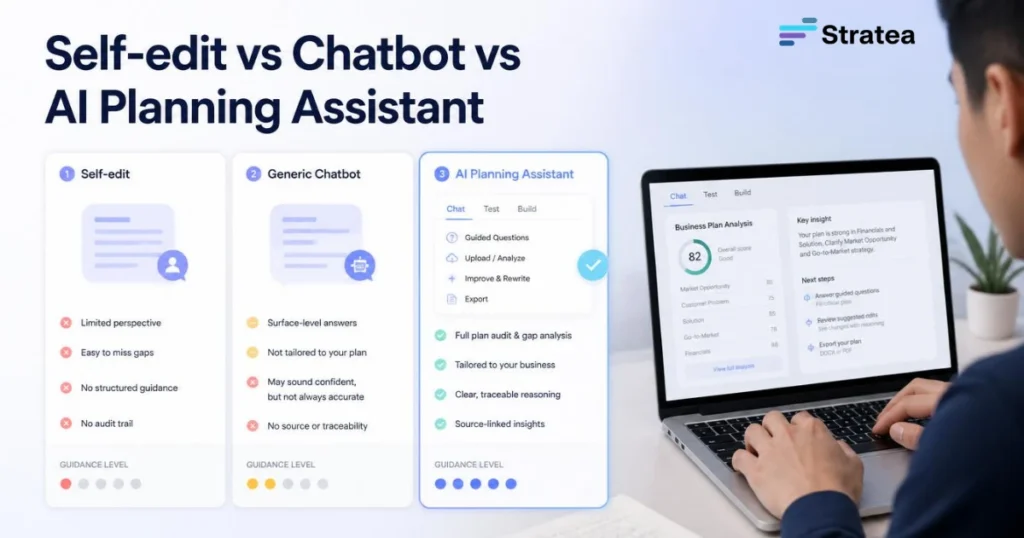
When founders set out to improve a plan, they usually reach for one of three approaches. Each solves a different part of the problem.
| Approach | Best for | Main limitation |
|---|---|---|
| Editing it yourself | Founders who already know exactly which assumptions are weak. | Easy to keep polishing wording while leaving the underlying logic untouched. |
| Generic AI chatbot | Quickly rewriting clunky paragraphs and reorganizing notes. | Improves the prose, not the strategy, and may invent data to fill gaps. |
| STRATEA AI Planning Assistant | Auditing an existing plan and rebuilding weak sections with traceable logic. | Requires honest input and human review for the strongest result. |
Have a draft already? Use STRATEA to audit it and find the weak assumptions first, before you rewrite a single line.
How STRATEA helps you improve an existing plan
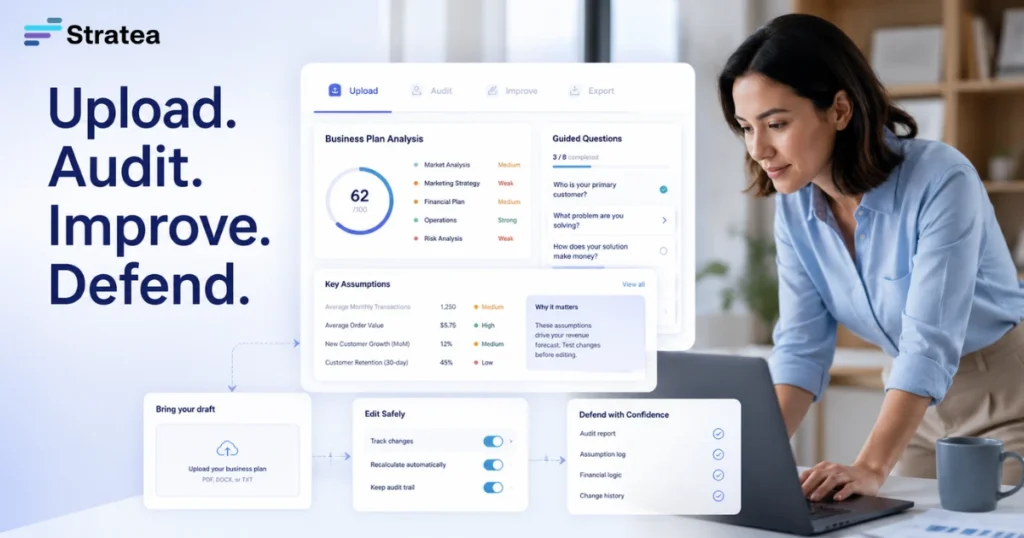
STRATEA isn’t only for starting from scratch. It’s built to take a plan you already have and make it more defensible, working through it the way a good consultant would: methodically, section by section, without quietly rewriting the parts that already work.
- Bring in your draft. Start from your existing plan or messy notes instead of an empty page, so you keep the thinking you’ve already done.
- Audit section by section. STRATEA reads through the plan and flags the weak joints: vague customers, borrowed market claims, and financials that don’t trace to assumptions.
- Rebuild through guided questions. Rather than a one-click rewrite, it asks the hard questions that force a stronger answer, so the improved version reflects your decisions.
- Keep your assumptions visible. Each number stays connected to the inputs behind it, so you can trace a projection back to price, volume, and conversion when someone asks.
- Edit without breaking the rest. Strengthen one section at a time while the sections that already hold up stay intact.
The result is a plan you can hand to a lender, an investor, or a partner and stand behind, not because it sounds confident, but because the logic is visible and holds.
Turn your current draft into a plan you can defend. Improve your business plan with STRATEA.
Who should put a plan through this kind of improvement?
- Founders with a generated first draft. You got a fast, structured starting point , and now it needs the decisions and evidence that survive real questions.
- Small business owners applying for a loan. Lenders scrutinize cash flow, repayment ability, and realistic costs far more than polished prose.
- Teams preparing for investors. An investor-ready plan stands on unit economics, traction, and growth logic you can defend in the room.
- Consultants and agencies. When a client hands over a fragmented draft, a structured audit turns it into a robust final product faster.
Frequently Asked Questions
How do I know if my business plan is weak?
Read it as a skeptic with no reason to believe you. If you can’t trace your revenue numbers back to price and volume, your customer is described as “everyone,” or your market section leans on broad industry stats instead of your specific buyer, the plan needs work. A weak plan sounds confident but can’t survive a follow-up question.
Can AI improve a business plan I already wrote?
Yes, and that’s often where AI is most useful. It can read an existing draft, reorganize messy sections, and surface gaps quickly. The important caveat is that AI should expose weak assumptions for you to fix, not invent data to paper over them. The strategic decisions still have to be yours.
Should I make my business plan longer to improve it?
Usually not. Length rarely correlates with quality. A plan improves when each claim becomes more specific and better supported, which often means cutting filler such as generic market statistics, buzzwords, and padding, rather than adding pages.
How often should I update my business plan?
Treat it as a living document. Revisit it whenever reality challenges your assumptions: after your first handful of sales, a shift in the market, a jump in costs, or before any conversation with a lender or investor.
Will improving my plan guarantee loan or investor approval?
No tool can guarantee that. A stronger, more defensible plan improves how clearly you present your business and how well you can answer hard questions, but lenders and investors weigh many factors. Always verify specific financial, legal, and immigration requirements with qualified professionals.
Start improving your business plan with STRATEA
A polished draft can give you false confidence. A defensible plan gives you something better: the ability to explain your business clearly, show where the numbers come from, and answer the hard questions before someone else asks them.
Find the weak sections. Rebuild them with real evidence. Keep your assumptions visible. That’s what turns a plan that merely reads well into one you can stand behind.
Improve your business plan with STRATEA today.