
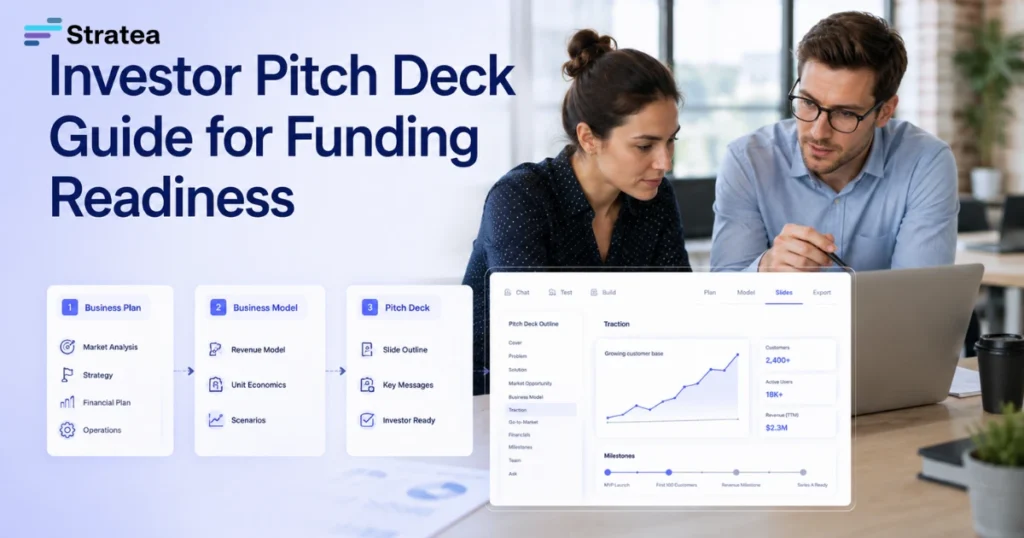
An investor pitch deck is a concise presentation that explains why a business deserves an investor’s attention. A compelling deck does more than look polished – it gives investors a clear, credible case to explore further. With STRATEA, founders can clarify the planning logic behind the slides before presenting their opportunity.
An effective deck connects the problem, business model, target market, traction, unit economics, funding request, growth strategy, and key milestones. Each element should support the same central argument: the business understands its opportunity, has a practical plan to execute, and knows how investment will create measurable progress.
The slides may open the conversation, but the underlying business plan keeps it moving. Pressure-testing assumptions before building the deck helps founders answer the questions investors will ask next – and present their opportunity with greater clarity and confidence.

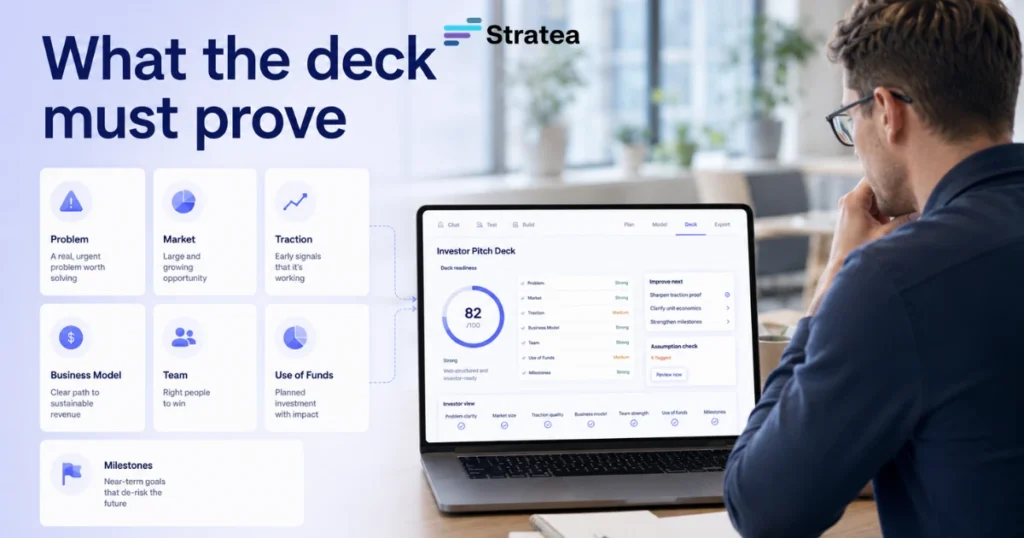
What an investor pitch deck has to prove
A useful deck does not answer every possible question. It gives investors enough clarity to decide whether the opportunity deserves more time. The deeper answers should live in your business plan, model, data room or follow-up materials.
YC’s seed deck guidance emphasizes clear slides that explain the company, problem, solution, market, traction, business model and team. DocSend’s fundraising research also points to investor attention on the connection between traction and monetization, especially when business model clarity is weak.
A deck is not the whole funding case
Founders often treat the deck as the main product. Investors usually treat it as a filter. They want to know whether your story holds together when they ask harder questions.
A strong deck should make a reader think, “This founder understands the business, the market and the next proof points.” It should not make them think, “This founder found a nice template.”
Definitions founders should separate
A pitch deck is the presentation used to introduce the funding story. A business plan explains how the company operates, sells, spends, hires and grows. Financial projections translate that plan into numbers.
Funding readiness is the state where the founder can explain the market, traction, unit economics, risks, use of funds and milestones without relying on vague claims. This is where many decks fail. The slides look complete, but the reasoning underneath is thin.
Why a business plan matters before the deck
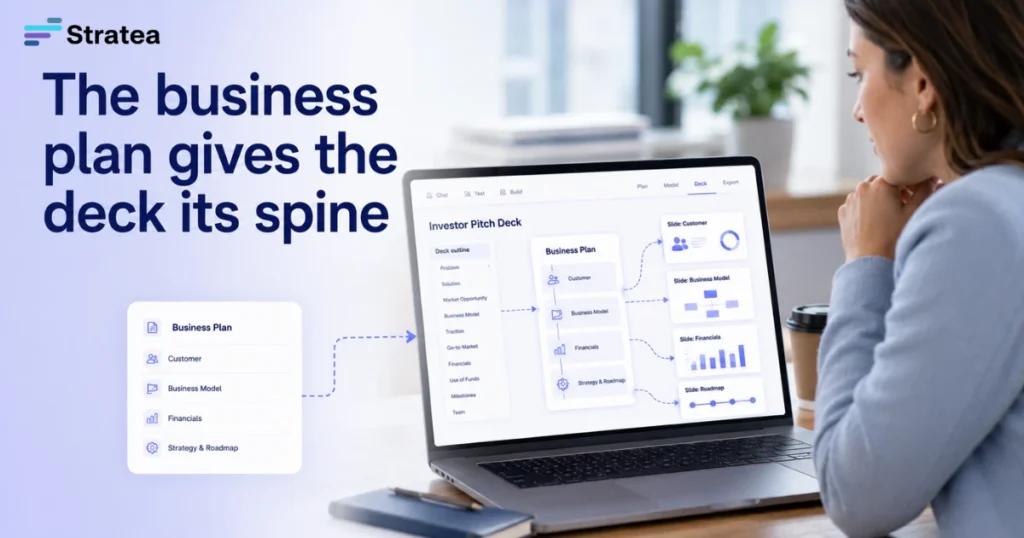
The business plan gives the deck its spine. Without it, the deck can become a collection of claims: large market, big vision, great product, strong team. Those claims only matter when they are backed by decisions and evidence.
The U.S. Small Business Administration describes a business plan as the foundation of a business (Small Business Administration), while BDC explains that financial projections help show bankers and investors cash inflows, outlays, financing needs and growth plans. For founders in the United States and Canada, that means the planning document should support the funding conversation, not sit separately from it.
In Canada, that same conversation may involve BDC financing, regional innovation funds or angel networks rather than venture-scale rounds, but the expectation is similar: reviewers want to see disciplined assumptions and a plan that explains the numbers, not just a polished deck.
The plan explains the logic behind the slides
A deck might say the company will reach $1 million in annual recurring revenue. The plan should explain the path: target customer, pricing, acquisition channels, conversion assumptions, churn, sales capacity and cash needs.
A deck might say the company needs $750,000. The plan should explain how that money will be spent, what milestones it should unlock, and what happens if the base case underperforms.
What changes by funding stage
At pre-seed, investors may accept a sharper hypothesis if the founder has strong insight and early validation. At seed, investors expect more evidence that demand exists. At Series A and later, traction, repeatable acquisition, financial discipline and stronger unit economics usually carry more weight.
The principle is simple: the later the stage, the less room there is for unsupported belief.
What investors check beyond the slides
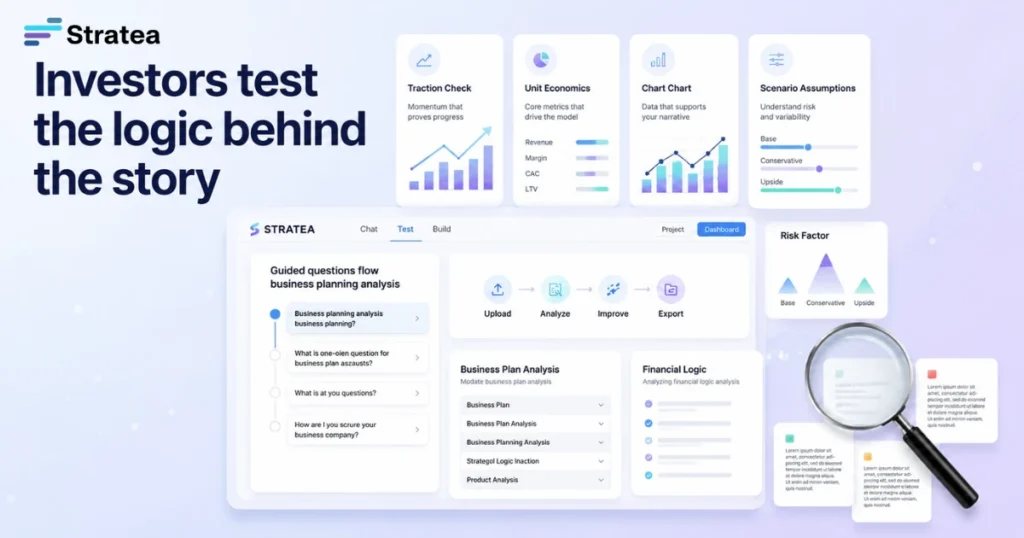
Investors do not only read what you wrote. They look for gaps between the story and the business reality. A clear slide can still create doubt if the numbers, milestones or assumptions do not support it.
Traction and demand evidence
Traction can include revenue, pilots, waitlists, retention, signed letters of intent, usage, repeat purchases or paid customer interviews. The right type depends on your business model.
For a marketplace, liquidity may matter. For a SaaS product, activation and retention may matter. For a local service business, repeat bookings and referral rate may matter. The mistake is treating all traction as equal.
Unit economics and financial logic
Unit economics explain what happens at the customer, order, account or location level. Investors want to see how revenue turns into contribution margin, how acquisition cost is recovered, and what scale does to margins.
This does not mean early founders need perfect numbers. It means they should know which numbers drive the model. If one assumption breaks the forecast, say so and show how you plan to test it.
Use of funds and milestones
A weak use-of-funds slide lists expenses: product, marketing, hiring, operations. A stronger version connects spending to proof.
For example: hire two sales reps to test outbound conversion, launch in three cities to validate local demand, fund product development to reach a paid pilot milestone, or build inventory to prove repeat purchase economics.
Risk mitigation
Every business has risk. Investors know that. Hiding risks makes the founder look less prepared.
A better approach is to name the risk, show why it matters, and explain the mitigation plan. For example, if customer acquisition cost is uncertain, the plan should include channel tests, budget caps, measurement windows and decision rules.
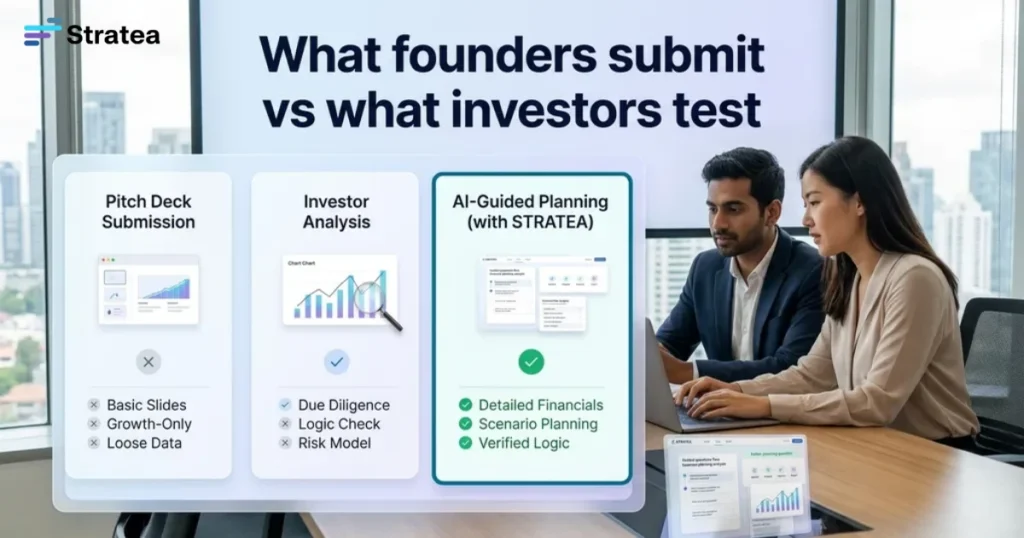
Comparison table: what founders submit vs what investors review
| Area | What founders often submit | What investors usually test | Better planning question |
| Problem | Broad pain point | Is the pain urgent enough to pay for? | Who has the problem now, and what are they doing instead? |
| Market | Large total market | Is there a reachable first segment? | Which segment can you win first with current resources? |
| Traction | Vanity metrics | Evidence of repeatable demand | What signal proves people want this repeatedly? |
| Unit economics | Revenue forecast | Margin, payback and sensitivity | Which assumption most affects profitability? |
| Use of funds | Expense categories | Milestone logic | What will this capital prove by month 6 or 12? |
| Growth strategy | More marketing | Scalable acquisition path | Which channel can scale without breaking margins? |
| Risk | Minimal disclosure | Founder judgment | What can fail, and how will you know early? |
How to connect the plan to the pitch narrative
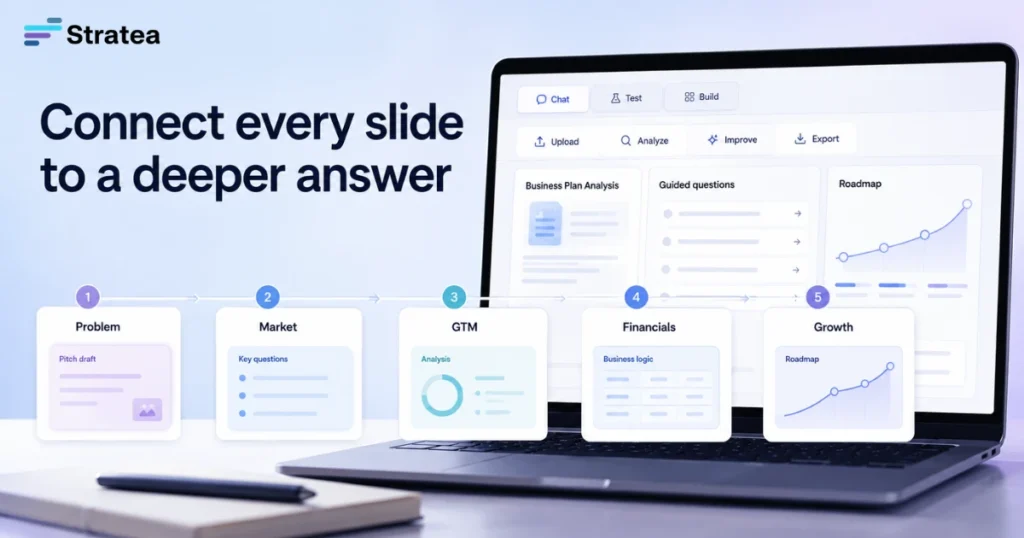
A deck should feel concise because the planning work has already been done. Each slide should point to a deeper answer that exists somewhere in your plan, model or operating roadmap.
Problem and market
The problem slide should not simply describe frustration. It should identify a customer segment with a measurable need and a reason to act now.
The market slide should avoid inflated top-down numbers that do not connect to your entry strategy. Investors care about the market you can reach, then the market you can expand into.
Go-to-market strategy
A go-to-market strategy should explain who you will reach, through which channels, at what cost, with what conversion logic. It should also show sequencing.
For example, a founder might start with referral partnerships, then add paid search after conversion data improves, then build an inside sales motion after average contract value supports it. The sequence matters because it shows operating judgment.
Financial projections
Financial projections should not pretend to predict the future with precision. They should explain how the business works under a base case, downside case and upside case.
BDC notes that projections help identify financing needs, pricing, production planning, cash flow and growth. That is the right standard for a funding conversation. The model should help the founder make better decisions, not just produce a neat spreadsheet.
Growth strategy
Growth strategy should connect product, market, hiring, capital and operations. Investors are not only asking, “Can this grow?” They are asking, “Can this team grow it without losing control of quality, margins or focus?”
Your investor pitch deck should make that connection visible without overloading the reader.
Worked example: ClearNest Residential Cleaning
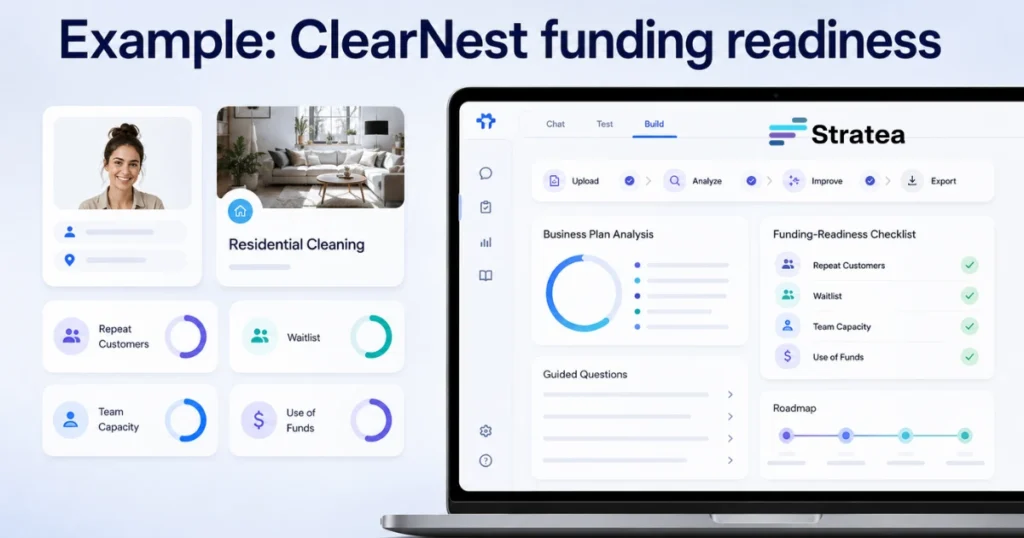
ClearNest is a fictional residential cleaning company in Austin, Texas, used here to illustrate funding-readiness planning logic. In this example, the founder started as a solo operator and now has repeat customers, strong local reviews and more demand than she can serve alone. She wants to raise $150,000 to move from one-person operations to a small team.
Starting position
ClearNest has 42 recurring customers, an average job value of $165, and a mix of weekly, biweekly and monthly plans. The founder has tracked repeat booking rate, referral source, cleaner hours, supply cost and customer complaints for six months.
This is not venture-scale traction by itself. But it can be credible for a small business funding conversation if the numbers show repeat demand and disciplined operations.
Investor story
The deck should not say, “The home cleaning market is huge.” It should say, “ClearNest has proven repeat demand in three neighborhoods, has a waitlist of 28 households, and needs capital to hire, train and equip two cleaning teams.”
The business plan should then support that story with pricing, staffing, scheduling, quality control, insurance, payroll, customer acquisition and cash flow.
Metrics and assumptions
ClearNest models revenue by team capacity. One two-person team can complete three jobs per day, five days per week, at an average job value of $165. That creates a weekly revenue capacity of $2,475 per team before cancellations.
The founder also models supply cost per job, payroll per hour, travel time, booking conversion and churn. The most sensitive assumption is not market size. It is utilization: how many paid jobs each team completes each week.
Use of funds
A weak ask would say the $150,000 will be used for hiring, marketing and equipment. A stronger ask would break it into milestones:
- Hire and train two cleaning teams.
- Add scheduling software and quality checklists.
- Fund local acquisition tests in three neighborhoods.
- Maintain three months of payroll buffer.
- Reach 110 recurring customers within nine months.
- Keep customer complaint rate below a defined threshold.
This turns the use of funds into an operating plan.
Milestones and risks
ClearNest’s risk is not only competition. The bigger risks are hiring reliability, quality control, underpriced jobs, route inefficiency and customer churn.
The deck should show the founder knows those risks. The plan should show the controls: training SOPs, route planning, pricing review every 60 days, customer feedback tracking and retention reporting.
How STRATEA supports funding readiness
STRATEA is an AI Planning Assistant built around guided discovery. Its role is not to promise funding or replace legal, financial or investment advice. Its value is helping founders organize the planning logic that supports a stronger funding conversation.
Current capabilities
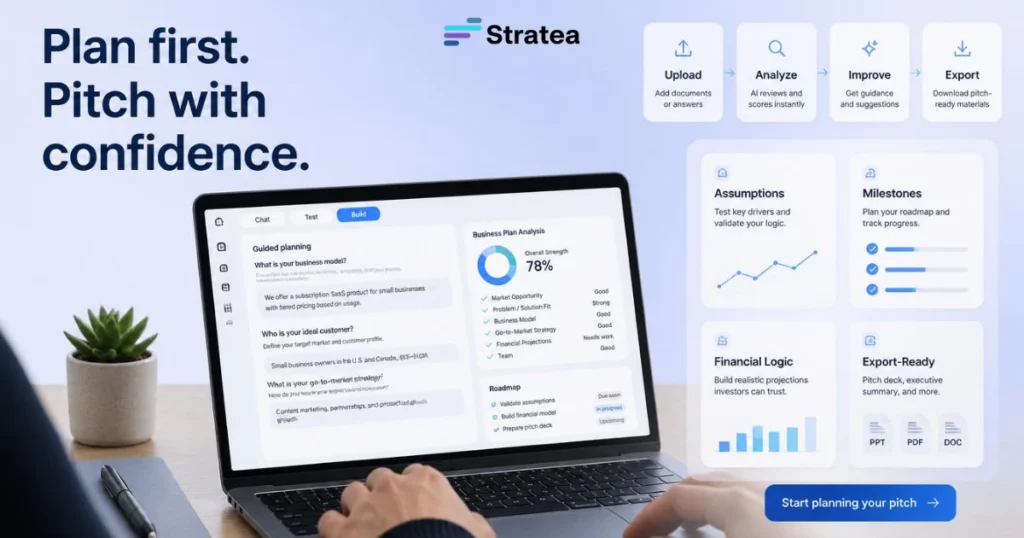
STRATEA currently supports guided question-based business plan generation from user inputs. Founders can also use an existing business plan draft as input, then combine that draft with follow-up answers to analyze, improve and regenerate a stronger plan.
This is useful when a founder has rough notes, a partial plan or a generic draft that does not yet explain the assumptions clearly. STRATEA helps move those inputs into a more structured, editable and decision-ready business plan.
Planned capabilities
Near-term directions include faster uploaded-plan analysis, chat and edit flow, heading-level review, consultant workflows and export-ready planning support. These should be treated as planned or future-facing unless confirmed live inside the product.
For consultants and agencies, the long-term value is repeatable planning work: reviewing client drafts, improving structure, checking assumptions and preparing stronger business plan materials for funding, loan or visa-related discussions. Qualified legal or financial review is still important where required.Review checklist before pitching
Before sending the deck, review it against the questions an investor is likely to ask. The goal is not to make the deck longer. The goal is to make the story tighter.
Check whether your plan can answer:
- What specific customer segment are you targeting first?
- What evidence shows that segment has real demand?
- What traction do you have, and what does it prove?
- Which unit economics matter most?
- Which financial assumptions are validated, estimated or untested?
- What will the funding unlock?
- What milestones define success after the raise?
- What risks are most likely to break the plan?
- What will you do if growth is slower than expected?
If you cannot answer these questions clearly, the deck is not ready yet. The issue may not be the slides. It may be the planning logic behind them.
FAQ
What should be included in a pitch deck for investors?
A pitch deck should usually include the problem, solution, market, product, business model, traction, go-to-market strategy, competition, team, financials, use of funds and milestones. The exact structure depends on stage and business model.
How long should a startup pitch deck be?
Most early-stage decks are concise, often around 10 to 15 slides. The better question is whether each slide answers a real investor question. A shorter deck with strong evidence is usually better than a long deck filled with generic claims.
Do I need a business plan before making a pitch deck?
You do not always need a formal long plan, but you do need the planning logic. Your deck should be backed by assumptions, financial projections, traction evidence, market analysis, use of funds and milestone thinking.
What is the difference between a pitch deck and a business plan?
A pitch deck is a short presentation for investor conversations. A business plan is a more detailed explanation of how the company operates, makes money, spends capital and reaches milestones.
Can AI help create investor materials?
AI can help structure planning inputs, identify gaps, draft sections and improve clarity. It should not be treated as a guarantee of funding or as a substitute for founder judgment, financial review or legal advice where needed.
What makes a deck investor-ready?
A deck is investor-ready when the founder can defend the story behind it. That means traction is defined, assumptions are visible, financial logic is clear, risks are addressed and the use of funds connects to measurable milestones.