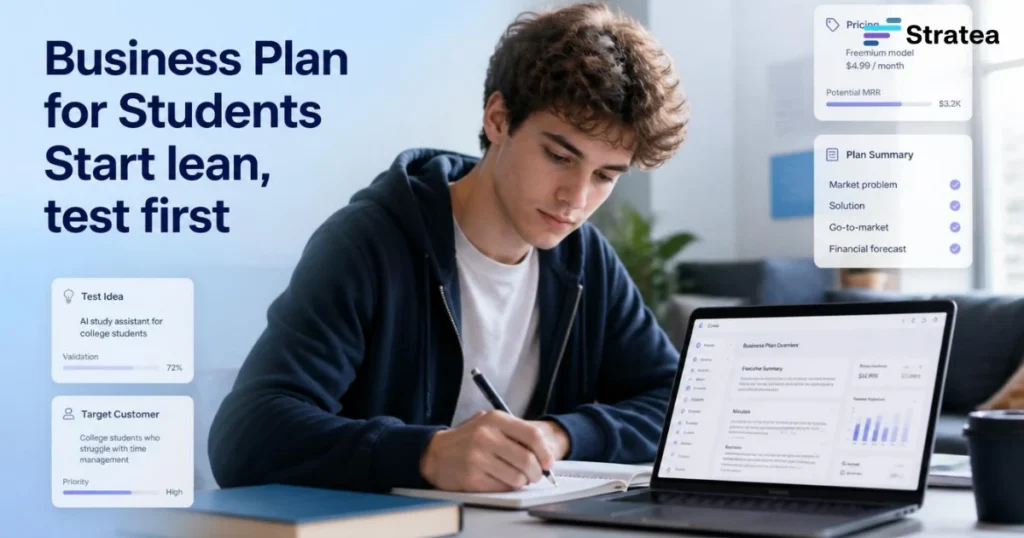
A business plan for students doesn’t look like a formal business plan for a loan application. You don’t need a 30-page document, detailed financial projections, or market research reports. What you need is a way to test whether your idea is worth your time before you invest heavily in building it.
A student business plan is a testing framework. It’s a simple way to make decisions: Is there real demand? Can I actually deliver? Do I want to do this? Only after you’ve answered those questions is it worth writing anything down formally, whether that’s a few notes on paper or an ai business plan generator you can refine as your idea takes shape.
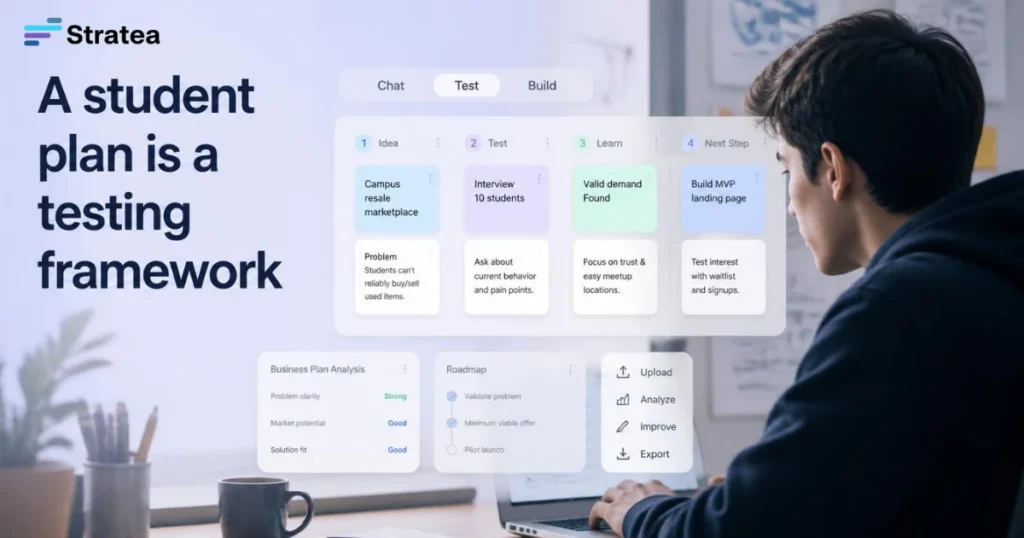
What a Business Plan for Students Actually Is
A business plan for students is not a formal document. It’s a decision framework that helps you test whether your business idea is worth pursuing.
Here’s what it does:
- It forces you to clarify what you’re actually trying to test
- It helps you design simple tests that don’t cost money
- It gives you a way to track what you’ve learned
- It guides you on when to invest time, money, or both
- It prevents you from building a business no one wants
Here’s what it doesn’t do:
- It doesn’t predict revenue accurately (you don’t have enough data yet)
- It doesn’t impress lenders or investors (that comes later)
- It doesn’t require perfect market research or financial models
- It doesn’t need to be formal or polished
- It doesn’t lock you in (it changes as you learn)
Think of it as a living document that starts as a series of questions and becomes a plan only after you’ve tested the answers.
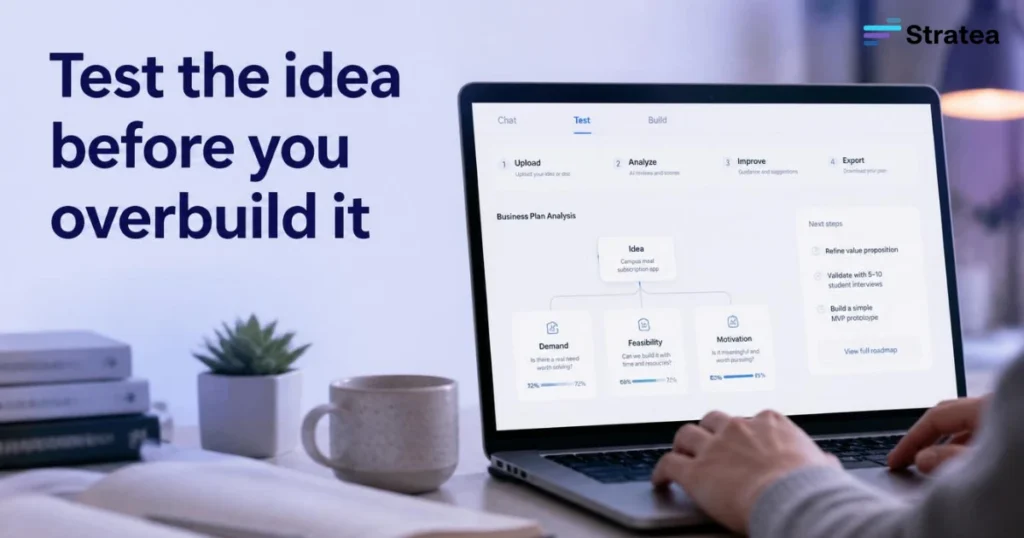
The Decisions a Student Founder Must Make (Before Writing Anything)
Most student founders jump straight to planning details. Instead, start with three core decisions. Until you’ve tested these, everything else is guesswork.
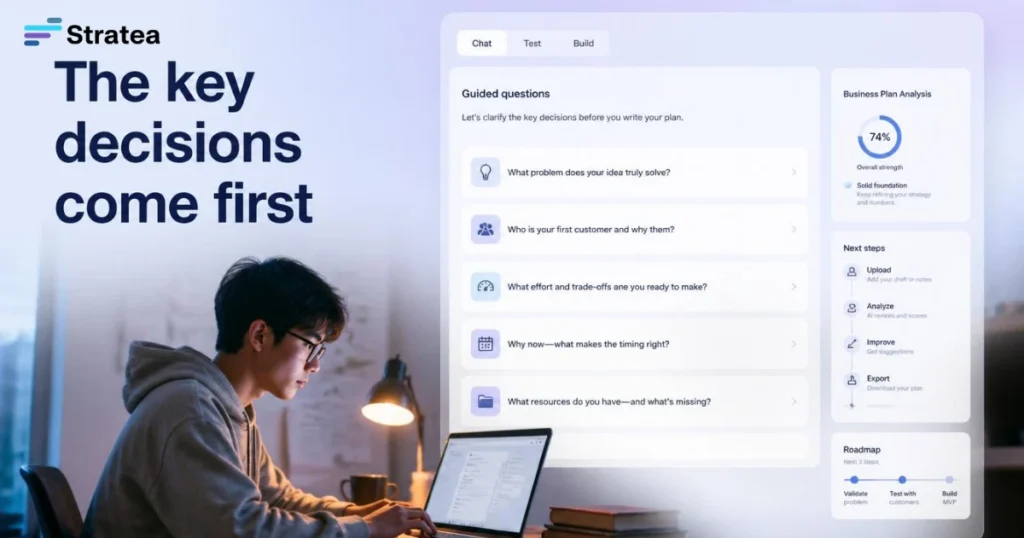
Idea: Do People Actually Want This?
Your first job is to find out if anyone cares about your idea besides you.
The test is simple: Talk to 10 potential customers. Not your friends (they’ll be polite). Ask them directly: Do you have this problem? Would you pay for a solution? What would it cost?
You’re not pitching. You’re listening. Your job is to find out if the problem is real or if you’ve invented a problem no one actually has.
Some ideas will fail this test fast. If you propose a tutoring service and potential students say they already get free tutoring from school, you’ve learned something valuable before investing time.
Other ideas will pass. You’ll hear consistent stories from multiple people about the same problem. That’s when you move to the next decision.
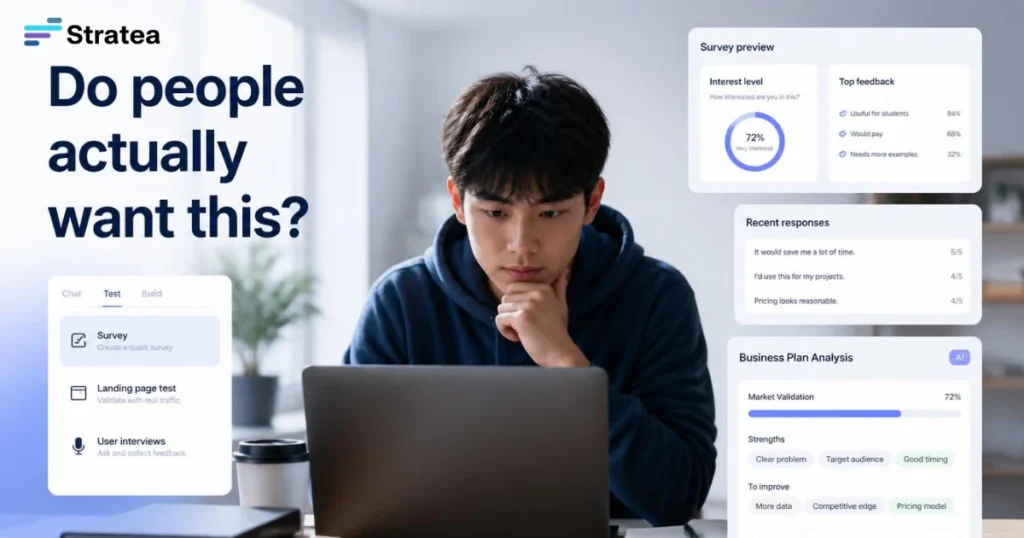
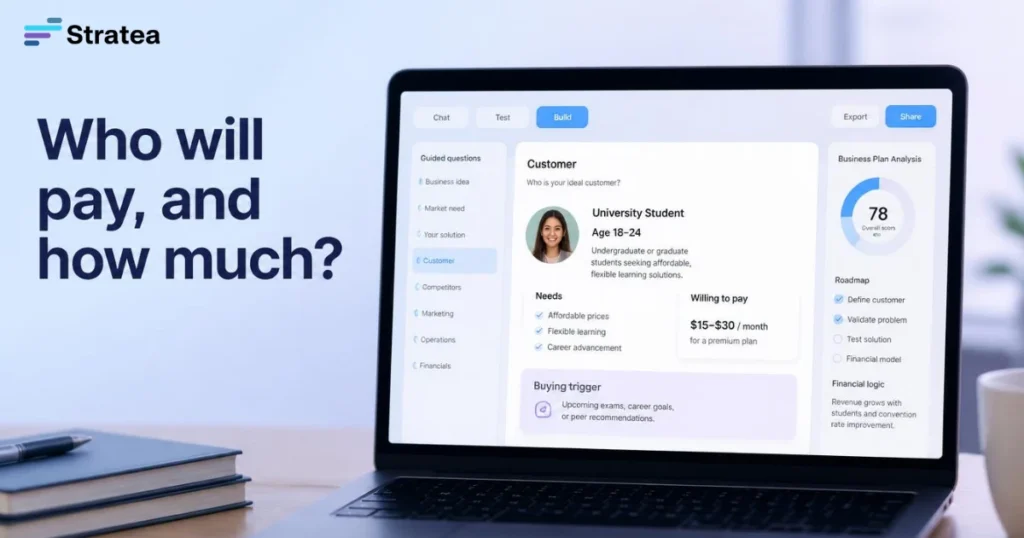
Customer: Who Will Pay, and How Much?
Once you’ve confirmed people want something, you need to know who your customer is and what they’ll pay.
Be specific. Not “anyone who needs help with writing.” Instead, “ESL students applying to US colleges” or “small business owners in my city who need social media help.”
The more specific, the easier it is to find them and the higher the price you can charge.
Test this by:
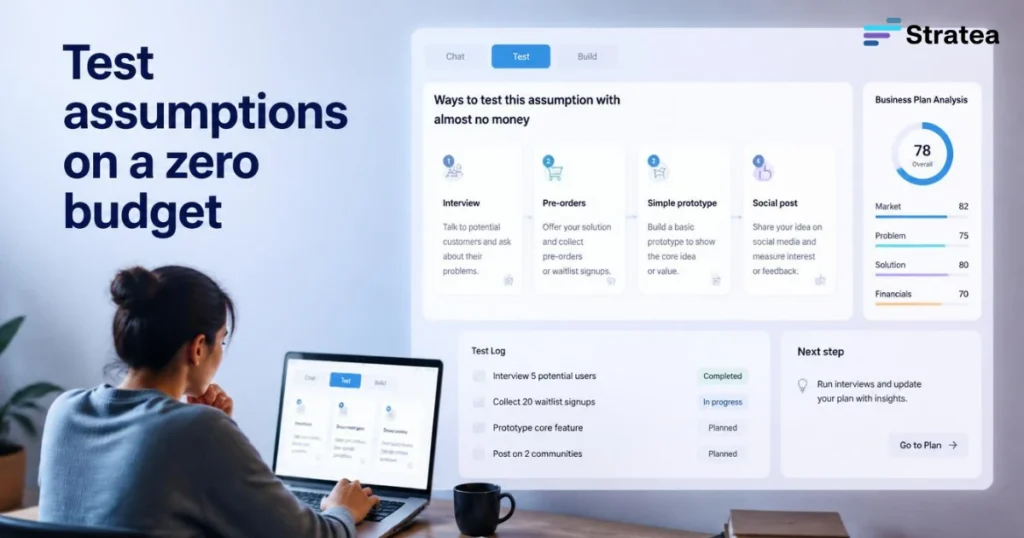
- Creating a simple landing page or social media post describing your offer
- Asking a few potential customers directly what they’d pay
- Seeing if anyone clicks, comments, or expresses interest
You don’t need them to buy. You need them to show interest. If you put up a post saying “Freelance writing for niche businesses, $500/project” and no one engages, you’ve learned that either the price is wrong, the audience is wrong, or the offer is wrong.
Effort: Can I Actually Do This While Learning?
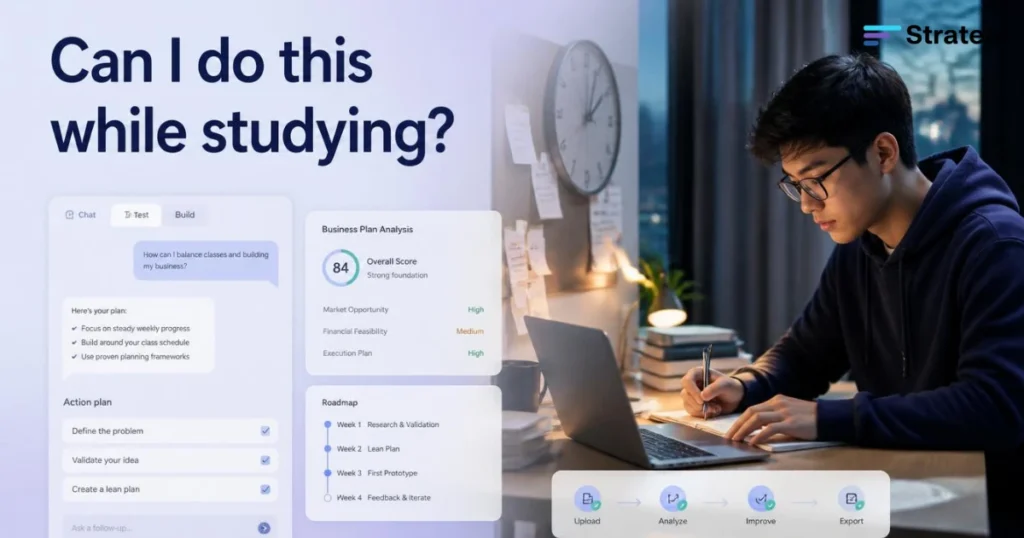
This decision is about your time and capacity.
Ask yourself:
- How many hours per week can I realistically spend on this while in school or working a day job?
- Does the business model fit that time commitment? (A service business takes more time than a digital product.)
- What skills do I need, and can I learn them while operating the business?
- When would I need to hire help, and can I afford it?
Some student business ideas are realistic. Freelance writing, tutoring, or social media management can start with 5-10 hours per week. Other ideas (e-commerce, physical products, apps) require more upfront work before revenue starts.
Be honest about your constraints. A business that requires 30 hours per week while you’re taking 12 credit hours will fail.
Testing Your Assumptions on a Zero Budget
You can validate most of your assumptions without spending money. Expensive market research and elaborate planning tools aren’t necessary.
Validating Your Idea Without Spending Money
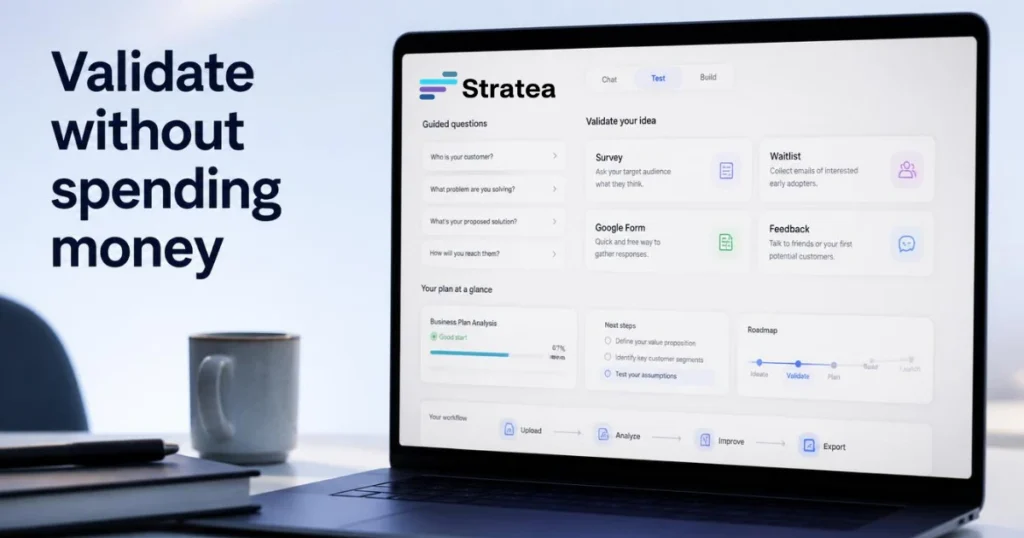
Before you build anything, prove that the problem is real.
Methods:
- Direct conversations: Talk to 10 people in your target customer group. Ask if they have the problem you’re solving.
- Online communities: Find Facebook groups, Reddit communities, or Discord servers where your target customers hang out. Read the conversations. Do they mention problems you could solve?
- Social media listening: Search Twitter, Instagram, or TikTok for people talking about your problem. Are they frustrated? Asking for solutions?
- Competitor research: Look for existing solutions. If competitors exist, that’s good (the market exists). If none exist, the market might not exist.
- Small survey: Create a Google Form and share it with people in your target group. Ask about their problem and what they’d pay for a solution.
All of these are free.
Your goal is not to confirm your idea is perfect. It’s to find out what’s actually wrong with it so you can fix it before spending time or money.
Finding Your First Customers (or Testing Interest)
Once you’ve validated the idea, you need to find people who will actually pay.
For students, this usually means:
- Direct outreach: Email, message, or call people you think might be customers. For a tutoring service, that might be parents in your network. For writing help, that might be international students at local universities.
- Social media: Post about your service on Instagram, TikTok, or LinkedIn. Make it specific and show examples of your work.
- In-person: For local services (tutoring, cleaning, social media management), put up flyers or talk to small business owners directly.
- Referrals: Ask people who know you if they know anyone who needs your service. Personal referrals are often the best early customers for student businesses.
- Online platforms: For freelance work, set up profiles on platforms like Upwork, Fiverr, or specialized freelance networks. You’ll compete on price, but it gets you experience and reviews.
Don’t expect to land customers immediately. But as you talk to people, you’ll learn what’s actually working and what’s not.
Understanding Your Unit Economics (The Simple Version)
You don’t need a complex financial model. You just need to know three numbers.
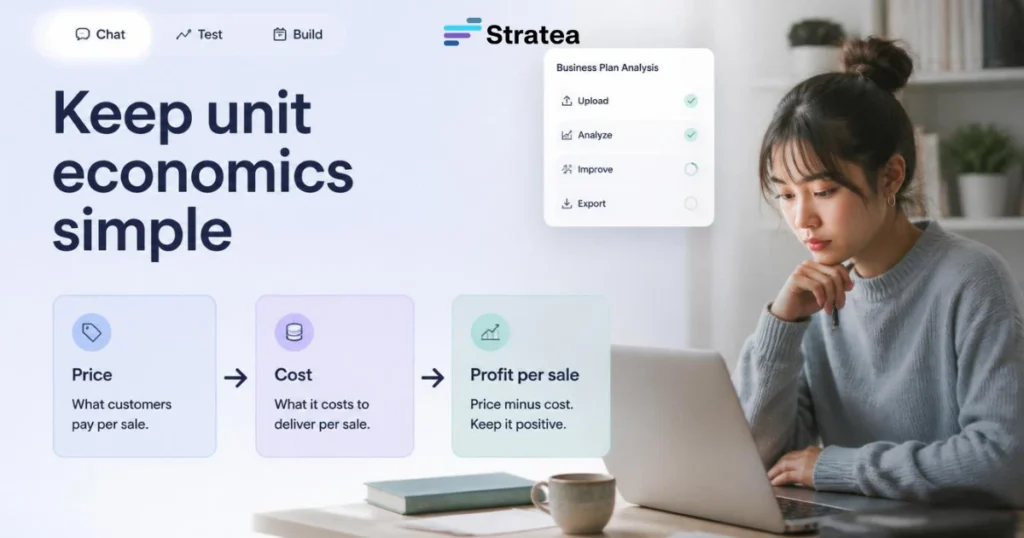
How much does one unit cost you to deliver? If you’re tutoring, it’s your time. Calculate it: If you charge $30/hour for one-on-one tutoring, and it takes you 30 minutes to prepare for each hour of tutoring, your cost is your time (let’s say you value your time at $15/hour, so it costs you $7.50 per hour of tutoring delivered).
How much will customers pay? You should have tested this by now. If customers say they’ll pay $30/hour for tutoring, and it costs you $7.50 to deliver, you have a gross margin of $22.50 per hour.
How many customers do you need? If you can spend 10 hours per week on this business, and each customer takes 2 hours per week, you can serve 5 customers. At $30/hour × 10 hours, that’s $300/week in revenue. Enough to decide whether to scale?
This simple math answers the question: Is this business viable at your current scale, or do you need to hire help?
Common Mistakes Student Founders Make
Student founders often make the same early mistakes. Knowing them helps you avoid wasting time.
Mistake 1: Writing a plan before testing the idea. You spend weeks on a perfect business plan document, then find out no one wants what you’re offering. Test first. Write later.
Mistake 2: Building before validating. You invest $500 in inventory or building a website, then realize the market doesn’t want it. Validate with conversations and small tests first. Build only after you’ve confirmed demand.
Mistake 3: Targeting everyone. “My tutoring service is for anyone who needs help.” Too broad. It makes marketing harder and pulls you in different directions. Get specific: “ESL students preparing for college entrance exams in Boston.”
Mistake 4: Thinking validation takes research and money. You don’t need a professionally designed survey or paid ads. Talk to people. Join online communities. Pay attention to what people are saying. Most validation is free.
Mistake 5: Expecting customers from day one. Your first customer will likely come from your network or through direct outreach, not through marketing. Don’t expect organic growth immediately.
Mistake 6: Not tracking what you learn. You talk to customers, get feedback, test things, but don’t write down what you discovered. Six weeks later, you’ve forgotten half of it. Document your learning as you go.
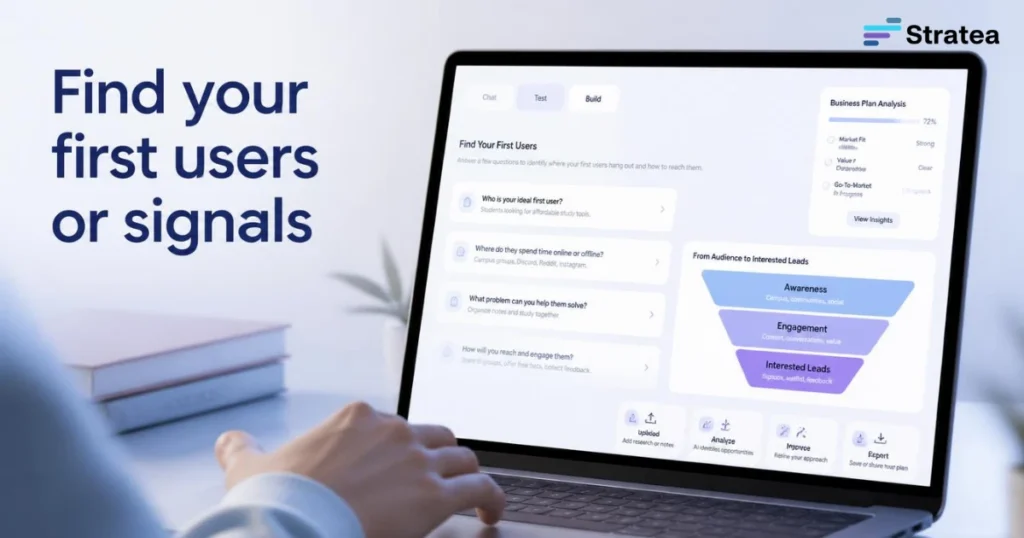
Worked Example: Freelance Writing for Niche Audiences
Let’s walk through how a student founder might test a freelance writing business.
Jordan is a junior in college. They like writing and have noticed that international students applying to US universities struggle with essay editing. They think they could offer affordable editing and writing coaching.
Testing the Idea
Jordan doesn’t immediately build a website or create fancy marketing materials. Instead, Jordan asks 10 questions:
They reach out to 5 international students they know: “Do you struggle with essay writing for college applications? Would you pay for help editing your essays?”
Responses: 3 say yes immediately. 2 say maybe. All mention that essay editors are expensive ($50-100 per hour) and they’re looking for something cheaper.
Jordan also joins 3 Facebook groups for international students and reads the conversations. In each group, at least 2-3 people per day ask for editing help or resources. The need is real.
Result: The idea passes the basic test. People want it, and they’ll pay.
Finding the First Customers
Jordan creates a simple post on Instagram and LinkedIn saying: “College essay editing and writing coaching for international students, $25/hour.” The post includes one example of before/after editing.
In the first week:
- 2 people message asking for a quote
- 1 person tags a friend
- 3 people save the post
Jordan also directly messages 5 international students they know from classes and asks if they’d be interested. 2 say yes. One asks about a monthly package.
Within 2 weeks, Jordan has 2 active clients and 1 waiting list.
Deciding Whether to Invest Time and Money
Now Jordan knows:
- Demand: Confirmed (both from conversations and initial interest)
- Customer: Specific (international students applying to US colleges)
- What they’ll pay: $25/hour for editing, possibly interest in packages
- Effort: At 10 hours/week available, Jordan could handle 3-4 ongoing clients at 2-3 hours per week each
Jordan does the math:
- 3 clients × 3 hours/week × $25/hour = $225/week
- That’s enough to justify 10 hours/week of effort (includes client communication, marketing, admin)
- Cost: Just time (no overhead yet)
Decision: This is worth doing. Jordan invests more time in marketing and takes on more clients. After 2 months, if revenue reaches $500/week, Jordan might invest in a simple website or hire another editor to handle overflow.
This is how lean validation works. Test with conversations. Launch with a simple offering. Track what works. Then invest.
When and How to Document Your Plan
After you’ve tested and validated, it’s time to document. But this is different from a traditional business plan.
Your documented plan should include:
- What you’ve tested and what you learned: What customers want, what they’ll pay, what you’ve tried.
- Your current business model: How you’re making money right now (not how you hope to in 3 years).
- Your next decision point: What do you need to learn next? What will trigger you to hire help, invest money, or pivot?
- Your constraints: Time available, skills you need to develop, decisions you need to make.
Keep it to 1-3 pages. It should be a living document that you update monthly as you learn.
Documentation is not about impressing people. It’s about clarity. A written plan helps you stay focused and makes it easier to onboard a co-founder or advisor later.
FAQ
Q: Do I need a business plan before starting my side business?
A: You don’t need a written plan, but you do need to test three things before you start: Does anyone want it? Will they pay? Can you actually deliver? Once you’ve tested those, you can start. Document your plan once you’re operational and have learned something.
Q: How do I validate my idea if I don’t know anyone in my target market?
A: Online communities, social media, and direct outreach are your friends. Find where your target customers hang out (Reddit, Facebook groups, Twitter, Discord, LinkedIn). Listen to their conversations. Join, ask questions, offer help before you ask for money. You’ll find validation this way.
Q: What if I can’t find customers even after testing?
A: That’s valuable information. It means either the idea isn’t viable, your target customer is wrong, or your offering isn’t clear. Instead of giving up, try one of these: change the target customer, adjust the price, change the service slightly, or try a different marketing channel. Most successful student businesses succeed on the second or third iteration.
Q: Should I spend money on a website or logo before I have customers?
A: Not yet. Your first customers will come from your network or direct outreach, not from finding you online. Build a simple free presence (Instagram, LinkedIn, a Google Form for inquiries) and validate first. After you have 3-5 customers, then invest in a website.
Q: How long should I test before deciding whether to scale?
A: Test for at least 4-6 weeks. You need enough time to talk to 10+ potential customers and ideally land 2-3 early customers. At that point, you have real data about demand and your ability to deliver. Then decide: Keep going as a side hustle, invest more time and money, or move on to another idea.
Q: Can I use STRATEA’s planning process for a student side business?
A: Yes. Start with STRATEA’s guided questions about your idea, target customer, and offer. As you test and learn, update your answers. STRATEA will help you organize your validation decisions and assumptions so you stay focused on what matters.
Next Steps
Don’t write a perfect plan. Test first.
Start by making one decision: Talk to 10 people in your target market and ask if they have the problem you think you’re solving. Listen to what they say. If at least 7 of them confirm the problem is real, move to the next test.
After you’ve tested the three core decisions (idea, customer, effort), then think about documenting. Use STRATEA to organize your learning as you go. Start Strategic Discovery free, and work through your validation decisions. As you test and learn, STRATEA helps you turn your assumptions into a plan you can actually explain.
The goal isn’t a formal document. It’s clarity about whether this business is worth your effort. Build that clarity through testing. Document it once you know it’s real.