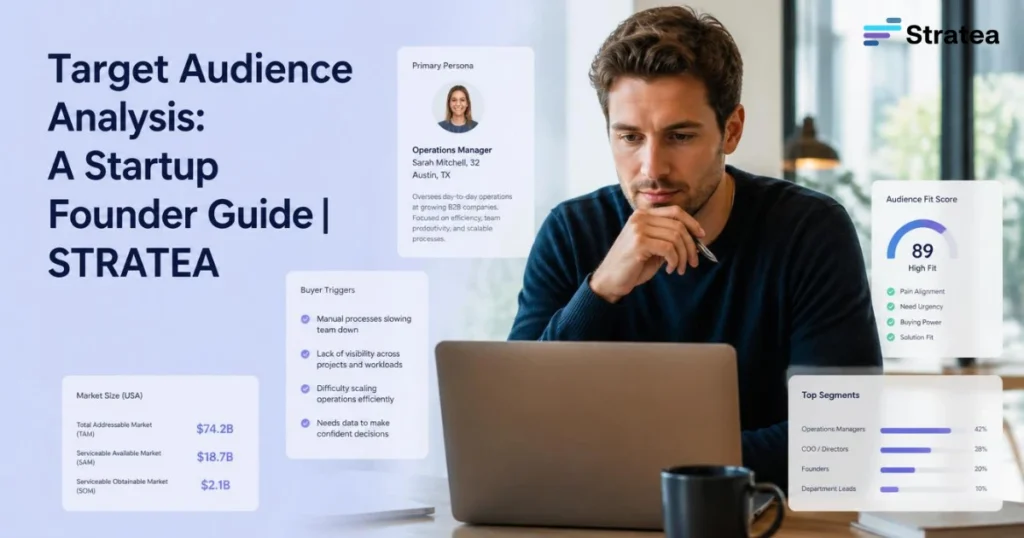
When founders pitch a new venture, they often present massive market sizing figures to prove their potential. They point to multi-billion-dollar industries and assume that capturing a tiny fraction of that space guarantees viability. This top-down approach rarely satisfies bank loan officers, angel investors, or regional economic development agencies.
To build a business plan that commands respect, you must reverse this logic. A defensible business plan requires a granular target audience analysis that demonstrates an intimate understanding of specific buyer groups. You must prove exactly who wants your product, why they will pay for it, and how their daily habits drive market demand. An ai business plan generator can help you organize this research, but the underlying insight into your buyers still has to come from you.
Beyond Vague Demographics: Why Broad Market Claims Fail Reviewers
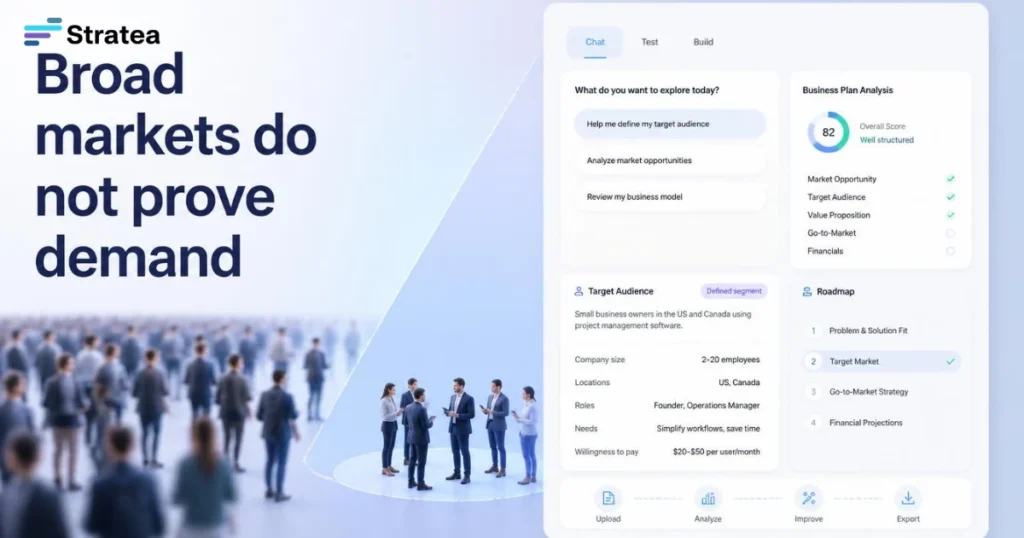
Traditional business plan templates often encourage founders to define their target customer using surface-level traits. A typical template might describe an audience as “millennial professionals aged 25 to 40 who value sustainability.” This definition is too broad to guide a marketing campaign or satisfy a cynical investor. Millions of people fit this demographic category, yet their buying habits, disposable income, and specific pain points vary wildly.
Vague profiles make it impossible to build a predictable customer acquisition model. If you cannot pinpoint the exact context in which a buyer seeks your solution, your marketing spend will be distributed across an expensive, indifferent audience. Lenders and investors recognize this flaw immediately. They look past sweeping industry descriptions to find proof of localized or niche market demand.
An effective target audience analysis replaces assumptions with verifiable buyer evidence. Reviewers want to see that you understand the trade-offs your customers face every day. They want to know what alternative solutions your audience currently uses and what specific friction forces them to switch. Moving from broad demographic categories to precise behavioral segments is the first step toward building a business that stands up to external scrutiny.
De-risking Your Plan With a Targeted Customer Profile
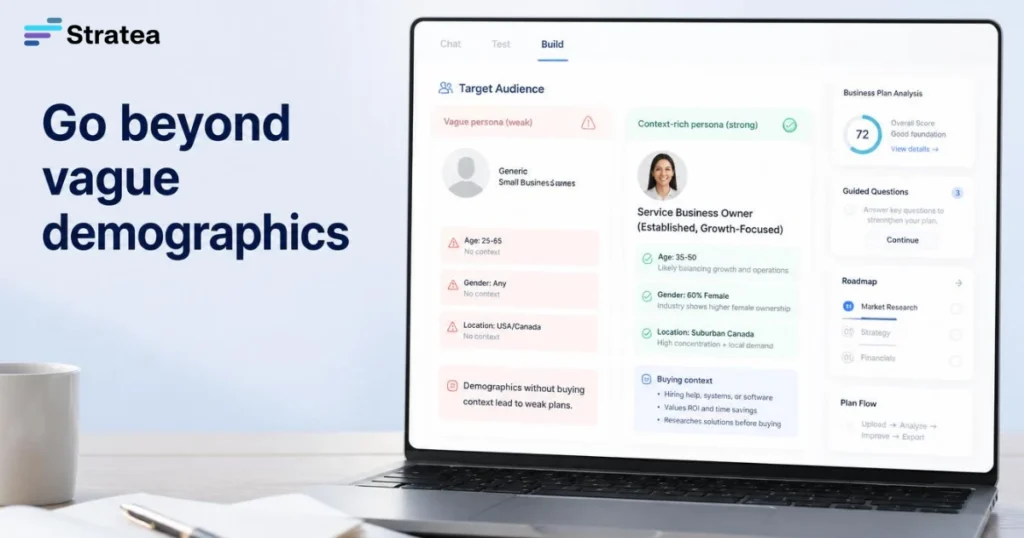
A disciplined customer profile does more than fill out a section of your business plan. It serves as an active risk-mitigation tool that protects your initial working capital. By narrowing your focus to a highly specific group of early adopters, you can optimize your product positioning and pricing strategy before scaling your operations.
Quantifying Market Demand and Market Sizing
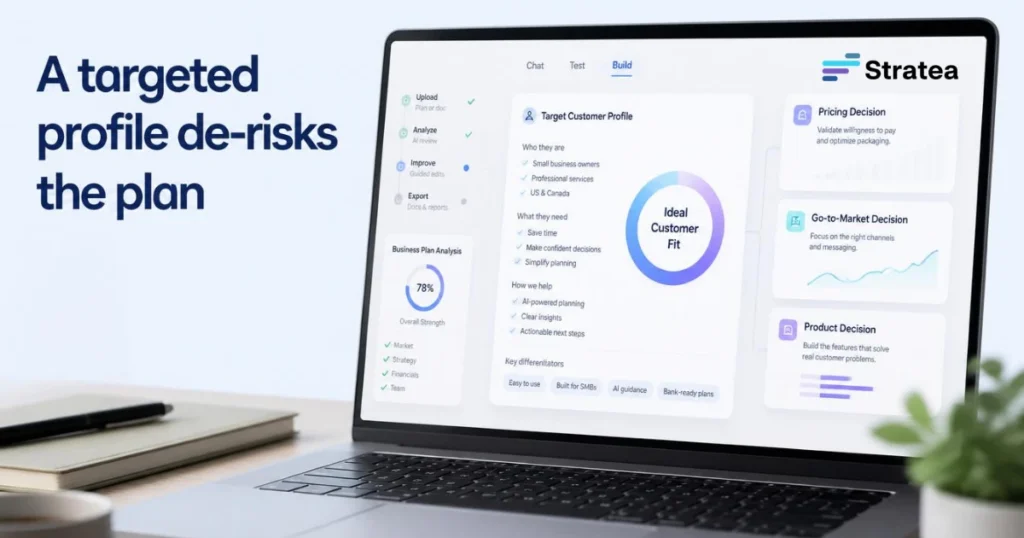
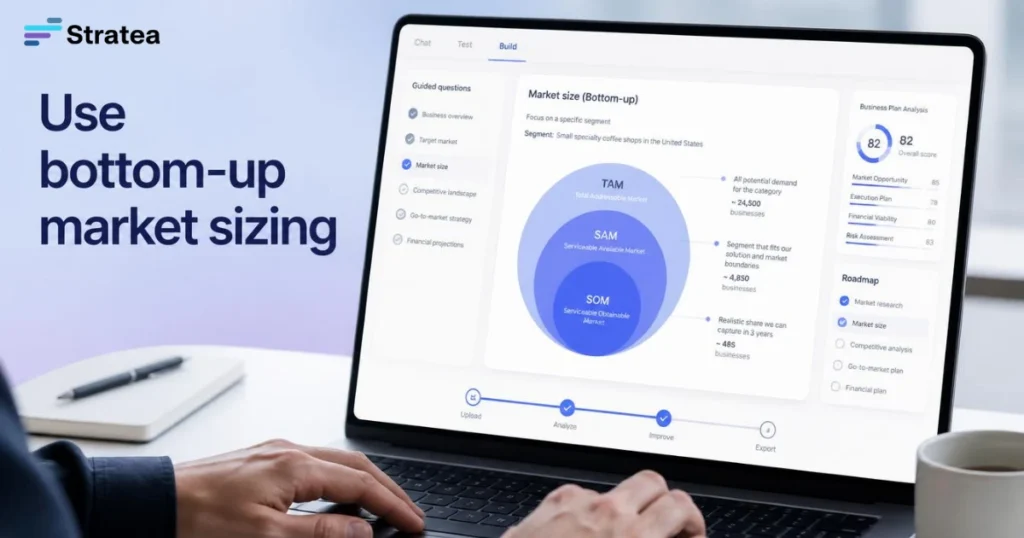
Instead of starting with the global industry valuation, your market sizing should follow a bottom-up calculation. Begin by defining your Total Addressable Market (TAM) as the overall revenue opportunity available if your business achieved 100% market share within your category.
From there, isolate your Serviceable Addressable Market (SAM), which represents the portion of the TAM that fits your geographic reach, technology limits, or distribution model.
Finally, calculate your Serviceable Obtainable Market (SOM). This is the highly realistic share of the SAM that your startup can realistically capture within your first three to five years, given your actual marketing budget and operational constraints.
SOM = SAM x Target Market Share Percentage
This mathematical progression forces you to ground your growth projections in operational reality. It shows reviewers that you are not relying on luck, but on a structured evaluation of accessible market volume.
Mapping Real Buyer Behavior and Purchasing Triggers
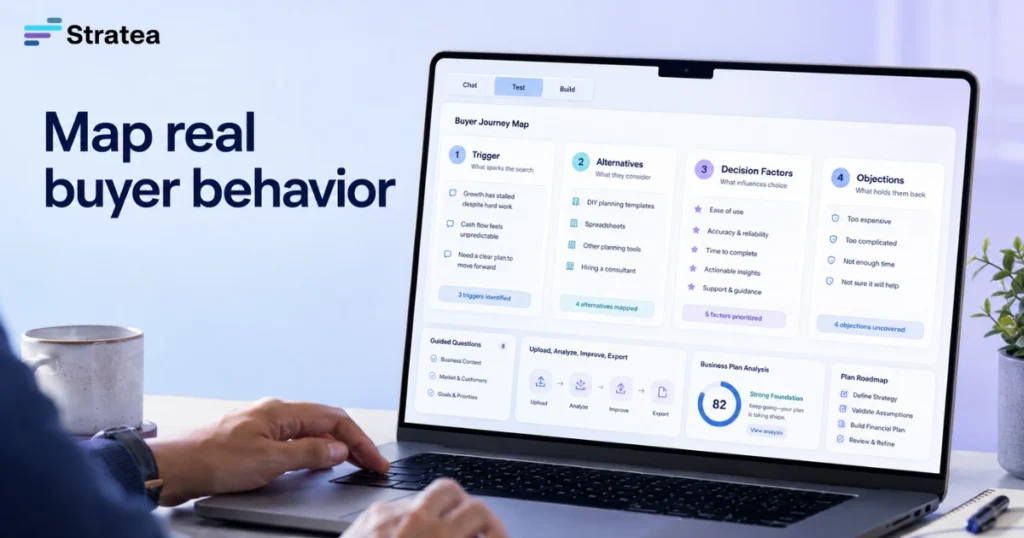
Understanding market volume is useless without mapping the psychological and environmental triggers that cause a customer to spend money. Your audience analysis must document the specific circumstances that turn a passive observer into an active buyer.
- The Situational Catalyst: What internal or external event forces the customer to look for a solution right now?
- The Current Alternative: How are they solving this problem today, even if the method is inefficient or manual?
- The Switching Friction: What risks or costs (time, money, emotional effort) keep them from abandoning their current solution?
- The Decision Criteria: When comparing options, do they prioritize price, speed, premium quality, or ease of integration?
Documenting these behavioral drivers allows you to predict customer acquisition costs with much greater precision. It shifts your planning from abstract theories to a realistic roadmap for capturing early market share.
Step-by-Step Target Audience Analysis for Startups
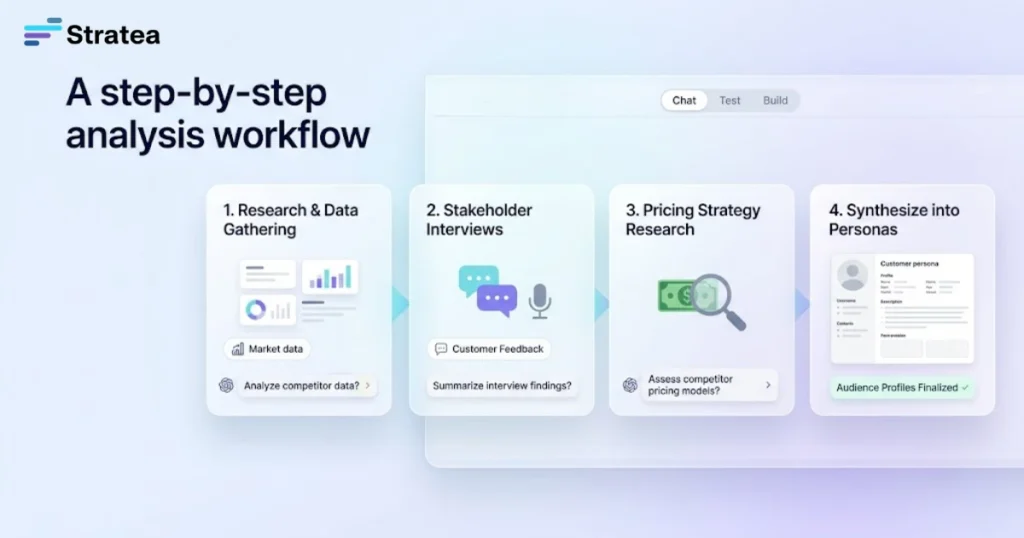
Conducting a professional analysis does not require an enterprise-level research budget. It requires a systematic approach to collecting, validating, and organizing consumer insights. Founders can execute a rigorous discovery process by following three distinct phases.
Phase 1: Gathering Initial Market Data and Competitor Analysis
Your first task is to examine the existing market environment. Analyze your direct and indirect competitors to understand how they currently communicate with their users. Look closely at their pricing models, customer reviews, and visible feature gaps.
Pay close attention to negative reviews of established players: this public data highlights unfulfilled market demand. It tells you exactly where the existing options are failing to satisfy user expectations.
Phase 2: Conducting Primary Customer Interviews and Pricing Research
To validate your findings, you must engage directly with potential buyers. Conduct structured customer interviews that focus on past behavior rather than speculative future actions. Instead of asking “Would you buy a product like this?”, ask “How have you tried to solve this problem in the last six months, and what did it cost you?”
Incorporate specific pricing research into these conversations. Use frameworks like the Van Westendorp Price Sensitivity Meter to identify the price points where your target customer views a solution as too expensive, a great value, or suspiciously cheap. This prevents you from overestimating your potential gross margin during the financial planning stage.
Phase 3: Synthesizing Insights into Defensible Persona Frameworks
Once you have gathered qualitative and quantitative data, compile your findings into highly focused buyer profiles. These profiles should read like professional case studies rather than fictional sketches.
Every claim you make about consumer preferences must be backed by data from your interviews, competitor analysis, or secondary research sources. This level of evidence builds credibility with lenders and ensures your internal team executes from a shared truth.
Worked Example: Audience Validation for Verdant Nest
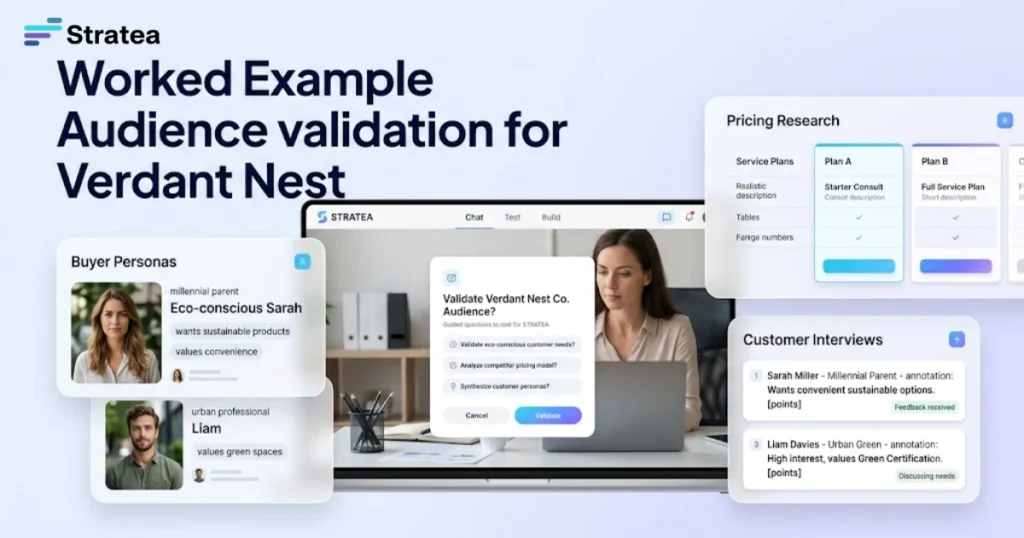
To see this methodology in action, consider Verdant Nest, a hypothetical e-commerce startup preparing to launch a line of premium, zero-waste kitchen and dining goods in the US market. The founder initially planned to target “environmentally conscious consumers.” Recognizing that this definition was too broad to guide operations, the founder executed a rigorous target audience analysis.
First, the founder used a bottom-up market sizing model to move from a massive national sustainability market down to a realistic initial focus.
| Market Category | Definition for Verdant Nest | Annual Revenue Potential |
| Total Addressable Market (TAM) | Online retail spend on premium eco-friendly kitchenware in the United States. | $1.2 Billion |
| Serviceable Addressable Market (SAM) | Eco-conscious suburban homeowners using premium direct-to-consumer e-commerce channels. | $140 Million |
| Serviceable Obtainable Market (SOM) | The specific niche segment of high-income suburban homeowners willing to pay a premium for certified plastic-free dining collections via targeted digital acquisition channels in Year One. | $2.8 Million |
Next, the founder conducted twenty-five in-depth customer interviews with individuals who had purchased premium kitchen goods within the last year. The insights revealed a distinct primary audience segment: the “Low-Waste Entertaining Host.”
The research completely overturned the founder’s original assumptions. While the founder thought buyers would be motivated purely by global carbon impact, the interviews proved that the primary purchasing trigger was actually aesthetic pride combined with personal health concerns regarding plastics.
Buyers wanted elegant dining sets that looked sophisticated when hosting dinner parties, but they were deeply frustrated by the lack of genuinely non-toxic, plastic-free options that were also dishwasher safe.
| Target Segment | Attribute Category | Operational Insight & Data Details |
| Low-Waste Entertaining Host | Core Trigger | Needs elegant dining ware for hosting; wants to eliminate plastics for health. |
| Primary Friction | Most eco-friendly options look industrial or cheap; premium brands use plastic coatings. | |
| Pricing Threshold | Willing to pay a 25% premium over standard ceramic sets if certified plastic-free. |
By uncovering this specific behavioral profile, Verdant Nest avoided spending its limited marketing budget on generic environmental messaging. Instead, the founder tailored the startup’s positioning directly around high-end durability and verified health safety.
This clear alignment between consumer data and product development provided the exact operational evidence needed to defend the company’s growth plan before prospective investment partners.
How Reviewers Evaluate Your Market Research
When a bank loan officer, SBA reviewer, or angel investor opens your market analysis, they are looking for specific warning signs. They want to ensure your business plan is built on verified market realities rather than optimistic speculation.
A common red flag is the claim that your business has “no direct competitors.” Reviewers know that if a genuine consumer problem exists, buyers are already trying to solve it using some alternative method. Claiming zero competition suggests that you either have not performed a thorough competitor analysis or that the market demand does not actually exist.
Reviewers also evaluate the logical connection between your audience size, your marketing spend, and your financial projections. If your target audience analysis claims a highly restricted, premium niche market, your sales volume forecasts must reflect that scale.
Your gross margin, pricing structures, and customer lifetime value metrics must align precisely with the specific consumer habits documented in your research.
If you need a clear framework for organizing these components, reviewing a comprehensive business plan outline can help you structure your market findings alongside your operational strategies.
Connecting Audience Insights to Strategic Planning Decisions
A great target audience analysis should never sit isolated in a static document. The data you collect must directly inform your broader operational roadmap, your hiring milestones, and your capital allocation strategy.
If your research shows a long sales cycle with multiple corporate decision-makers, your financial projections must account for that collection timing gap. If your buyers expect high-touch account management, your operational model must include early customer service hires.
This is where traditional static planning tools and generic templates fail founders. They encourage you to treat market research, marketing strategies, and financial projections as separate, disconnected checkboxes.
When these sections are built in isolation, the underlying assumptions often contradict one another, resulting in an unstable plan that collapses under professional review.
| Planning Phase | Strategic Framework | Core Objective & Impact on Business Plan |
| 1 | Target Audience Analysis | Uncovers specific buyer behaviors & triggers |
| 2 | Go-To-Market Strategy | Tailors channels directly to validated habits |
| 3 | Financial Projections | Grounds revenue capacity in realistic SOM limits |
Your market analysis must serve as the foundation for your entire business architecture. Every operational metric, marketing expense line item, and revenue milestone should be a direct, logical consequence of the customer habits you discovered.
When your plan demonstrates this deep structural cohesion, you can confidently present your venture to external stakeholders, knowing your strategy is built on verifiable evidence.
Aligning Market Validation with Financial Realities
As you refine your understanding of your primary buyers, it becomes critical to link those volume assumptions to your broader financial strategy. The size of your obtainable market directly caps your revenue capacity, which in turn dictates your operational scale.
If you want to ensure your audience validation connects seamlessly with your long-term capital strategy, explore how to build structured financial projections for business plan success to keep your operational goals grounded in true economic logic.
For founders who want to accelerate this synthesis without sacrificing rigor, using an advanced AI business plan generator provides a structured environment where market data and operational execution steps are evaluated together. This unified approach transforms raw consumer metrics into a cohesive strategy for growth.
To explore your target market constraints and test your core operational assumptions through a guided planning workflow, you can bring your early notes into STRATEA and start Strategic Discovery today.
FAQ
What is the difference between a target market and a target audience?
A target market represents the broad group of potential consumers who might buy your product, often defined by generalized industry parameters or geographic locations. A target audience is a highly specific subset of that market, defined by distinct behavioral triggers, unique pain points, and specific purchasing habits that dictate how you market to them directly.
How many customer interviews should a startup conduct for a valid audience analysis?
For most early-stage startups, conducting fifteen to thirty deep, structured interviews with individuals who fit your target profile is sufficient to uncover primary behavioral patterns. The goal is to reach a point of qualitative saturation, where new interviews consistently validate established insights rather than revealing entirely new customer problems.
Should I include secondary market research in my audience analysis?
Yes, secondary market research from reputable industry analysts, government databases, and academic studies provides an essential baseline for your total addressable market sizing. However, this data must always be combined with primary research, like your own customer interviews and competitor testing, to prove that your specific local or niche business model is viable.
How do I prove target audience demand if my product is completely new to the market?
If your product is highly novel, focus your analysis on the existing alternative behaviors your customers use to solve their problems. Document their current frustrations, manual workarounds, and financial expenses to demonstrate that a deep, unfulfilled demand exists for a more efficient solution.