
A startup business plan is more than a document for a lender, investor, or grant application. It is a working framework for turning an idea into an executable business. With STRATEA AI, founders can organize their assumptions, priorities, and financial requirements into a plan that supports better decisions before capital is committed.
For startups in the United States and Canada, the planning process helps test whether the core model is viable: who the customer is, how the business will reach them, what resources the team needs, and how long available capital can support execution.
A credible plan must connect every operating objective to realistic funding needs and clear milestones. Whether you build it manually or begin with an AI business plan tool, the standard remains the same: the strategy, numbers, and execution plan must work together and stand up to external review.
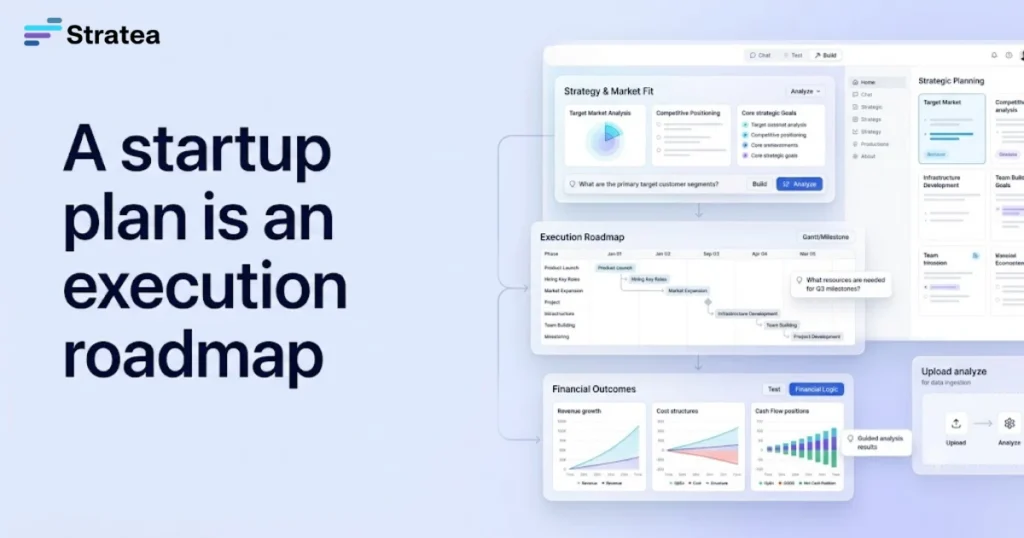
Direct Answer for Founders: A professional startup business plan must serve as a defensible execution roadmap that connects operational milestones directly to financial projections. Rather than acting as a static text document, a highly effective plan functions as an assumption-based planning tool. It demonstrates a deep understanding of unit economics, regulatory compliance constraints, and strategic risk mitigation to prove long-term business feasibility to institutional reviewers.
The Strategic Purpose of a Startup Business Plan
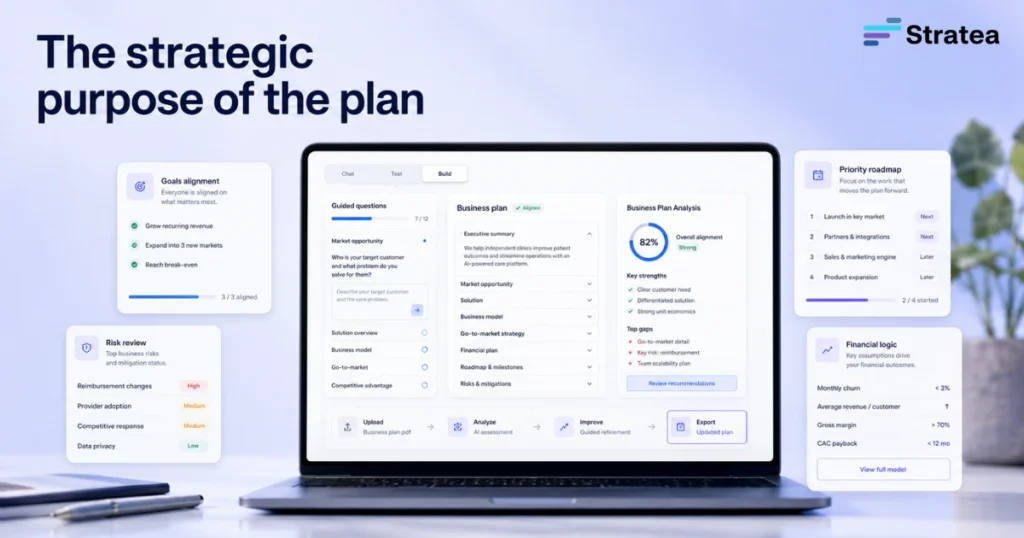
Moving Beyond Document Generation to Strategic Execution
Many founders treat the creation of a startup business plan as a bureaucratic chore designed to satisfy an external checklist. This perspective results in static documents filled with generic industry prose that fails to reflect actual operational realities.
A high-quality plan is an active strategic asset. It explicitly documents your business planning clarity, forcing you to map out exactly how your product strategy influences your hiring timeline, capital requirements, and cash flow constraints.
When you clarify your strategic thinking early, you protect your company against premature scaling. The value of the final document does not lie in its total page count. Instead, its value is determined by the clarity of its logical dependencies and how effectively it serves as an internal guide for critical business decisions.
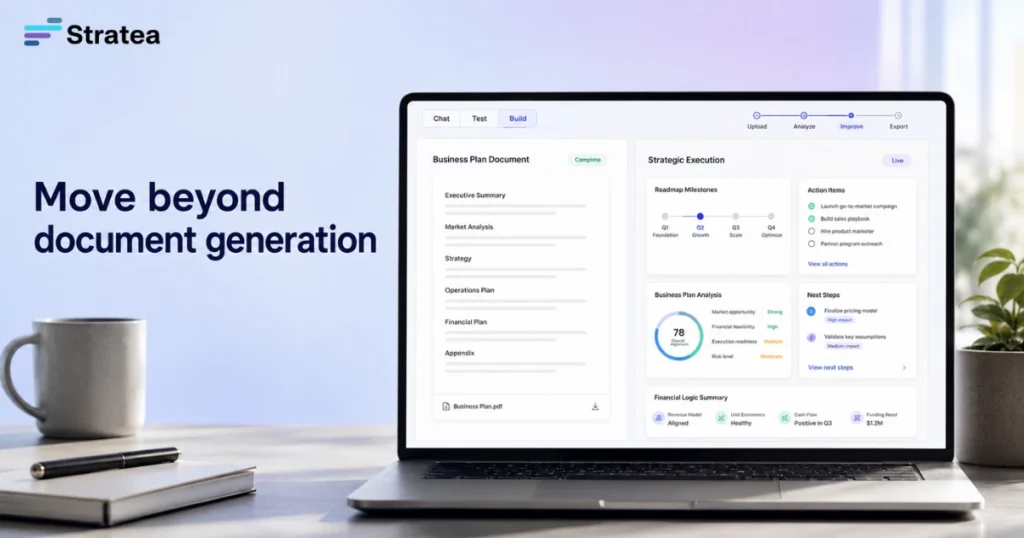
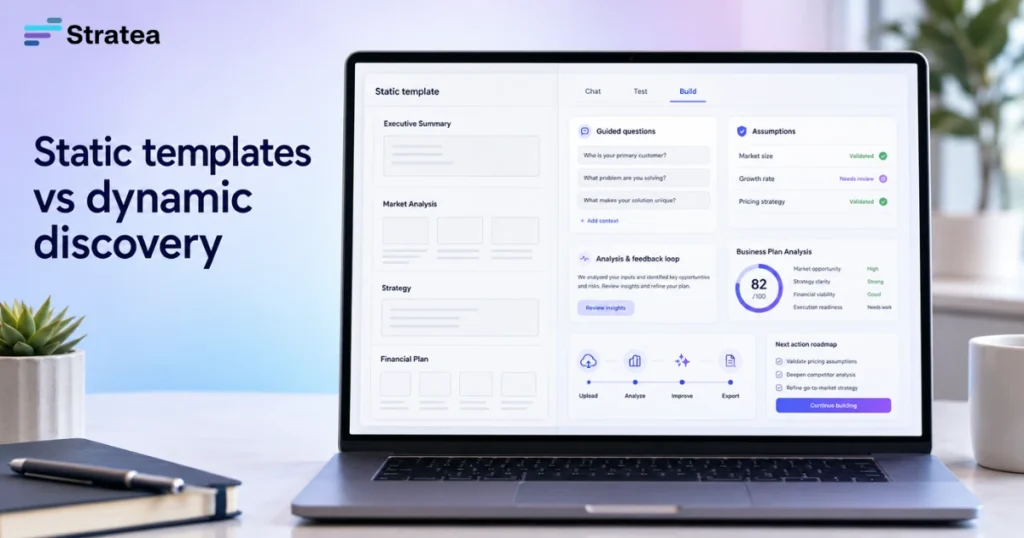
The Core Difference: Static Templates vs. Dynamic Discovery
Standard internet templates encourage founders to fill in empty text boxes with superficial descriptions. This method treats sections like market positioning, operational workflows, and cash flow statements as completely isolated components.
In reality, these elements are deeply interconnected. A change in your customer acquisition strategy immediately changes your marketing budget, which alters your working capital requirements.
[Customer Acquisition Strategy] —> [Marketing Budget Adjustments] —> [Working Capital Shift]
Using a guided discovery workflow allows you to approach planning as an interactive thinking partner. This method surfaces critical cross-sectional relationships, helping you see where an operational choice creates a heavy financial obligation.
Prioritizing deep strategic discovery over rapid document generation allows you to build a plan that can withstand rigorous financial audits.
Critical Structural Dependencies in Your Startup Business Plan
Mapping the Link Between Regulatory Compliance and Financial Runway
A common planning error is separating regulatory milestones from your financial runway projections. If your business model requires local zoning approvals, specialized health certifications, or federal licensing, these requirements cannot sit passively in an appendix. They act as major operational gatekeepers that dictate your capital burn rate.
For example, if a business cannot legally open its doors without a state or provincial license, the time required to secure that license must be factored directly into the pre-revenue financial projections.
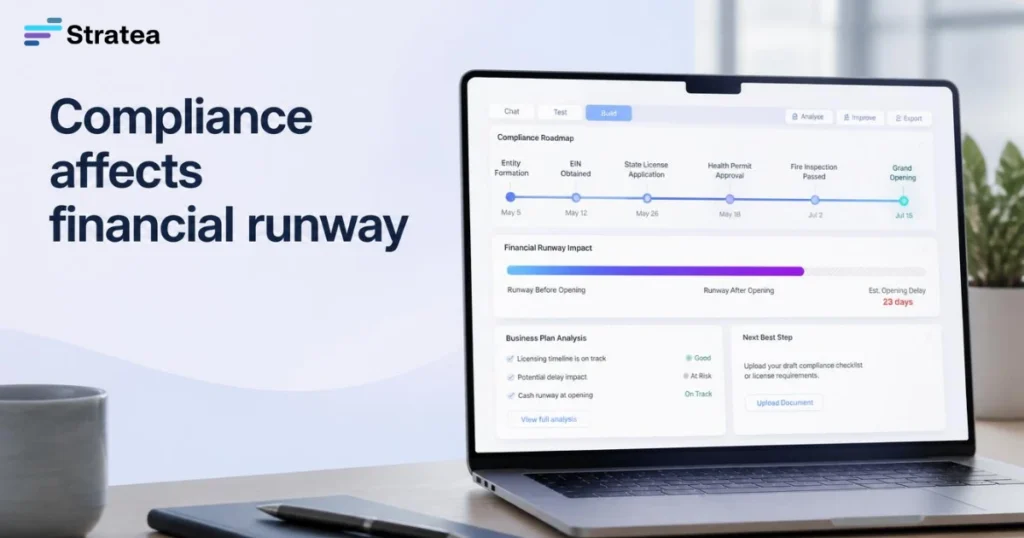
Founders must account for full fixed overhead costs, including facility rent, insurance premiums, and core administrative salaries, during this regulatory waiting period. Failing to align your compliance timeline with your cash reserves can deplete your startup capital before your launch.
Why Operational Milestones Must Dictate Financial Projections
A defensible financial model uses milestone-based projections rather than simple, linear monthly increases. Institutional reviewers can easily spot arbitrary revenue growth lines that show a perfect, uninterrupted 10% month-over-month increase.
Your financial projections must reflect the actual operational triggers that unlock new capacity or open up fresh revenue streams.
[Milestone: Hire 2nd Team] —> [Capacity Expands to 40 Clients] —> [Revenue Step-Up]
Your plan should clearly show how your capital expenditures scale alongside your real-world achievements. For instance, do not project an overnight spike in service capacity without showing the corresponding hiring costs, training periods, and equipment investments needed to support that volume.
Tying financial metrics directly to specific operational achievements shows reviewers that your team understands the practical realities of managing a corporate balance sheet.
Founders looking to map these connections can use STRATEA to transform raw regulatory notes into clear, structured planning inputs that align with long-term financial goals.
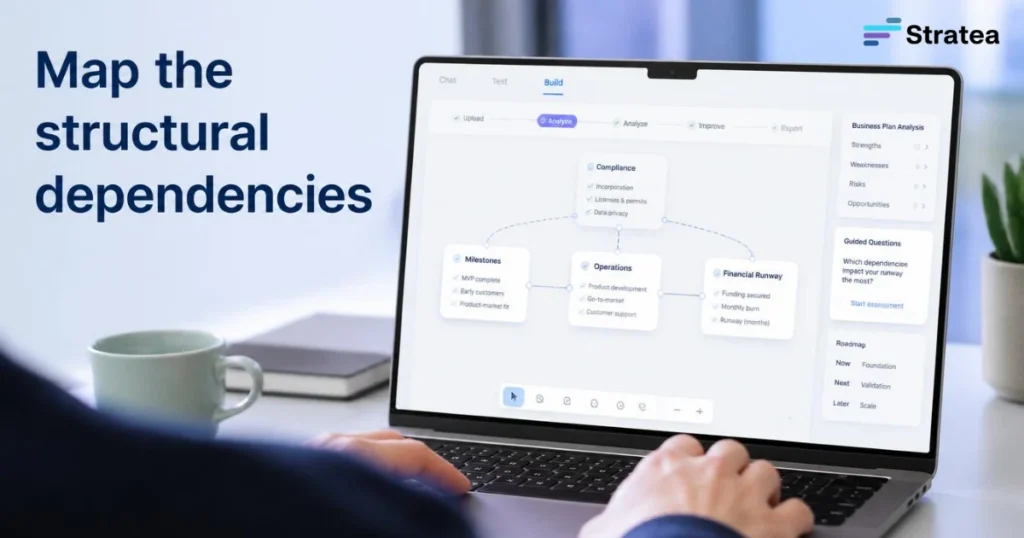
Selecting the Right Planning Framework for Reviewer Expectations
Traditional Comprehensive Plans vs. Lean Operational Roadmaps
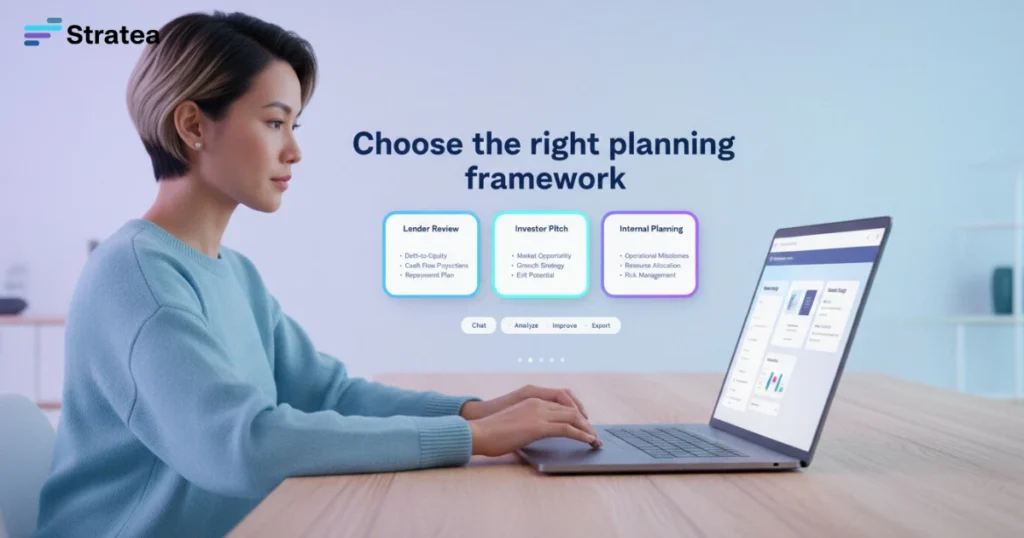
The structural format of your plan should match your specific operational goals and the expectations of your primary audience. A traditional comprehensive business plan is highly effective when applying for commercial bank loans, SBA or BDC financing, or institutional grants.
These formal entities require a thorough analysis of corporate governance, exhaustive market risk assessments, and multi-year financial statements.
| Planning Component | Traditional Comprehensive Plan | Lean Operational Roadmap |
| Primary Audience | Commercial Banks, SBA/BDC, Grant Committees | Internal Teams, Early Startup Co-founders |
| Financial Depth | 3 to 5 Year Full Projections (P&L, Balance Sheet) | Core Unit Economics and 12-Month Cash Flow |
| Operational Focus | Complete Governance, Legal, and Risk Overviews | Near-Term Milestones and Product Iterations |
| Core Utility | Securing Debt and Large Institutional Capital | Rapid Hypothesis Testing and Internal Alignment |
Alternatively, a lean operational roadmap works well for early internal alignment and fast strategic iterations. It prioritizes core unit economics, immediate go-to-market milestones, and direct cash flow monitoring.
The best strategy often involves starting with a highly focused operational core and then scaling it into a comprehensive institutional plan as your funding requirements grow.
How US and Canadian Institutional Reviewers Evaluate Feasibility
Lenders and credit analysts across North America use distinct frameworks to evaluate business viability. In the United States, commercial banking institutions evaluating plans for Small Business Administration (SBA) loan compatibility look closely at your historical secondary market research, debt service coverage ratios (DSCR), and collateral valuations.
Reviewers want to see that your projected cash flow can comfortably cover your monthly principal and interest payments, even if your sales match a conservative downside scenario.
In Canada, reviewers at institutions like the Business Development Bank of Canada (BDC) or major chartered banks place a similar emphasis on working capital ratios and realistic management experience. Both regulatory environments reject plans that rely on unsubstantiated performance claims.
Your document must show an understanding of localized labor costs, regional tax structures, and country-specific commercial insurance obligations to prove its overall feasibility.
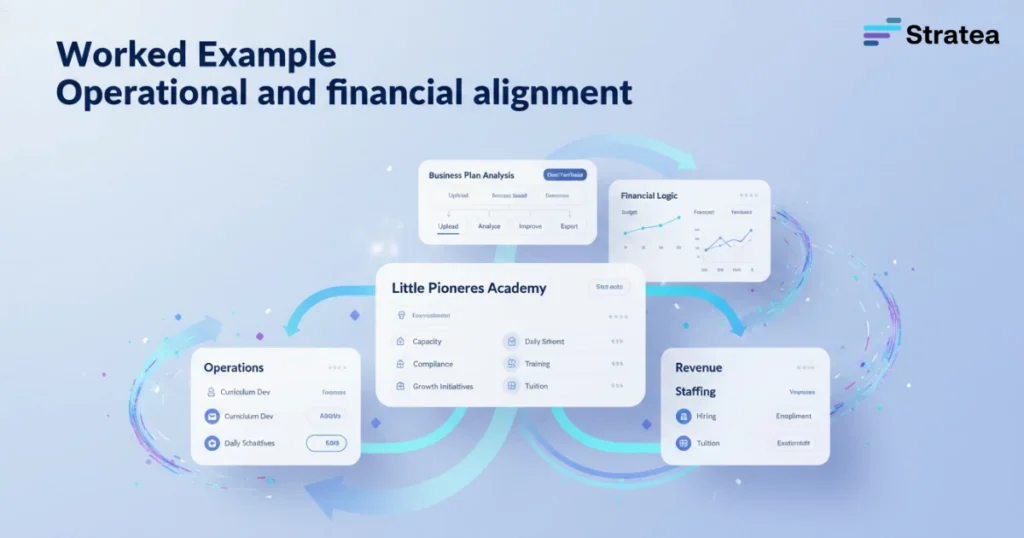
Worked Example: Operational and Financial Alignment for Little Pioneers Academy
To understand how these structural dependencies operate in a real plan, let us examine a practical example. We will look at Little Pioneers Academy, a premium early childhood education and daycare center based in a growing suburban market.
The founders are drafting a comprehensive startup business plan to secure regional licensing, complete a commercial facility build-out, and win approval for a $350,000 commercial bank loan.
Step 1: Documenting Operational Assumptions and Local Capacity Mandates
The planning process for Little Pioneers Academy begins with local regulatory mandates rather than revenue targets. State and provincial childcare licensing rules dictate strict teacher-to-child staffing ratios and precise square-footage allocations per individual child:
- Infant Classroom Ratio: 1 trained educator for every 4 infants. Maximum classroom capacity is set at 10 infants.
- Facility Space Mandate: 35 square feet of usable indoor activity space per child.
- Target Facility Profile: A 4,200 square foot commercial building, yielding a maximum safe operating capacity of 80 total children across all age brackets.
These regulatory requirements establish the baseline conditions for the entire business plan. The maximum cap on student enrollment is limited by physical space mandates, meaning the founders cannot simply project higher sales volume without leasing more real estate.
Step 2: Translating Staffing Ratios Into Unit Economics
Next, the operational constraints are translated directly into core unit economics. This step ensures that the financial projections match the physical limits of the business model.
[Local Ratio Mandate] —> [Staffing Count Required] —> [Direct Labor Cost Baseline]
The founders outline their baseline monthly operational assumptions based on these resource constraints:
- Average Monthly Tuition: $1,450 per child across all age groups.
- Fully Enrolled Monthly Revenue Cap (80 Children): $116,000.
- Direct Labor Baseline: 10 full-time educators at an average salary of $3,800 per month, plus an on-site licensed director at $5,200 per month.
- Total Monthly Payroll Burden (Including Taxes and Benefits): $48,500.
- Fixed Facility Rent and Utilities: $11,000 per month.
By matching student capacity directly with mandatory teacher headcount, the unit economics remain realistic. The plan avoids the common trap of scaling up customer volume while leaving payroll costs flat.
Step 3: Structuring the Funding Request Around Compliance Milestones
The final $350,000 capital request is structured around distinct construction and regulatory milestones rather than being spent all at once. This approach gives the commercial lender an explicit look at how capital corresponds to project phase risk mitigation.
[Phase 1: Capital Allocation] —> [Milestone: Facility Build-Out] —> [Risk Reduction]
The capital deployment schedule is integrated into the plan using a clear structural overview:
- Phase 1 ($150,000): Securing the commercial lease, finalizing architectural safety plans, and funding the internal facility build-out to pass local fire and health department inspections.
- Phase 2 ($100,000): Outfitting classrooms with certified educational materials, installing outdoor play structures, and launching targeted local enrollment campaigns.
- Phase 3 ($100,000): Direct working capital reserve dedicated to covering fixed payroll and facility overhead during the initial 4-month enrollment ramp-up phase.
This milestone-driven structure shows the bank credit committee that the founders have paired their funding request with verifiable operational inflection points, making the entire business model far more defensible.
Founders can use the startup business plan generator segment at STRATEA to build out similar milestone-based funding models tailored to their own unique industries.
Operational and financial alignment
Evaluating Planning Methods: Structural Defensibility Comparison
Reviewers look for consistency across all sections of your plan. The following comparison table highlights what an institutional credit analyst or investment reviewer expects to see, contrasted with the common structural gaps found in standard, template-driven submittals.
| Plan Component | Common Template Submittal (High Reviewer Risk) | Defensible Structural Approach (Low Reviewer Risk) |
| Go-to-Market Strategy | Assumes rapid, low-cost customer acquisition across all digital channels without tracking localized conversion metrics. | Ties local marketing expenses directly to verified regional acquisition costs, scaling budget alongside regional capacity growth. |
| Staffing and Payroll | Lists total employee headcount as a flat expense lines that do not scale alongside customer growth. | Links hiring timelines directly to capacity increases, building regional payroll taxes and training periods into the model. |
| Capital Expenditures | Requests a lump-sum funding amount without providing detailed asset itemization or clear vendor deployment schedules. | Pairs specific tranches of capital with clear operational milestones, including built-in contingency funds for supply chain delays. |
| Risk Mitigation | States that the company faces no direct local competition or assumes zero regulatory hurdles during launch. | Identifies specific operational vulnerabilities, maps out alternative supply options, and includes a detailed sensitivity analysis. |
Translating Your First Draft Into a Reviewer-Ready Document
Identifying Hidden Operational Blind Spots
Refining a business plan draft requires moving past high-level ideas to carefully analyze your everyday operational workflows. Reviewers routinely spot overlooked details in cost assumptions, particularly regarding commercial general liability insurance, software licensing stacks, and onboarding costs for new staff.
You must examine every step of your service delivery model to ensure your cash flow projections remain accurate. If your company relies heavily on specialized logistics, you must account for seasonal shifts in freight fees and shipping timelines.
Exposing and resolving these hidden overhead variables early ensures your financial runway remains intact during your critical first year of operation.
Preparing Stress-Test Scenarios for Financial Projections
A defensible business plan must stand up to changing economic conditions. Before presenting your plan to a lender or investment committee, you should subject your financial statements to a detailed sensitivity analysis.
What happens to your cash reserves if your customer acquisition costs increase by 30%? How long can your company operate safely if your regulatory licensing approval takes an extra 90 days?
[Base Case Scenario] —> Apply 30% Cost Hike / 90-Day Delay —> [Verify Cash Runway Security]
Building conservative downside scenarios directly into your strategic planning files demonstrates high financial literacy. It shows reviewers that your management team knows how to preserve working capital and adjust operations during market downturns.
What makes STRATEA different?
STRATEA operates as an interactive AI Planning Assistant through its unique Strategic Discovery Process rather than acting as a quick document generator. Instead of simply generating static boilerplate text, the system acts as a professional thinking partner that asks the challenging structural questions an experienced business advisor would ask. STRATEA prioritizes long-term strategic defensibility over simple document creation speed, helping founders identify hidden operational gaps and build comprehensive, review-ready plans.
If you have a rough working draft or a collection of disconnected launch notes, you can bring your audience notes into STRATEA to see how they affect your strategy, roadmap, and financial assumptions. Organising your operational evidence within a unified planning workspace ensures your document is ready for a professional audit.
FAQ
What evidence belongs in the startup business plan section of a new company?
Your plan must contain objective, third-party data to validate its core operational claims. This includes local demographic data from official census bureaus, verified commercial real estate quotes for facility overhead, documented supplier pricing, and clear references to state or provincial regulatory mandates. Avoid relying on speculative personal estimates; use public, attributable industry data instead.
How do local licensing requirements change my financial projections?
Local licensing requirements often act as pre-revenue cost centers. Your financial plan must account for all fixed overhead expenses, including property rent, utility costs, and insurance premiums, during the months you spend waiting for official regulatory approvals. These pre-opening costs must be built directly into your initial capital requirements to protect your working capital runway.
What should I do if my target market appears too small for investor backing?
A small, highly concentrated target market is often an asset rather than a liability, especially for small businesses or local service providers. Lenders and niche investors prefer a realistic, well-defined target audience that shows high purchase intent over a massive, unvalidated market claim. Focus your plan on proving strong unit economics and clear path to profitability within that specific segment.
How do I connect my go-to-market strategy to my operational capacity milestones?
Your go-to-market strategy must scale in direct alignment with your physical or technical infrastructure constraints. If your marketing plan is projected to double your customer count by Q3, your operational plan must show the exact hiring schedules, equipment orders, and facilities expansion needed to handle that volume. Never project an increase in sales without showing the corresponding operational expenses.