Business plan for visa interview preparation should do more than summarize a company. It should help you explain the business, support major claims, and keep spoken answers consistent with the application. That matters most in business-based cases, including US E-2 investor interviews and some entrepreneur or expansion pathways. Not every visa requires a business plan, and no document guarantees approval. The goal is a plan you understand well enough to defend under direct questioning.
A polished plan can still fail under questioning
A professionally formatted plan can create false confidence. If the applicant cannot explain where the revenue forecast came from, why the location was chosen, or how the investment will be used, the document starts to look borrowed rather than owned.
The risk grows when the plan, application forms, bank records, corporate documents, and spoken answers tell slightly different stories. An interview may be brief, but a few precise questions can expose weak assumptions. Your preparation should therefore focus on logic and consistency, not memorizing pages.
Build the plan around the immigration decision
Before writing, identify the decision the reviewing authority must make. The same business can need different evidence under a different pathway.

For a US E-2 interview
An E-2 case generally turns on a treaty investor’s nationality, a substantial investment in a real operating enterprise, control or the ability to develop and direct it, and an enterprise that is more than marginal. The plan should connect these criteria to operational facts.
Show what has been committed, what the money purchased, when operations begin, how customers will be acquired, and why the applicant can lead execution.
For EB-5 and L-1 new-office cases
Other US categories require different evidence. EB-5 planning must support verifiable job creation. An L-1 new-office plan should explain the launch timetable, premises, staffing, structure, and intended managerial or executive role.
For Canadian entrepreneur pathways
Canada has no universal entrepreneur interview standard. Federal processing and provincial streams can ask different questions. A useful plan should still show active management, local operations, ownership, market need, funding, and economic contribution.
For a Start-up Visa application accepted before the pause, align the plan with the qualifying business, designated-organization support, ownership, and Canadian operations. For a provincial stream, follow current criteria.
Six sections an interview-ready plan must get right
The strongest plan is not the longest. It gives reviewers traceable answers and applicants a reliable preparation tool.
1. Business concept and applicant fit
Explain the customer, problem, solution, revenue model, location, and current stage. Connect the applicant’s experience to the work ahead and show how prior skills reduce execution risk.
2. Market and competitive evidence
Define the reachable customer, not only a national industry. Use local demand, competitor pricing, interviews, contracts, pilot results, or reliable public data. Label estimates clearly.
For example, a 15-seat café forecasting 120 daily customers should explain opening hours, seat turnover, takeout volume, average ticket, nearby demand, and competitor traffic. One broad coffee-market statistic cannot support that forecast.
3. Operations, staffing, and milestones
Describe premises, permits, suppliers, equipment, staffing, sales channels, responsibilities, and launch sequence. Connect hiring to revenue or capacity milestones.
4. Investment and use of funds
Break the investment into lease deposits, buildout, equipment, inventory, payroll reserve, marketing, and working capital. Connect major lines to invoices, quotes, agreements, bank records, or documented assumptions.
5. Financial projections
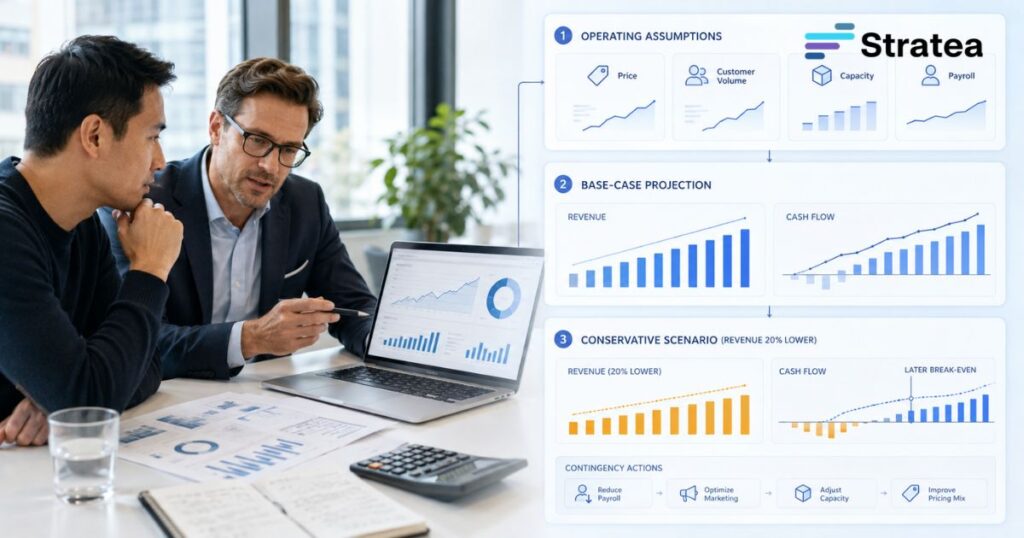
Build revenue from operating behavior, not a desired year-five total. Show pricing, volume, conversion, capacity, margins, payroll, fixed costs, cash needs, and break-even logic. Include a conservative case.
6. Risks and contingency actions
A credible plan acknowledges uncertainty. Name execution risks, then define triggers and responses. If a permit is delayed, a supplier fails, or customer acquisition costs rise, what changes?
Turn the plan into an interview evidence map
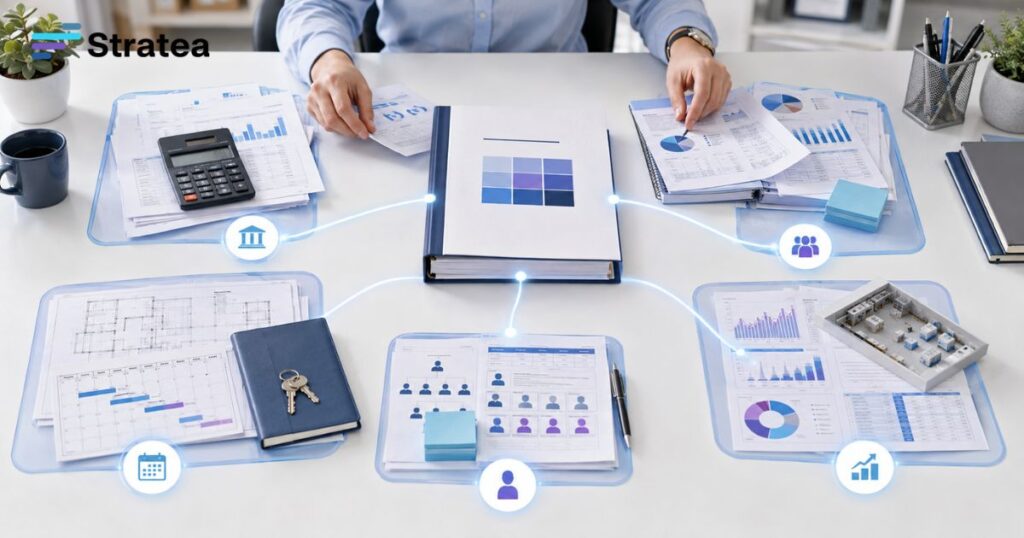
Do not prepare by rereading the document from page one. Convert it into a compact evidence map that links likely questions to answers, plan sections, and supporting documents.
Prepare a 30-second business explanation
State what the business sells, who buys it, where it operates, why the market needs it, how it earns revenue, how much has been invested, and what you will manage. Use ordinary language. If the answer sounds like a pitch competition, simplify it.
Match every major claim to evidence
- Investment amount -> bank trail, invoices, contracts, and use-of-funds schedule.
- Market demand -> research, customer evidence, sales, reservations, or letters of intent.
- Premises and launch timing -> lease, permits, buildout schedule, and supplier quotes.
- Hiring plan -> role descriptions, payroll assumptions, workload triggers, and milestones.
- Revenue forecast -> pricing, volume, conversion, capacity, and scenario assumptions.
Stress-test the numbers aloud
Ask someone unfamiliar with the business to challenge each important assumption. Answer without opening the plan, then check whether the document supports what you said.
Questions your business plan should help you answer
Questions vary by case and post. Preparation is stronger when it follows the plan’s logic rather than a memorized script.
- What does the business do, and who is the first customer segment?
- Why did you choose this market and location?
- Who are the direct competitors, and why will customers choose you?
- How much have you invested, where did the funds come from, and how were they used?
- What will you personally manage after entry?
- How were sales, expense, and hiring projections calculated?
- When does the business reach break-even, and what happens if revenue is 20% lower?
- Which facts are already proven, and which are still assumptions?
Common mistakes that weaken interview credibility
The most damaging errors are usually contradictions, not design flaws. Avoid rounded numbers that change between documents, unsupported market-share claims, copied industry language, unexplained cash transfers, and hiring forecasts disconnected from operations.
Do not memorize a consultant’s wording. Learn the logic and use your own language. If facts change after filing, tell your legal adviser and prepare an accurate, documented explanation.
How STRATEA supports interview-ready planning
STRATEA is an AI Planning Assistant designed to turn raw business information into a structured plan. Its guided Strategic Discovery Process helps organize the idea, market, operating model, financial assumptions, risks, and milestones before the writing looks finished.
You can also use an existing draft and additional answers to improve the next version. This helps connect the narrative, operations, and numbers. The aim is a clearer business case for you and your professional advisers to review, not automated legal conclusions.
Final business plan for visa interview checklist
- Confirm that the visa or entrepreneur pathway is current and that a business plan is relevant.
- Match names, dates, ownership, investment totals, locations, and timelines across every document.
- Verify that market claims and financial assumptions have identifiable sources.
- Practice the business explanation and the base-case numbers without reading.
- Prepare supporting evidence in the same order as the plan’s core claims.
- Review material changes and immigration-specific requirements with qualified counsel.
Conclusion
A business plan for visa interview preparation works best as a map of decisions and evidence. It should show how the company operates, why the assumptions are reasonable, where the money goes, and why the applicant can execute the plan.
Build around the actual pathway, test every important number, and practice in plain language. STRATEA can refine the business logic; qualified counsel should review legal strategy and filing requirements.
FAQs
Is a business plan required for every visa interview?
No. It is most relevant to investor, entrepreneur, and business-expansion cases. Requirements vary by category, location, and application.
How long should a visa business plan be?
Long enough to explain the business and support the decision. Clarity, evidence, and internal consistency matter more than a fixed page count.
Can AI write a visa business plan?
AI can organize inputs, expose gaps, and model scenarios. It must not invent evidence or replace legal review. The applicant must verify the plan.
What should I bring to a business visa interview?
Follow the instructions from the relevant authority and interview location. Organize the required forms and supporting evidence so key business-plan claims can be verified quickly.