
A Canada Start-up Visa business plan must do more than describe an exciting idea. It should demonstrate commercial viability, explain why the venture belongs in Canada, and show how the founding team can execute the strategy. Using an ai business plan generator can help entrepreneurs organize their research, assumptions, financial forecasts, and implementation roadmap into one coherent document.
However, software cannot replace verified evidence, founder judgment, professional immigration advice, or the independent assessment of a designated organization. The strongest plan connects every claim to realistic data and every financial projection to a practical operating decision.
Important program update: As of August 2026, Canada’s Start-up Visa Program is paused for new applications. Immigration, Refugees and Citizenship Canada stopped accepting new commitment certificates after December 31, 2025. Applicants holding a valid 2025 commitment certificate had until June 30, 2026, to apply. IRCC continues to process applications accepted before that deadline. Always review the latest information on the official IRCC website.
What is a Canada Start-up Visa business plan?
A Canada Start-up Visa business plan is a structured document explaining how an innovative venture will enter the Canadian market, create value, operate sustainably, and compete at scale. It may support discussions with designated organizations and help maintain consistency across an existing immigration application.
The document should not be treated as a generic startup template. It must reflect the founders’ actual business model, ownership structure, experience, market evidence, funding position, and implementation progress.
Before the program pause, applicants generally needed support from a designated venture capital fund, angel investor group, or business incubator. These organizations could establish their own evaluation and selection processes. Therefore, a business plan often functioned as both a strategic document and a central part of the founder’s pitch.
For applications already being processed, the plan can also remain valuable when preparing for information requests, business development discussions, or an interview. Founders should be able to explain its assumptions without relying on memorized statements.
Why a generic business plan creates credibility problems
Many startup plans look polished but remain commercially weak. They use broad market statistics, present aggressive revenue growth, and claim to have no meaningful competitors. These weaknesses become more serious when the document supports an immigration-related business proposal.
A reviewer may question the venture if the plan:
- Describes a product without identifying a specific customer problem.
- Uses global market figures without calculating an obtainable Canadian market.
- Presents revenue forecasts with no pricing or sales assumptions.
- Assigns unclear responsibilities to the founding team.
- Claims Canadian job creation without an operational basis.
- Conflicts with the pitch deck, website, application forms, or Letter of Support.
The problem is not only missing information. It is the absence of a logical connection between the opportunity, execution plan, and projected results.
A credible Canada Start-up Visa business plan should make that connection visible. If the business expects 2,000 paying customers, the document should explain how those customers will be acquired, what they will pay, how long acquisition may take, and what resources the company needs to serve them.
Core sections of a Canada Start-up Visa business plan
The exact format may vary by venture and designated organization. Nevertheless, most strong plans contain several core sections that allow reviewers to assess the opportunity from commercial, operational, and financial perspectives.
Executive summary
The executive summary should provide a concise overview of the complete venture. It normally covers the problem, proposed solution, target customers, competitive advantage, business model, traction, founding team, Canadian strategy, and funding requirements.
Although it appears first, this section is usually easier to write last. Every statement should match information presented later in the plan.
Avoid opening with a vague ambition such as “becoming the world’s leading platform.” Begin with a concrete problem and explain why the company is positioned to solve it.
Problem, solution, and innovation
The plan must define a problem experienced by a specific customer group. It should then show how the product or service addresses that problem better than available alternatives.
Innovation does not always mean inventing an entirely new technology. It may involve a new process, delivery model, application of technology, or underserved market. The important point is to explain what is meaningfully different and why customers would care.
Support this section with evidence such as interviews, pilot results, letters of intent, prototype testing, waitlist data, or early sales. Evidence is generally more persuasive than enthusiastic language.
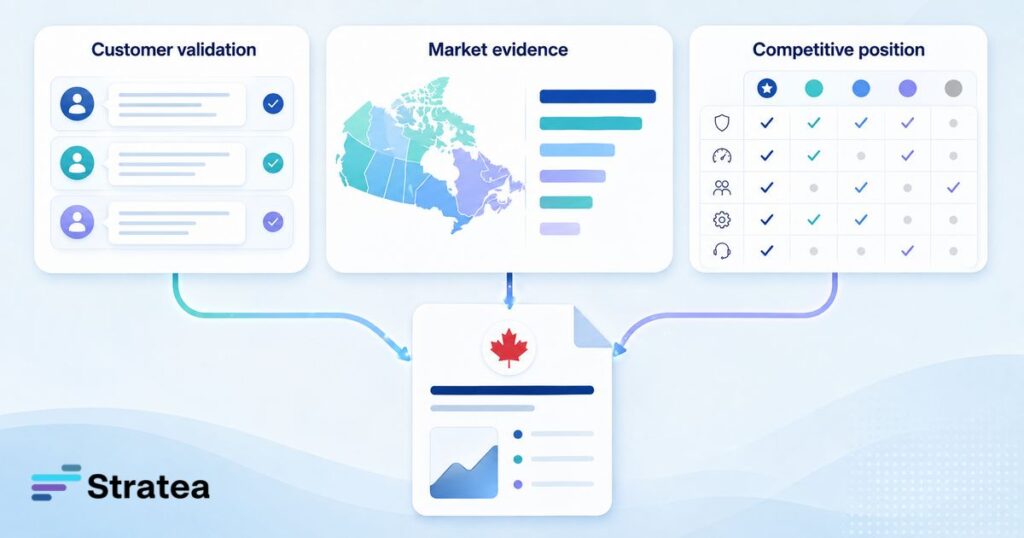
Canadian market analysis
A market analysis should move from broad industry context to a realistic target segment. Statistics about a multibillion-dollar global industry are insufficient unless the plan shows which part of that market the startup can actually reach.
Explain:
- Who the initial Canadian customers are.
- Where they are located.
- How they currently address the problem.
- What influences their buying decisions.
- Whether regulations or regional differences affect entry.
- How much the initial target segment may be worth.
The analysis should distinguish total addressable market, serviceable market, and the realistic share the company aims to capture. Each estimate should use traceable sources and clearly stated assumptions.
Competitive analysis
Saying that the company has no competitors can weaken credibility. If a meaningful problem exists, customers are probably already using another product, a manual process, internal staff, or no solution at all.
Compare the venture with both direct and indirect alternatives. Relevant dimensions may include price, performance, accessibility, specialization, implementation time, customer support, and intellectual property.
The goal is not to prove that every competitor is inferior. It is to identify where the startup can establish a defensible position.
Business and revenue model
This section explains how the company creates, delivers, and captures value. It should identify the customer, buyer, pricing model, sales channel, expected transaction size, payment frequency, and major costs.
For a subscription business, include expected pricing tiers, conversion rates, churn assumptions, and customer acquisition costs. For a product-based company, explain production capacity, suppliers, inventory, distribution, and gross margin.
The revenue model must connect directly with the financial projections. If the narrative describes enterprise contracts but the forecast assumes thousands of individual monthly subscriptions, the inconsistency may raise questions.
Go-to-market strategy
A strong marketing section is more specific than a list of channels. It explains how the company will attract its first customers, test demand, convert leads, and expand after validating the model.
For each channel, clarify the target audience, campaign or sales activity, expected cost, and performance indicator. Early-stage ventures should usually prioritize a few testable channels instead of claiming they will dominate search, social media, partnerships, and direct sales simultaneously.
The plan should also separate existing traction from future intentions. Completed pilots, signed agreements, and verified revenue must not be presented in the same way as planned activities.
Founding team and ownership
The team section should show why the founders are capable of building this particular company. Relevant evidence may include technical expertise, industry knowledge, entrepreneurial experience, professional networks, and previous achievements.
It should also explain each founder’s responsibilities and the ownership structure. Under the program’s eligibility framework, each applicant must hold at least 10% of the voting rights, while the applicants and designated organization must jointly hold more than 50%.
If up to five owners apply through the same venture, their roles should be genuine and operationally necessary. The plan must not present several founders with identical or unclear responsibilities.
Canadian operations and job creation
A Canada Start-up Visa business plan should explain why Canada is strategically important to the venture. This requires more than stating that Canada has a strong economy or startup ecosystem.
Identify where the business will operate, which activities will happen in Canada, and how the founders will actively manage the company from within the country. Address incorporation, facilities, recruitment, suppliers, partnerships, product development, and customer support where relevant.
Job projections should be tied to business milestones. Instead of promising ten positions immediately, explain which role will be hired, when it becomes necessary, and how the company will fund it.
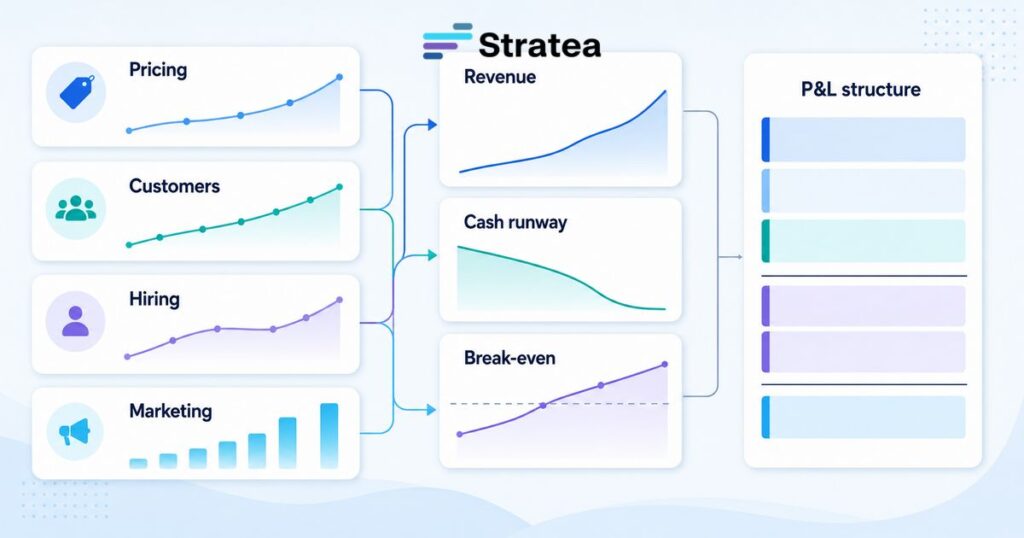
Financial projections and funding needs
Financial projections convert the strategy into measurable assumptions. A typical plan may include revenue, profit and loss, cash flow, balance sheet, startup costs, and break-even analysis.
Each figure should have an operational explanation. Revenue may be calculated from customers multiplied by average transaction value. Payroll should reflect the hiring plan. Marketing expenses should align with the acquisition strategy.
Include a base case and consider alternative scenarios. A slower-growth case can demonstrate that the founders understand uncertainty and have considered how to preserve cash if sales take longer than expected.
Build an evidence-backed implementation roadmap
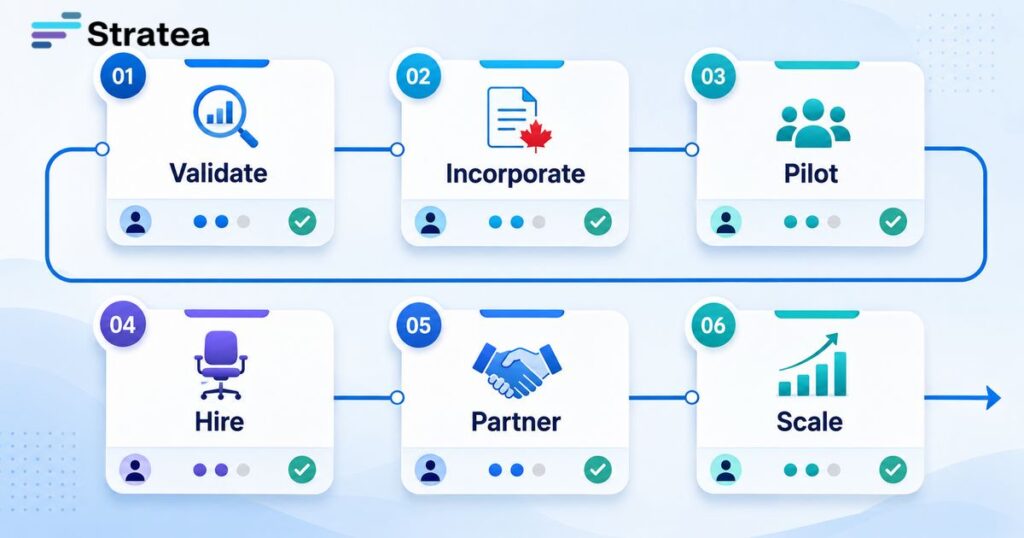
A business plan becomes more credible when it shows what will happen after each stage. Divide the roadmap into practical milestones covering product development, market validation, Canadian incorporation, recruitment, sales, partnerships, and funding.
Each milestone should include:
- A target period.
- A responsible founder or team.
- A measurable deliverable.
- The resources required.
- A success indicator.
For example, “expand in Canada” is not measurable. “Complete 30 customer interviews in Ontario and secure three paid pilot customers by the end of the second quarter” is more useful.
The roadmap should reflect the company’s current status. A startup with only a concept needs different milestones from a venture with a working product, customers, and international revenue.
Keep every document and answer consistent
A polished plan cannot compensate for contradictions elsewhere in the case. Founders should compare the business plan with their pitch deck, website, application records, ownership documents, financial model, and communications with the designated organization.
Before using the plan, verify important facts including:
- Founder titles and responsibilities.
- Shareholding and voting rights.
- Product development status.
- Investment and available capital.
- Customer or partnership claims.
- Revenue history and projections.
- Canadian hiring and operating timelines.
Founders should understand how every major projection was calculated. If assumptions change while an application is being processed, record the change and seek advice about whether updated information should be provided.
Common mistakes to avoid
The most damaging mistakes often come from exaggeration or inconsistency rather than formatting. Avoid unsupported market figures, copied industry descriptions, unrealistic hockey-stick forecasts, and fabricated traction.
Do not treat acceptance by an incubator or another designated organization as a guarantee of permanent residence. IRCC independently assesses immigration eligibility and the information in the application.
The business plan should also avoid giving the impression that immigration is the venture’s only purpose. It needs to present a commercially rational company whose founders intend to provide active and ongoing management from Canada.
How STRATEA supports the planning process
STRATEA guides founders through a Strategic Discovery Process that turns business information into an organized strategic plan. Users can develop market analysis, feasibility assumptions, financial projections, implementation milestones, and a business roadmap within one connected workflow.
Instead of beginning with a blank document, founders can answer structured questions and refine the resulting plan as new evidence becomes available. An existing plan can also be uploaded for analysis and improvement, helping users identify missing sections or inconsistent assumptions.
STRATEA does not determine immigration eligibility, provide legal representation, obtain a Letter of Support, or guarantee an application outcome. Its role is to help users create a clearer and more internally consistent business document for review by qualified professionals.
Frequently asked questions
Is the Canada Start-up Visa Program accepting new applications?
No. As of August 2026, the program is paused for new applications. IRCC continues to process applications accepted before June 30, 2026. Check the official government website for future changes.
Is a business plan an official guarantee of approval?
No. A strong plan may communicate the venture more effectively, but it cannot guarantee support from an organization or approval by IRCC.
How long should the business plan be?
There is no universal ideal length. It should be detailed enough to explain the opportunity, strategy, team, Canadian operations, and financial assumptions without unnecessary repetition. Supporting technical or financial details can be placed in appendices.
Can AI write the entire plan?
AI can structure information, identify gaps, and help develop projections. Founders must still verify every claim, provide genuine evidence, and ensure the final document reflects their actual business.
Conclusion
A credible Canada Start-up Visa business plan is built from evidence, consistent assumptions, and an achievable Canadian operating strategy. It should clearly connect the problem, innovation, market opportunity, founding team, financial model, and implementation roadmap.
For applications already in process, keeping the plan accurate can help founders explain their venture consistently as circumstances evolve. Entrepreneurs considering future opportunities should monitor IRCC announcements and avoid relying on outdated program information.
STRATEA can make the planning process more structured, but final immigration decisions remain with Canadian authorities. Before submitting updates or making decisions about an existing application, consult the official IRCC guidance and a qualified Canadian immigration professional.