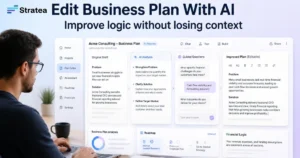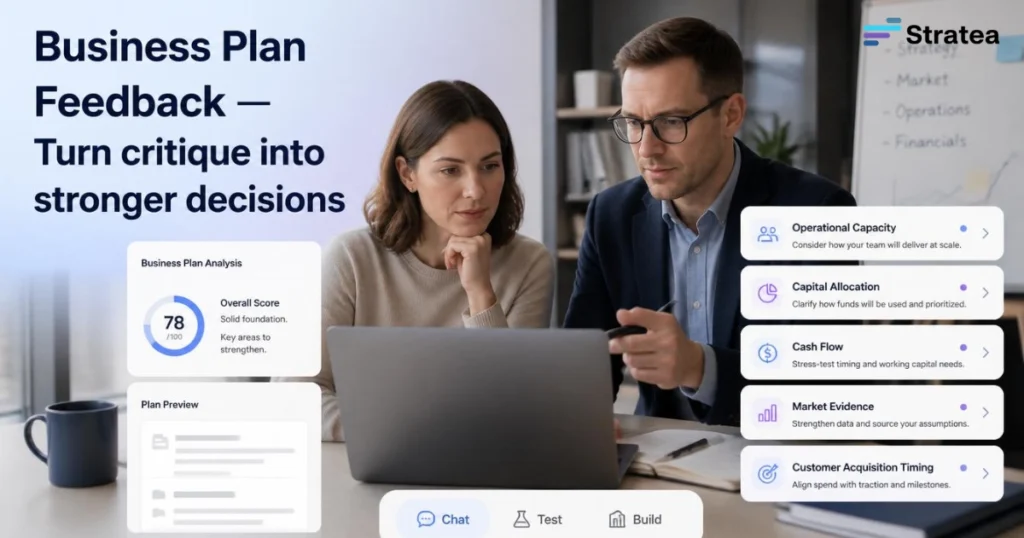
Completing a business plan is an important milestone, but it is only the beginning of the review process. Before sharing it with mentors, advisors, lenders, or potential investors, use stratea.ai to examine whether the plan’s core assumptions, market logic, and financial structure hold together. External feedback can be valuable, but it often arrives in conflicting forms: one reviewer may focus on presentation, while another questions pricing, customer demand, or the operating model itself.
The goal of business plan feedback is not to collect approval. It is to identify gaps that could weaken your case under closer scrutiny. A polished document may still rely on untested market assumptions, unclear growth targets, or financial projections that do not match the business model. By organizing feedback around evidence, priorities, and practical revisions, founders can turn scattered comments into a stronger, more defensible plan-one that is ready for serious conversations with lenders, investors, or strategic partners.
The Difference Between Strategic Feedback and Document Proofreading
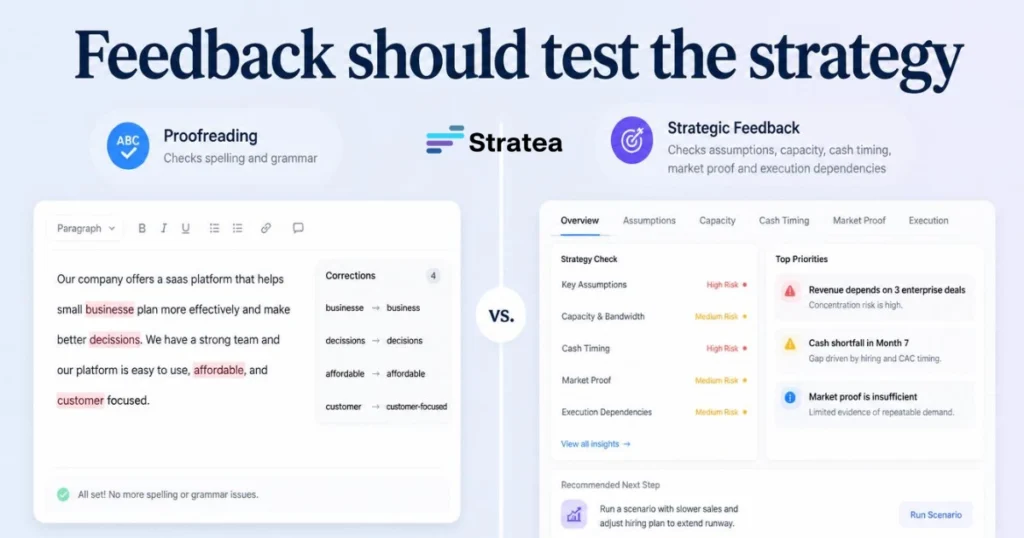
Many startup founders mistake cosmetic editing for a rigorous strategic assessment. Proofreading checks spelling, standardizes font choices, ensures grammatical compliance, and verifies formatting consistency. While a clean document prevents immediate dismissal by professional reviewers, it does not validate whether your business model can achieve profitability or survive a capital crunch.
Strategic feedback analyzes the underlying mechanics of your business operation. It asks whether your customer acquisition costs match your pricing architecture, whether your hiring timeline supports your sales projections, and whether your cash reserves can withstand a delayed collection cycle. A perfectly punctuated paragraph can still describe an operational model that will exhaust its cash reserves within ninety days.
When you seek evaluation, you must explicitly ask reviewers to target your logic rather than your prose. You want to know if your unit economics make sense, if your regulatory compliance steps are accurate, and if your operational timeline reflects reality. This distinction shifts your focus from cosmetic refinement to true structural defensibility.
The Core Elements of Actionable Business Plan Feedback
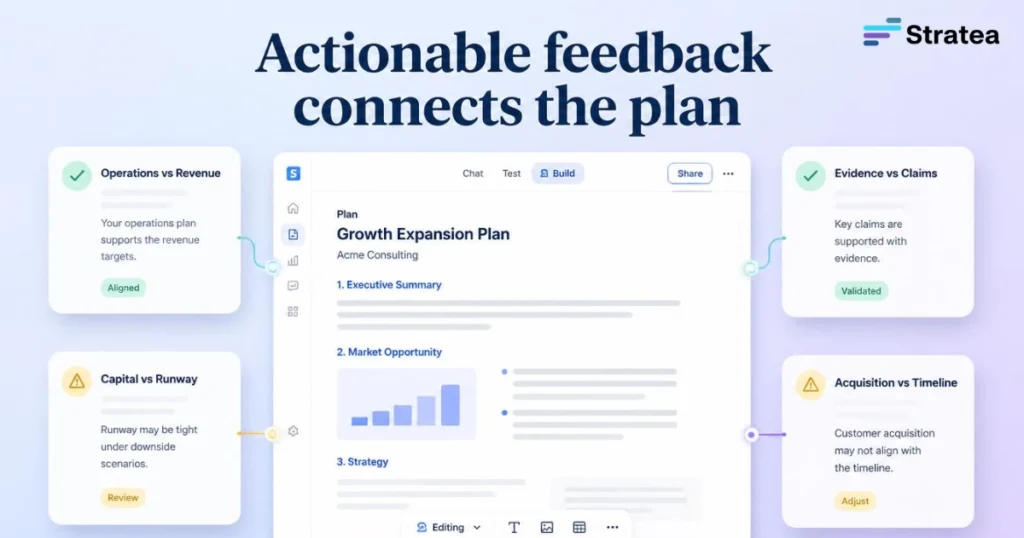
High quality evaluations look at specific linkages between different sections of your document. Useful feedback points out exactly where a claim in your executive summary fails to find support in your financial appendix. To make the most of the commentary you receive, look for insights across three primary operational areas.
[Raw Draft Inputs] ➔ [Strategic Feedback Audit] ➔ [Defensible Operating Model]
│
┌────────────────┴────────────────┐
▼ ▼
[Operational Capacity] [Financial Realism]
Validating Operational Capacity Against Revenue Goals
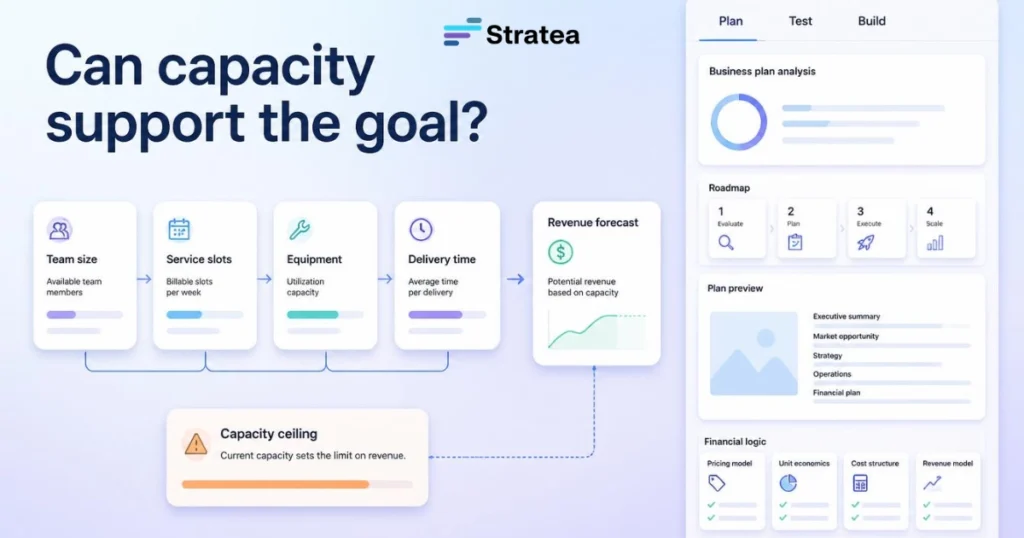
A frequent critique from experienced operations managers involves overambitious revenue targets paired with insufficient headcount or infrastructure. If your plan predicts a triple digit growth rate in client acquisition without showing a corresponding increase in customer service personnel or physical equipment, the plan lacks internal logic.
Reviewers look closely at capacity limits. For a service based organization, this means evaluating employee fulfillment limits, onboarding durations, and regional labor availability. For a product company, it means scrutinizing production throughput, inventory storage costs, and supply chain lead times. Actionable feedback will force you to document the exact operational steps required to deliver your projected sales volumes.
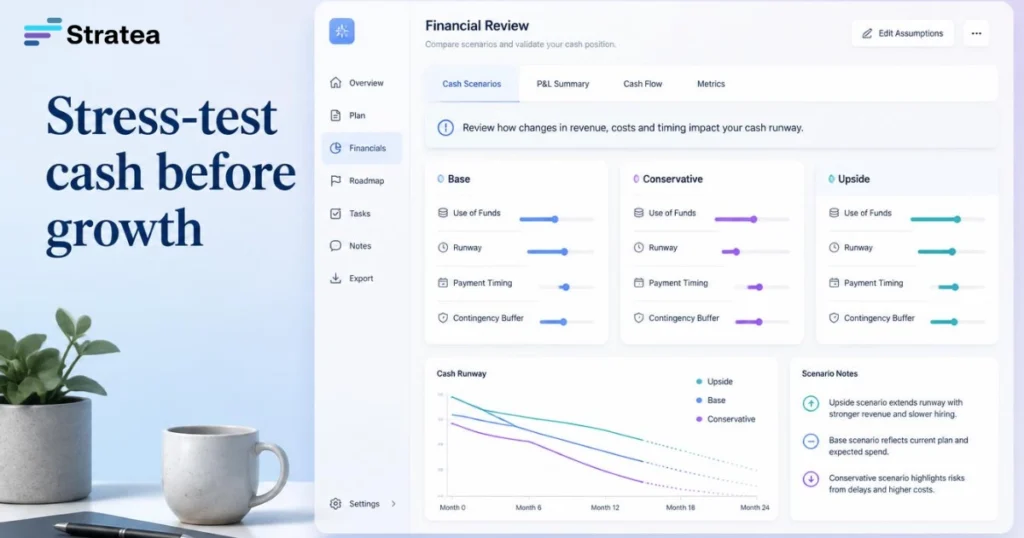
Stress-Testing Capital Allocation and Cash Flow Assumptions
Lenders and institutional investors focus heavily on cash flow timing risk. Feedback in this category often highlights unrealistic collection schedules. For example, assuming all B2B clients will settle invoices within thirty days ignores standard corporate procurement cycles, which frequently extend to sixty or ninety days.
Your feedback should challenge the buffer capital built into your financial model. A strong evaluation will ask what happens to your cash reserves if your primary product launch faces a ninety day regulatory delay, or if initial marketing conversion rates drop by half. By adjusting these variables based on critical input, you protect your company against early technical insolvency.
Assessing Market Evidence and Customer Acquisition Timelines
Generic statements about large addressable markets rarely satisfy professional reviewers. Valuable feedback pushes back on broad claims like catching just one percent of a billion dollar market. Instead, it asks for localized market evidence, direct competitor analysis, and clear conversion data.
Look for critiques that question your marketing budget allocation. If your plan relies on organic social media visibility to acquire high value corporate accounts, an experienced strategist will point out the historical failure rates of that approach. The feedback should guide you toward mapping explicit acquisition channels, estimated ad spends, and verified conversion benchmarks for your specific industry.
Comparing Feedback Frameworks: What Reviewers Check vs. What Founders Submit
To understand why certain elements of your draft receive criticism, it helps to contrast typical founder assumptions against the rigorous benchmarks used by institutional reviewers, including commercial banks and active angel networks.
| Content Section | What Founders Typically Submit | What Strategic Reviewers Actively Check |
| Executive Summary | A high level narrative focused on vision, abstract market scale, and long term optimism. | Clear capital requirements, immediate use of funds, target launch dates, and foundational risk factors. |
| Market Analysis | Broad industry reports showing massive global growth figures and macro level trends. | Direct regional competitor pricing, localized demographic validation, and current vendor friction points. |
| Operational Plan | A simplified list of upcoming milestones without explicit resource tracking or dependency maps. | Exact headcounts, specialized software needs, supply chain vulnerabilities, and local compliance requirements. |
| Financial Projections | Polished spreadsheets showing rapid revenue acceleration paired with fixed, unchanging operational expenses. | Cash flow sensitivity models, accounts receivable delay buffers, and direct alignment between marketing spend and new sales. |
Worked Example: Refine Strategy for Aura Medical Spa
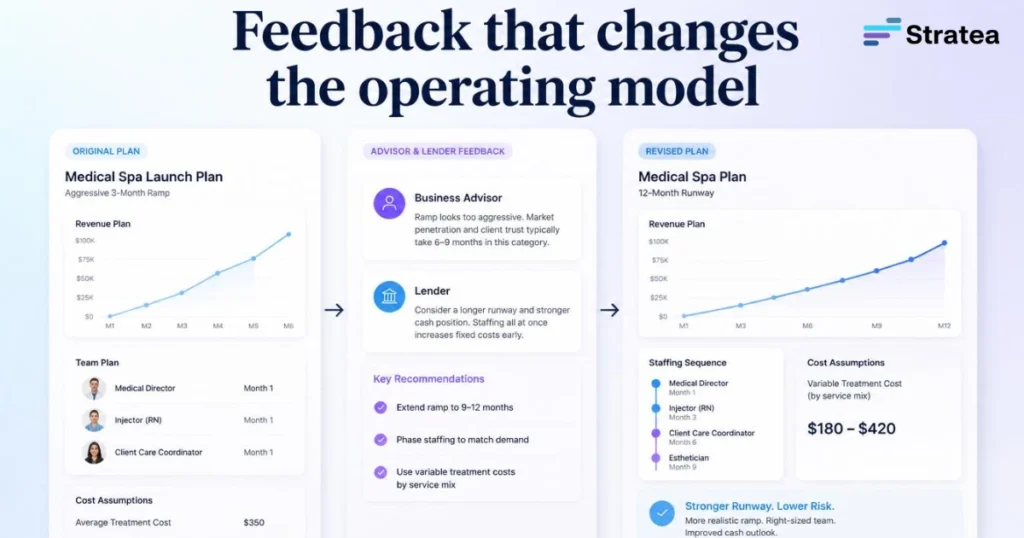
To see how strategic business plan feedback alters an operating model, let us look at the evolution of a regional service business draft. A founding team designed a premium medical spa called Aura Medical Spa, aiming to capture the growing demand for non invasive aesthetic procedures within a specific suburban market.
The Initial Operational Plan
The original draft submitted by the founders outlined an ambitious expansion strategy. They projected servicing forty clients per day within the first four months of operation using three specialized laser platforms. Their financial model assumed a steady profit margin based on low hourly labor costs and direct digital ad conversions. They budgeted twenty thousand dollars for initial launch marketing and planned to open their doors within sixty days of securing their lease.
The Feedback Received
An experienced medical operations advisor and a commercial lender reviewed the draft, providing critical section-by-section feedback that highlighted three critical flaws:
- Practitioner Utilization Limits: The plan ignored local licensing laws requiring an advanced nurse practitioner or medical director to oversee all active laser treatments, meaning the three machines could not operate simultaneously without additional high salary headcount.
- Regulatory and Credentialing Latency: The sixty day launch timeline failed to account for regional health department inspections, medical equipment calibration certificates, and insurance credentialing, which typically average four to six months.
- Consumable Cost Volatility: The financial projections treated laser treatments as pure profit, ignoring the high per use tip costs and specialized serum replenishments mandated by equipment manufacturers.
The Structural Correction
Instead of ignoring the critiques or merely rewriting the introductory paragraphs, the founders rebuilt their planning logic. They updated their document to reflect a realistic four phase approach.
| Phase 1: Compliance & Setup | Phase 2: Single Laser Operation | Phase 3: Extended Shift Hiring | Phase 4: Multi Platform Scale |
| Timeline: Months 1–5 | Timeline: Months 6–9 | Timeline: Months 10–12 | Timeline: Year 2+ |
They extended the pre launch runway from sixty days to five months, adding sufficient working capital to cover rent during the inspection period. They adjusted the practitioner scheduling matrix, showing that during the first year, they would focus on maximizing a single laser platform under one full time nurse practitioner rather than running three machines underutilized.
Finally, they integrated a variable cost line item for every treatment type, lowering their initial gross margins but presenting a highly credible, stress tested document that successfully secured a commercial line of credit from their local bank.
How to Organize Conflicting Feedback from Multiple Stakeholders
Receiving commentary from multiple sources often introduces deep contradictions. A startup mentor might urge you to lower your prices to capture early market share, while a potential commercial lender will look for higher margins to ensure consistent debt service coverage. Trying to implement every piece of advice simultaneously will distort your strategy and turn your plan into an unreadable document.
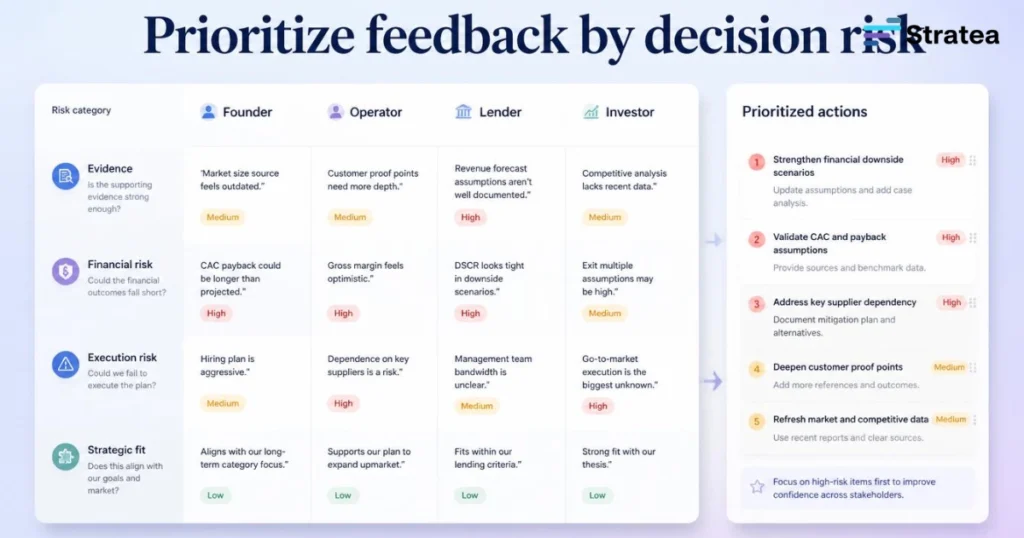
To resolve these contradictions, categorize every comment by stakeholder intent. Use the following hierarchy to decide which advice takes priority during your revision cycle:
- Tier 1: Regulatory and Financial Compliance: If an insurance specialist, CPA, or legal advisor points out an error in your tax structure, employment classification, or licensing timeline, correct this immediately. These items are non negotiable floor requirements for any operating entity.
- Tier 2: Primary Reader Requirements: If your immediate goal is securing a small business loan, prioritize the feedback focused on cash flow consistency, debt service coverage ratios, and collateral valuation. If you are pursuing venture capital, prioritize scalable acquisition loops and technology defensibility.
- Tier 3: General Operational Advice: Insights regarding workplace culture, office layout, or secondary marketing channels can be cataloged for later operational iterations rather than forcing an immediate rewrite of your core funding proposal.
The Role of an AI Planning Assistant in Analyzing Draft Assumptions
Evaluating a business draft manually requires hours of cross referencing numbers against structural text. This is where moving beyond a simple word processor or a basic text generator changes the workflow. Utilizing an AI Planning Assistant allows you to upload an existing business plan draft to run an immediate, section-by-section audit of your underlying logic.
Rather than just rewriting paragraphs to sound more sophisticated, a structured assistant acts as a rigorous thinking partner. It analyzes whether your marketing budget supports the client intake numbers stated in your operational strategy. It reviews your financial statements to confirm that cash flow realities match your revenue recognition assumptions.
This interactive exploration ensures that your document remains entirely your own, built on your true operational parameters while exposing the blind spots that human reviewers typically flags. Integrating this type of automated analytical loop helps you identify structural vulnerabilities early, allowing you to refine your strategy before presenting your model to external partners.
Building a Sustainable Plan Maintenance and Versioning Cycle
A business plan is not a static milestone that you complete once and archive on a hard drive. It functions as an evolving roadmap that requires frequent recalibration as real world data replaces your initial projections. When you receive critical feedback, establish a systematic versioning process to track how your business model changes over time.
Avoid saving over your master file every time an advisor offers a new suggestion. Maintain a clean version history, marking drafts by date and specific target audience, such as a lender facing version or an internal operations manual. Review your actual operational metrics against your planned projections every quarter.
If your customer acquisition costs double or your supplier increases material costs by ten percent, update your assumptions immediately. Keeping your planning logic closely aligned with live operational results allows you to maintain strategic clarity long after your initial funding round concludes.
Moving from Static Reviews to Decision-Ready Execution
Collecting observations on your startup framework is only valuable if you use those insights to drive explicit operational adjustments. A beautifully written strategy document that relies on unverified assumptions provides a false sense of security. True entrepreneurial readiness requires an ongoing commitment to objective analysis, financial realism, and structural adaptability.
As you prepare to share your plan with external stakeholders, shift your focus away from superficial praise. Look closely at the friction points within your model, pressure test your cash flow timelines, and verify that every operational goal connects to a visible financial reality. By actively seeking out and addressing structural critiques, you build an enterprise that is prepared to survive early market challenges and achieve long term commercial viability.
Turn your rough planning inputs into a clearer decision path with STRATEA. You can use STRATEA to clarify the assumptions behind your next business plan draft, allowing you to isolate weak spots before presenting your files to commercial lenders. Start with what you know, then let STRATEA help expose what still needs proof. Start Strategic Discovery today to move from a basic text draft toward a highly structured, editable, and decision ready operating model.
FAQ
What is the difference between a copy edit and a strategic business plan review?
A copy edit focuses exclusively on mechanics, including spelling errors, grammar fixes, formatting flow, and professional tone consistency. A strategic review evaluates the viability of the business model itself, analyzing whether your revenue projections match your operational capacity, market evidence, and cash flow timing parameters.
How should I handle completely contradictory feedback from two different advisors?
Filter the advice by your immediate strategic objective. If your current goal is securing a bank loan, prioritize the advice focused on asset protection, cash reserves, and predictable debt service. If the advice pertains to long term equity growth, prioritize insights regarding market scale and unit economics. Always ensure regulatory and legal compliance feedback takes absolute precedence over personal strategy preferences.
How detailed should the operational capacity section be to satisfy a commercial reviewer?
Your operational section must clearly demonstrate that you have the infrastructure, staff, and time required to deliver your projected sales volumes. For a service based firm, show explicit worker utilization rates and hiring lead times. For a product company, detail your manufacturing caps, storage logistics, distribution agreements, and inventory cash requirements.
Can an AI tool provide accurate feedback on industry specific regulatory compliance?
An AI Planning Assistant serves as an exceptional structural auditor to identify logical gaps, missing operational sections, and cash flow calculation misalignments. However, it should be treated as a guided starting point rather than a replacement for certified local professional advice. Always validate regional regulatory timelines, local licensing obligations, and complex tax requirements with a qualified local corporate attorney or CPA.