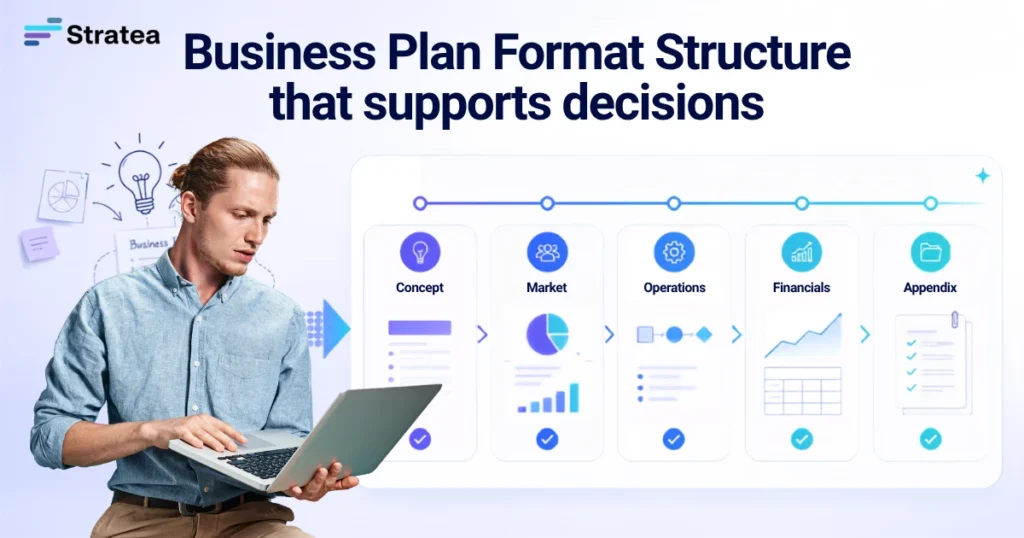
A business plan format is the framework that turns a business idea into a clear, reviewable case for action. With STRATEA AI, founders can organize their assumptions, market evidence, operating model, and financial projections into a plan that is easier to build, refine, and explain. A strong format does more than arrange headings on a page—it shows how the business will reach customers, deliver its offer, manage day-to-day operations, and make sound decisions using evidence.
Most traditional business plans include an executive summary, company description, market analysis, product or service line, marketing and sales strategy, operations plan, financial projections, and an appendix. Depending on the purpose of the plan, it may also include organization and management details, a funding request, and the proposed use of funds.
An AI business plan tool can make drafting these sections faster, but it cannot replace the reasoning behind them. Every section should support a consistent story: who the customer is, why the offer matters, how the business will operate, and what the numbers must prove.
A good format helps readers make a decision
A founder may think the format is about presentation. A reviewer usually sees it differently. The format tells them where to find the logic behind the business.
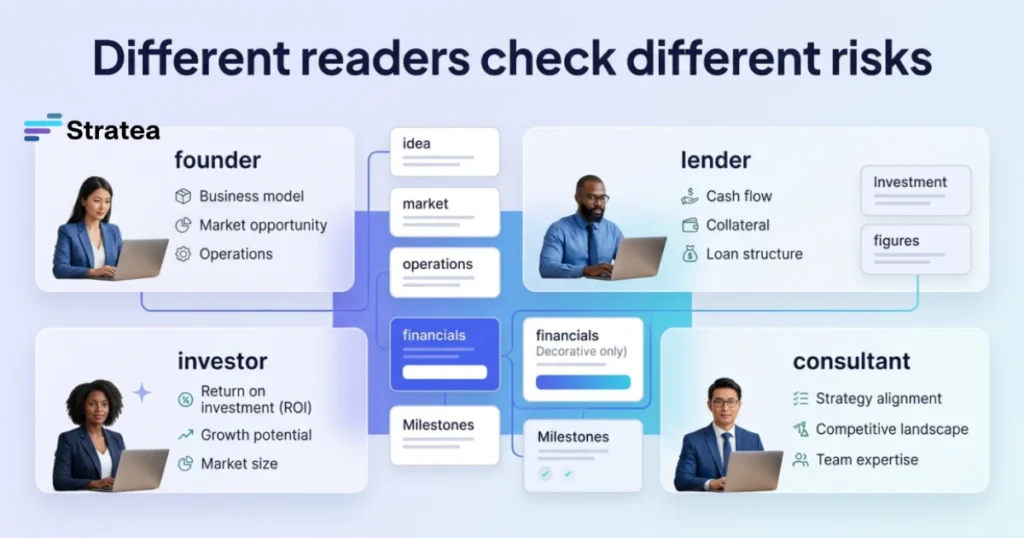
A lender wants to see repayment capacity. An investor wants to understand scale, risk and milestones. A founder needs to know what to do next. A consultant needs a structure that can be reviewed, improved and reused without hiding weak assumptions.
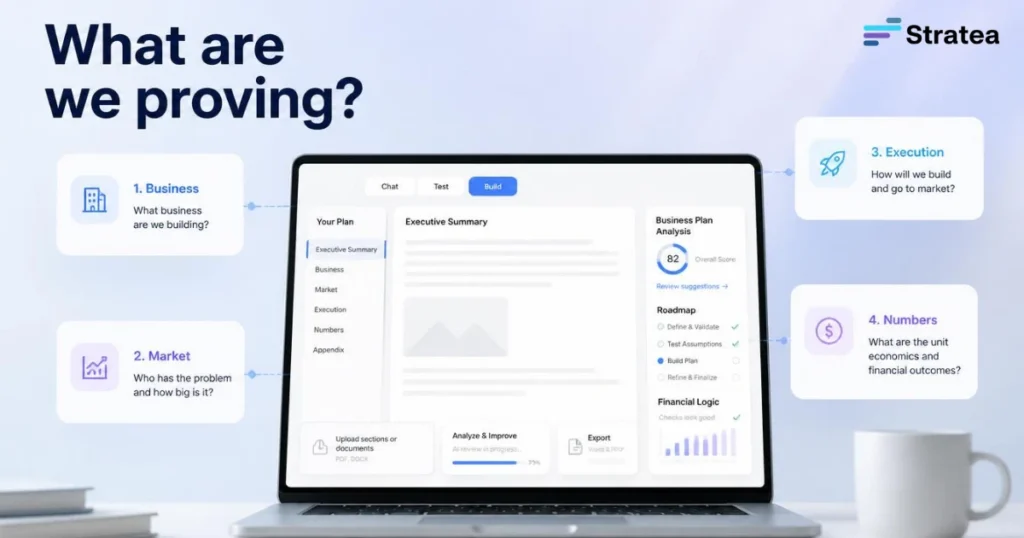
That is why the format should answer four practical questions:
- What is the business trying to do?
- Why should the market care?
- Can the team execute the plan?
- Do the numbers support the strategy?
A document can look polished and still fail these tests. Strong formatting makes gaps visible before someone else finds them.
How to choose the right business plan format
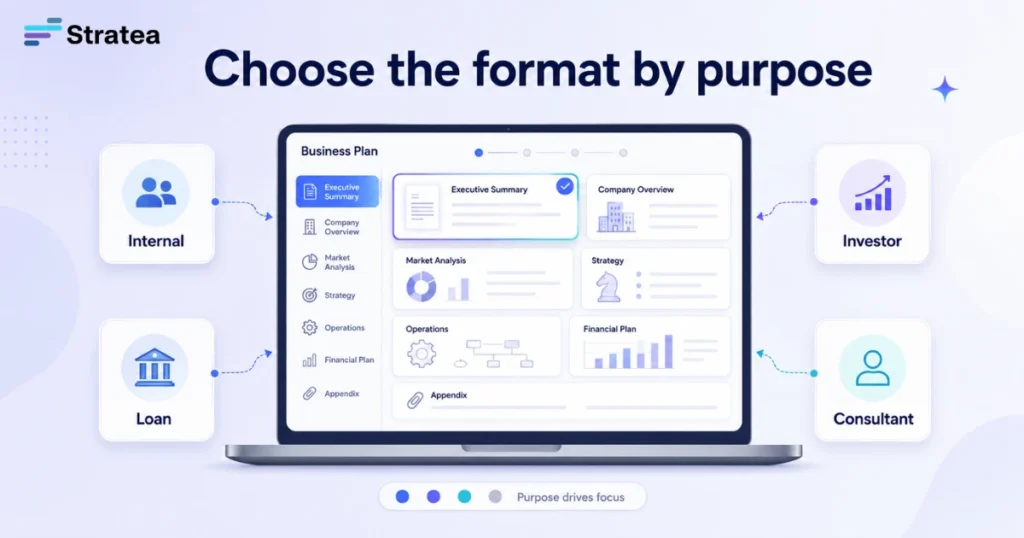
The right business plan format depends on the job the document must perform. A launch plan, a funding plan and a consultant-prepared plan may share sections, but they should not give each section the same weight.
For internal planning
An internal plan should be practical and action-oriented. It can be shorter, but it should be specific about customers, pricing, costs, owner responsibilities, launch milestones and near-term cash needs.
Founders often overbuild the executive summary and underbuild the operating model. For internal use, the operations plan and roadmap may matter more than a long market overview.
For funding or lending
A funding-facing plan needs more evidence. Readers will look for market size, demand validation, revenue assumptions, cost structure, cash flow and repayment or return logic.
For U.S. readers, a plan may need to align with what banks or SBA-oriented financing discussions typically expect. For Canadian readers, banks and BDC-related planning resources often emphasize financial planning, cash flow and financing needs. BDC describes financial projections as a way to plan for lower cash flows, identify financing needs and decide when to move forward.
For consultant or client-facing use
Consultants need a format that is repeatable but not generic. The plan must be easy to audit, edit and explain to the client.
That means clear headings, visible assumptions, a documented financial logic and a section-by-section review process. A consultant can then improve the plan without rewriting from scratch each time.
The core sections and what each one must prove
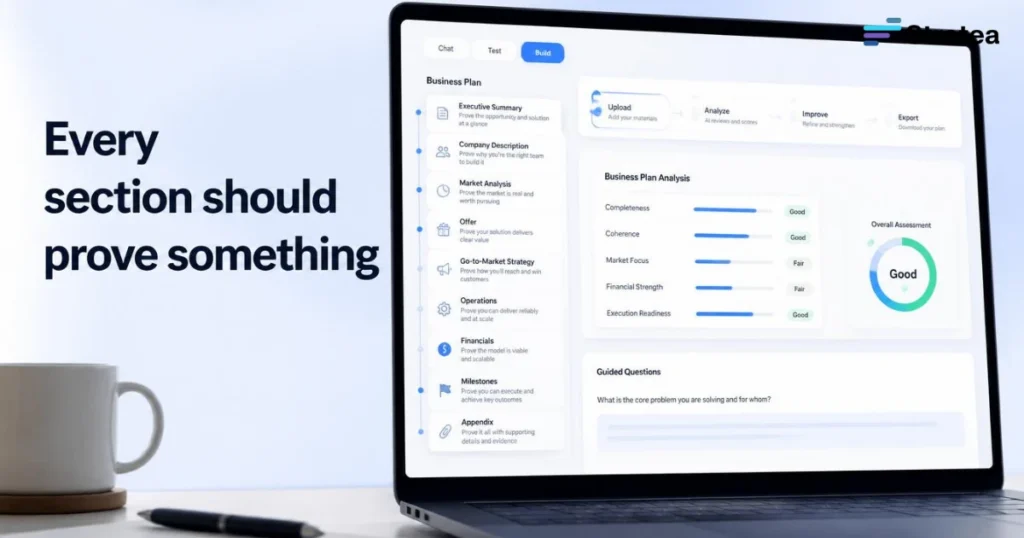
A standard plan structure is useful because it gives readers a familiar path. The mistake is treating each section as a writing assignment instead of a proof point.
Executive summary
The executive summary is not an introduction. It is a compressed version of the business case.
It should cover the business concept, target customer, problem, solution, business model, traction or validation, financial highlights and next milestone. Write it last, after the rest of the plan has exposed the real logic.
A weak summary says the business is promising. A strong summary explains why the plan deserves more attention.
Company description
The company description should explain what the business is, who it serves and why it exists.
Include the legal structure if known, location or service area, ownership, mission, business model and current stage. Avoid vague language such as “a modern solution for everyone.” Be specific about the customer and the situation that creates demand.
Market analysis
Market analysis should prove that the business is not guessing about demand.
Include target segments, customer behavior, competitor categories, market trends and the evidence behind your assumptions. This does not require pretending that AI-generated research is verified data. Use AI research as a structured starting point, then validate important claims with real sources, interviews, search data, local observations or industry reports.
For a small business, a narrow local market may be more useful than a large national market. For a scalable startup, the plan should explain which segment comes first and why.
Products and services
This section should explain the offer in business terms, not just product terms.
Describe what the customer buys, how it is delivered, why it is priced that way and what makes it different from alternatives. If there are multiple offerings, separate the launch offer from future expansion.
A clear offer section prevents a common planning problem: too many ideas competing for attention before the first offer has been validated.
Go-to-market strategy
The go-to-market strategy should show how the business will reach customers and convert demand into revenue.
Include acquisition channels, sales process, pricing, messaging, partnerships, retention and early testing. Do not list every possible channel. Choose the few that match the customer’s buying behavior.
A founder selling to local families does not need the same channel plan as a B2B software company selling to consultants.
Operations plan
The operations plan explains how the business will deliver what it promises.
Include staffing, suppliers, tools, locations, production, service delivery, quality control and workflow. This section matters because financial projections depend on operational reality. A revenue target is not credible if the team cannot serve that many customers, produce that many units or support that many clients.
Financial plan
The financial plan should connect assumptions to outcomes.
Include startup costs, revenue assumptions, cost of goods or service delivery, payroll, operating expenses, cash flow, profit and loss, break-even logic and funding needs if relevant. BDC notes that a business plan financial section should explain how the business expects to earn money, what it will spend and what financing it needs.
Do not hide uncertainty. Use base, conservative and upside cases when the numbers are sensitive to demand, pricing, labor or rent.
Milestones
Milestones translate the plan into action.
Good milestones include dates, owners, measurable outcomes and decision gates. Examples include customer interviews completed, first paid users, lease signed, prototype tested, supplier agreement secured, first month of positive cash flow or funding readiness review completed.
Milestones make the plan easier to manage after the document is finished.
Appendix
The appendix supports the main plan without interrupting the narrative.
Include resumes, detailed financial tables, market notes, legal documents, supplier quotes, product screenshots, research sources, lease details or supporting assumptions. The main plan should stay readable. The appendix should hold the evidence.
What changes by planning purpose
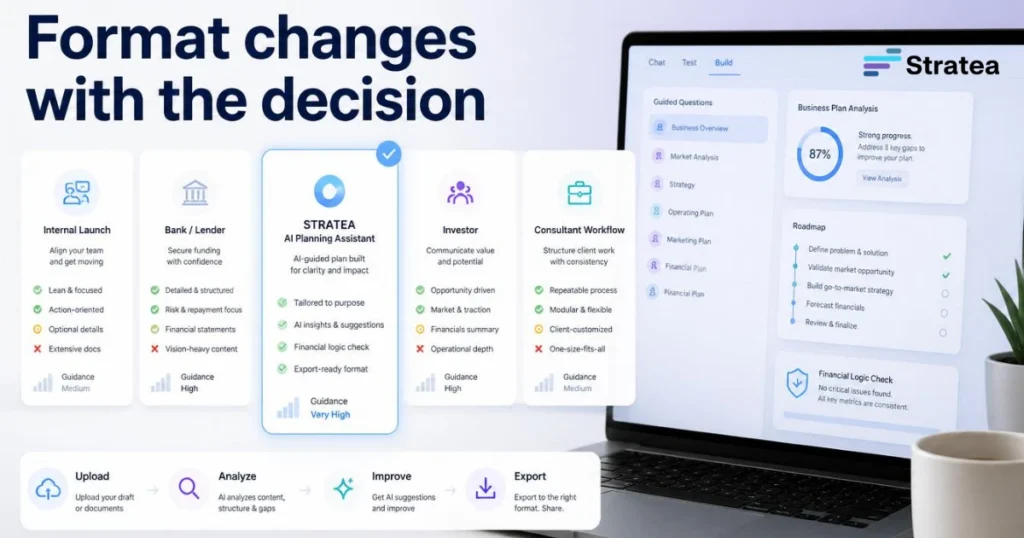
Different readers care about different risks. The format should make those risks easy to evaluate.
| Planning purpose | Sections to emphasize | What the reader is checking | Common mistake |
| Internal launch | Operations, milestones, financial plan | Can the team execute the next 90 to 180 days? | Too much market theory, not enough action |
| Bank or lender review | Financial plan, cash flow, market analysis | Can the business repay and manage risk? | Optimistic revenue with weak cost detail |
| Investor review | Market analysis, business model, milestones | Can the business grow and defend its assumptions? | Big market claims without a focused entry segment |
| Consultant workflow | Structure, assumptions, appendix, review notes | Can the plan be improved, explained and reused? | Static document with hidden logic |
| Existing draft improvement | Gaps, section order, financial logic | What needs revision before sharing? | Polishing language before fixing weak assumptions |
A format should not force every plan into the same shape. It should make the right evidence easier to find.
Worked example: NorthStar Mobile Vet
NorthStar Mobile Vet is a fictional mobile veterinary care service for suburban pet owners in Ontario and the Pacific Northwest. The company plans to offer wellness exams, vaccinations, senior pet checkups and follow-up visits at the customer’s home.
This is not a coffee shop, a generic software startup or a student project. It is a practical founder scenario with operating constraints, pricing decisions and market validation questions.
How the format changes for this business
For NorthStar, the plan should not overemphasize a large pet care market. The real question is whether enough households in the first service zone will pay for mobile care at a price that covers travel time, staff capacity and clinical supplies.
The plan should prioritize:
- Service area definition
- Customer segments, such as senior pet owners and multi-pet households
- Appointment capacity per day
- Pricing by visit type
- Licensing and professional requirements
- Vehicle and equipment costs
- Local competitor categories
- Referral partnerships with groomers, shelters or clinics
- Cash flow during the first six months
Section logic in practice
The executive summary should state the first service area, launch services, target customer and first-year milestone. A vague statement like “mobile care for pets” is not enough.
The market analysis should compare customer situations. A senior dog owner with limited mobility has a different willingness to pay than a price-sensitive customer looking for routine vaccination only.
The operations plan should show appointment capacity. If one veterinarian can complete six visits per day, with average revenue of $180 per visit, the maximum daily service revenue is not unlimited. Travel time, cancellations and documentation reduce capacity.
The financial plan should test that reality. If the base case assumes 22 service days per month, four appointments per day in month one and six appointments per day by month six, the plan can show a measurable ramp instead of a hopeful revenue line.
What the founder learns
The format helps the founder see the true decision points:
- Which service zone should launch first?
- How many appointments are needed to cover payroll, insurance, vehicle and supplies?
- Which customer segment has the strongest repeat potential?
- When should the business add a technician or second vehicle?
- Which partnerships can reduce acquisition cost?
That is the value of structure. It turns a business idea into a set of decisions the founder can defend.

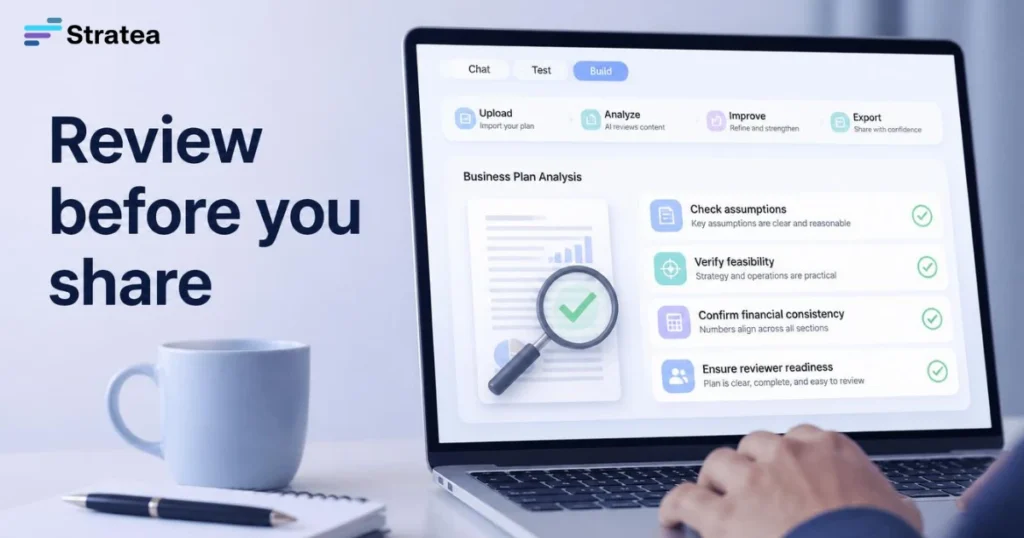
How to review your format before sharing it
Before sending a plan to a partner, lender, investor, consultant or internal team, review it like a skeptic.
Check the assumptions
Every major number should have an assumption behind it.
If the plan says monthly revenue will reach $40,000, the reader should be able to see the formula: number of customers, average ticket, frequency, capacity and timing. If the plan says marketing will work, it should explain the channel, audience, cost and expected conversion logic.
Check feasibility
Feasibility is where many plans break.
Can the team serve the projected number of customers? Can suppliers support the product mix? Does the timeline match hiring, permits, development or sales cycles? Can the business survive if revenue takes longer than expected?
A formatted plan should make these questions easier to answer.
Check financial consistency
The financial plan should match the rest of the document.
If the go-to-market section says the business will rely on direct sales, the financial plan should include sales labor or founder selling time. If the operations plan requires specialized equipment, the startup cost table should include it. If the market analysis points to price sensitivity, the pricing model should reflect that constraint.
Check reviewer readiness
A reviewer-ready plan does not need to be perfect. It needs to be explainable.
The founder should be able to defend the customer choice, pricing, milestones, operating plan and financial assumptions. That is more valuable than a beautifully formatted document with weak logic.
Build a plan you can defend
A useful business plan format is not about filling every possible heading. It is about making the business easier to evaluate.
The executive summary frames the case. The market analysis tests demand. The operations plan tests delivery. The financial plan tests whether the numbers work. The milestones turn the plan into action.
STRATEA helps founders move through this process with guided discovery, assumption-based planning and editable structure. You can start from raw answers or use an existing draft as input to analyze, improve and regenerate a stronger plan when combined with your follow-up answers.
STRATEA is free to start, with advanced or continued capabilities handled through paid plans. To build a plan you can explain, revise and defend, Start Strategic Discovery with STRATEA.
FAQ
What is the best format for a business plan?
The best format depends on the purpose. Most plans include an executive summary, company description, market analysis, products or services, marketing strategy, operations plan, financial plan, milestones and appendix. A lender-facing plan should emphasize financial projections and repayment logic, while an internal plan should emphasize execution and decision milestones.
How long should a business plan be?
A practical business plan can be 5 to 10 pages for internal planning and 15 to 30 pages for funding or formal review. Length matters less than clarity. The plan should be long enough to explain the business model, assumptions, market evidence, operations and financial logic.
What should come first in a business plan?
The executive summary usually appears first, but it should be written last. Write the market analysis, operating model, go-to-market plan and financial projections first. Then summarize the strongest points in the executive summary.
Is a one-page plan enough?
A one-page plan can be useful for early thinking, team alignment or a first concept review. It is usually not enough for lending, investor review or detailed launch planning because it cannot fully explain assumptions, financial projections, risks and execution milestones.
Can AI help format a business plan?
Yes, AI can help organize ideas, structure sections, identify gaps and improve an existing draft. Founders should still validate market research, financial assumptions and legal or funding-related requirements. STRATEA uses guided discovery to support planning clarity rather than treating the plan as a simple generated document.