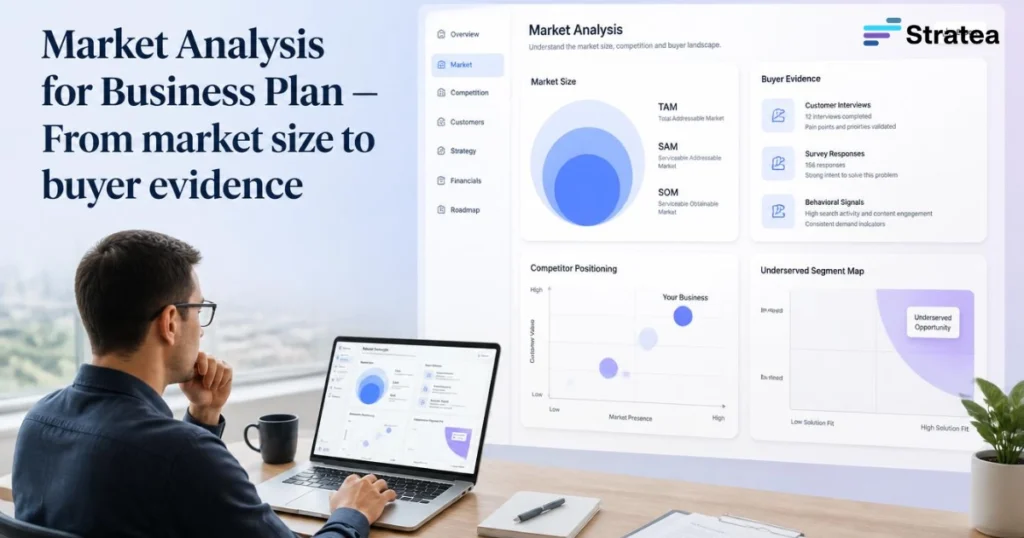
Most startup business plans contain a fatal flaw in the first few pages. Founders frequently open their market section with massive, top-down macroeconomic statistics, claiming their venture operates inside a multi-billion dollar industry. They assume that capturing a tiny fraction of a massive market guarantees success, but external reviewers like bank loan officers and angel investors see through this logic almost immediately. A credible market analysis requires shifting from broad industry assumptions to verifiable, bottom-up buyer evidence.
A professional market analysis is a structured proof that a specific group of target customers suffers from a problem they are actively willing to pay to solve. Instead of relying on generic industry reports, a defensible market analysis outlines precise buyer behaviors, clear local or niche market boundaries, and realistic competitive positions. This is a step where many founders reach for a fast AI business plan and get burned, since a tool that auto-populates a market size from a single industry database has no way of knowing whether your actual buyer segment is even reachable at the price point you’re planning around. This analytical framework transforms vague growth assumptions into a verifiable roadmap for customer acquisition.
The Trap of Macro Data in Startup Planning
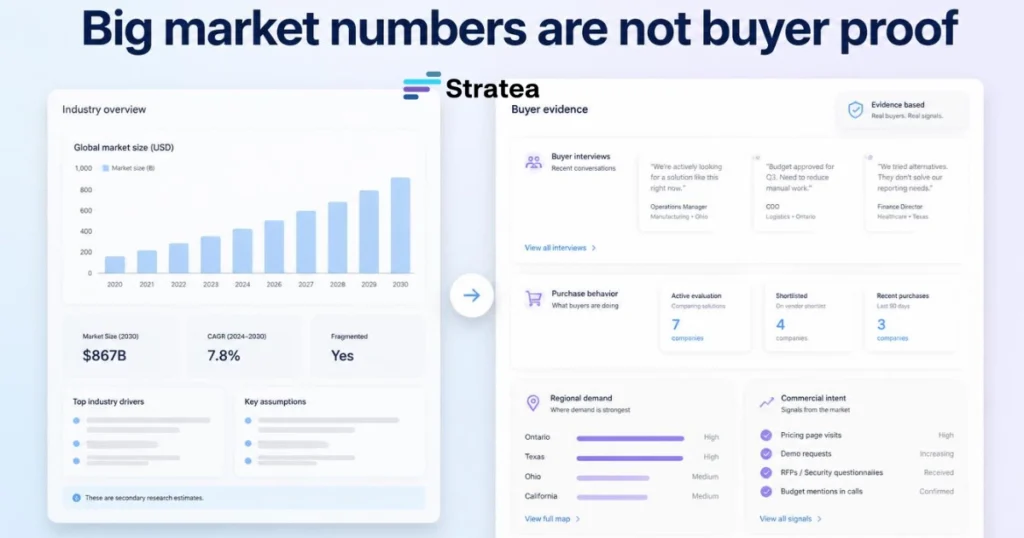
When founders rely solely on high-level industry statistics, they create a false sense of security. Showing a chart that predicts a sector will grow to fifty billion dollars by the end of the decade does not prove that a new company can acquire a single customer. Investors and commercial lenders look for operational realities, not generalized optimism.
Macro data fails because it obscures the friction of actual customer acquisition. It ignores geographic constraints, regulatory barriers, and entrenched competitor relationships. A strong planning process forces you to look past these broad figures and focus on the immediate mechanics of your target market.
What Is a Market Analysis for Business Plan Credibility?
A structured market section serves as the analytical foundation for your entire business strategy. It justifies your revenue model and proves to external readers that your operational milestones are grounded in reality.
Defining the Core Components of Market Validation
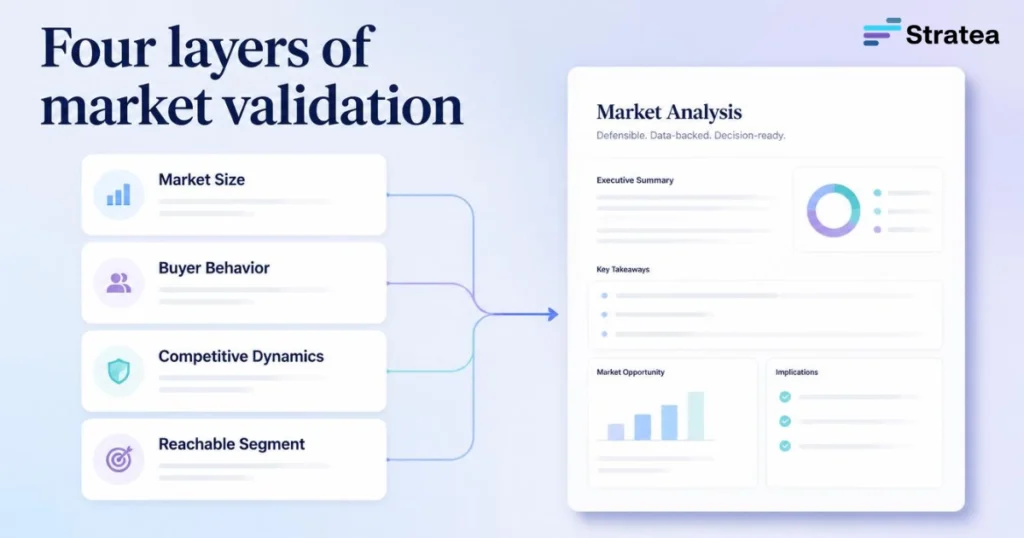
A complete market evaluation must address four distinct areas:
- Market Sizing: A bottom-up calculation of your addressable customer base.
- Buyer Behavior: Documented evidence of how, why, and when your target customer purchases solutions.
- Competitor Dynamics: A clear-eyed view of current alternatives and where they leave customers frustrated.
- Regulatory and Environmental Realities: The compliance factors, licensing rules, or geographic conditions that limit your operating scope.
The Shift from Broad Industry Estimates to Buyer Evidence
To make your plan defensible, you must replace industry estimates with direct buyer evidence. This evidence can come from primary sources, including structured customer interviews, pilot program results, or letters of intent from corporate clients.
If you use secondary sources, they must be highly specific. Look for regional chamber of commerce updates, trade association data, or verified pricing research from comparable markets. The goal is to prove that a distinct segment of buyers feels enough friction to change their current habits.
Step-by-Step Framework for Bottom-Up Market Sizing
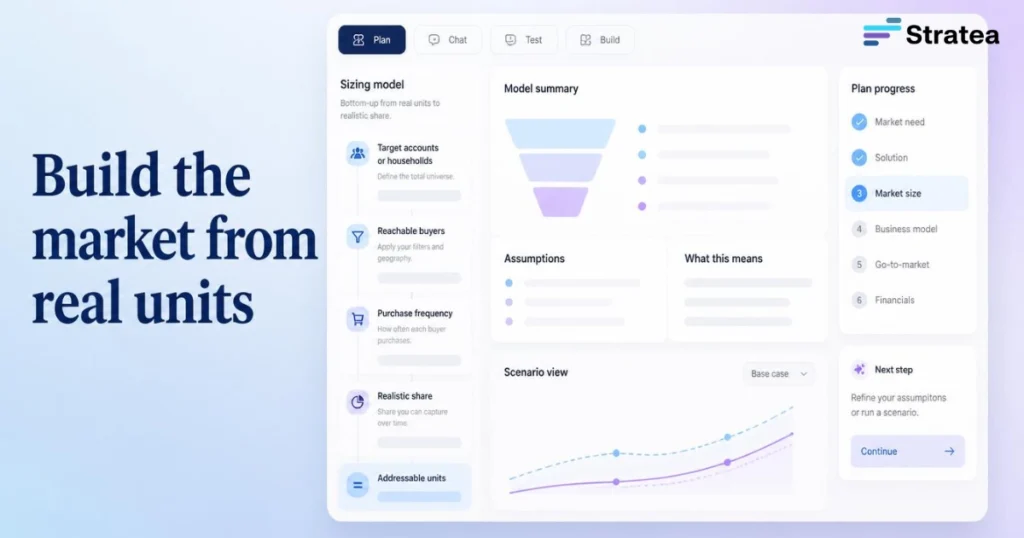
To build a model that reviewers trust, you must calculate your market size from the ground up. This method relies on concrete data points that you can defend during a formal planning review.
Calculating a Defensible TAM, SAM, and SOM
Instead of taking a top-down percentage of a multi-billion dollar industry, use specific numbers to define your market tiers:
- Total Addressable Market (TAM): The total global or national demand for your type of service, calculated by multiplying the total number of potential accounts by your average annual contract value.
- Serviceable Addressable Market (SAM): The portion of the TAM that fits your specific geographic reach, technology limits, or operational model.
- Serviceable Obtainable Market (SOM): Your realistic short-term target, representing the sub-segment you can capture within your first two to three years based on your actual sales capacity and marketing budget.
Documenting Buyer Behavior and Commercial Intent
Reviewers look closely at the path to purchase. Your analysis needs to outline who holds the budget, how long the sales cycle takes, and what triggers a buying decision.
For consumer businesses, this means identifying specific household income levels, localized shopping habits, and clear seasonal preferences. For business-to-business planning, you must define the typical decision-maker job title, corporate budget cycles, and the specific alternative products they currently use.
Competitor Analysis: Mapping Pricing and Positioning Gaps
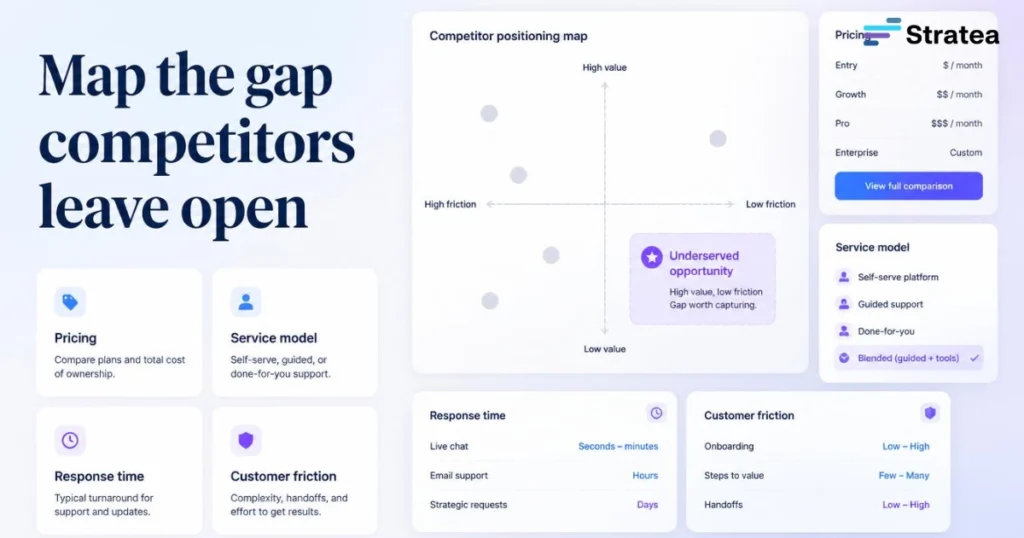
A weak competitor section simply lists three or four corporate rivals and claims your startup will be faster or cheaper. Professional planners use competitive research to discover structural gaps in the current market.
Beyond the Standard Matrix Feature Checklist
A standard feature grid with checkmarks is rarely enough to satisfy an experienced investor or loan officer. You need to explain the business models of your competitors.
Analyze how they make their margins, where their customer support falls short, and how their pricing structures exclude certain buyers. Understanding their operational limitations helps you defend your own positioning strategy.
Identifying the Under-Served Target Customer Segment
Every established competitor makes trade-offs to protect their profit margins. Often, they focus heavily on enterprise clients, leaving mid-sized or small businesses under-served.
Alternatively, they might rely on outdated software platforms, creating an opening for a modern digital experience. Your market analysis must clearly define the specific segment that competitors choose to ignore or under-serve.
| Sizing Component | Definition Strategy | Data Source Examples | Reviewer Focus Area |
| Total Addressable Market (TAM) | Total potential accounts multiplied by annual contract value. | Industry censuses, national trade association records. | Logical consistency of the core pricing model. |
| Serviceable Addressable Market (SAM) | The segment within your geographic or operational boundaries. | Regional business registries, local economic reports. | Reality of operational limits and distribution reach. |
| Serviceable Obtainable Market (SOM) | The share you can realistically win with your current sales capacity. | Initial pilot data, clear team capacity limits. | Direct connection to the immediate marketing budget. |
Worked Example: Market Analysis for Vanguard Logistics Partners
To see these principles in practice, let us examine Vanguard Logistics Partners, a hypothetical third-party freight brokerage startup based in Ohio. The founders are building a business plan to secure a working capital line of credit from a commercial bank.
Context and Segment Definition
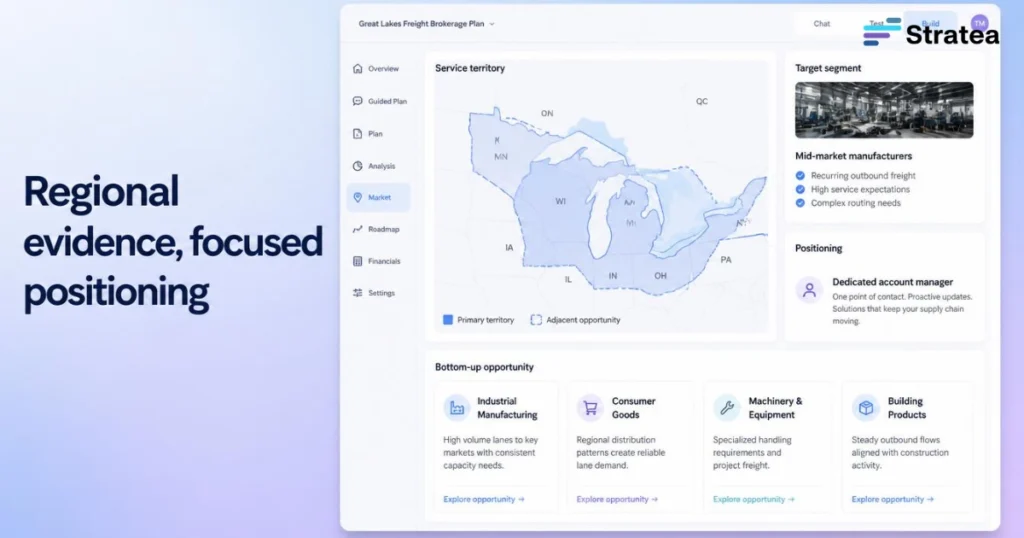
Vanguard Logistics Partners is not trying to capture the entire North American freight market. The founders are targeting mid-sized manufacturing companies in the Midwest United States that ship specialized industrial machinery. These shippers require flatbed trailers and constant communication, a segment often ignored by massive, automated digital freight brokers.
Bottom-Up Market Sizing Calculations
The founders avoid top-down industry estimates and build their market size using specific parameters:
- TAM: There are approximately twenty-five thousand mid-sized manufacturing firms across the United States shipping industrial machinery. With an estimated average annual freight spend of eighty thousand dollars per firm, the national addressable market is two billion dollars.
- SAM: Vanguard restricts its initial focus to Ohio, Indiana, and Michigan. State business registries confirm there are exactly three thousand two hundred manufacturing firms meeting their criteria in this three-state region. This creates a regional SAM of two hundred fifty-six million dollars.
- SOM: Based on a sales team of two experienced brokers who can manage a maximum of twenty active shipping accounts each, Vanguard sets its year-two SOM at forty accounts. At an average annual revenue of eighty thousand dollars per account, their immediate target is three point two million dollars.
Competitive Positioning Strategy
Vanguard’s competitive analysis reveals that the top national brokers rely heavily on automated tracking apps. These platforms work well for standard dry van freight but fail when heavy machinery encounters transport delays.
Vanguard differentiates itself by offering dedicated account managers who handle complex routing permits and provide manual updates every two hours. This premium service structure supports their target pricing model, allowing them to maintain healthy margins while avoiding price wars with automated providers.
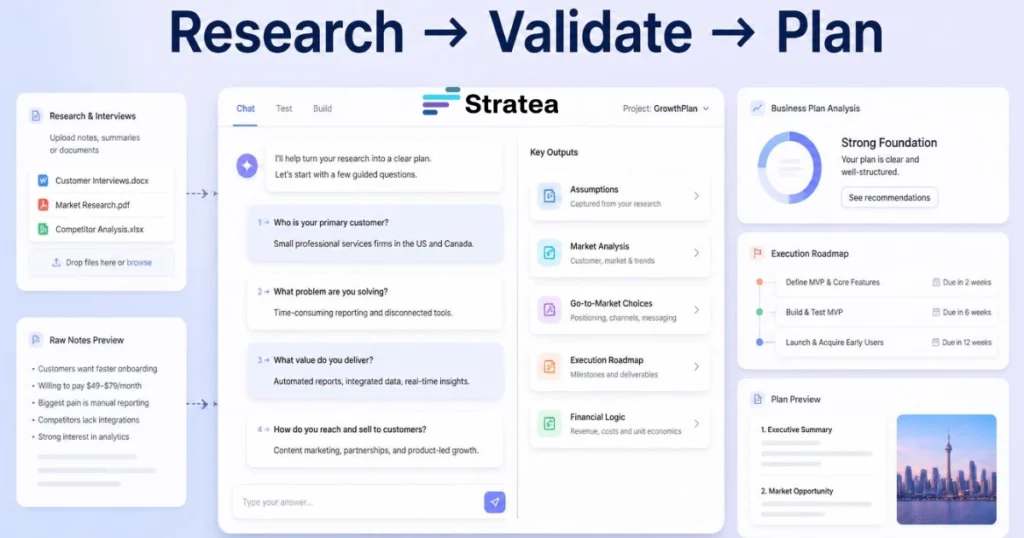
You can organize these types of target demographics and regional customer boundaries using a structured market research tool before writing your full text.
Integrating Market Insights into Your Execution Roadmap
A high-quality market analysis does not sit isolated in your business plan. Every insight you gather should directly shape your operational strategy, hiring timeline, and financial goals.
If your market research reveals a long corporate sales cycle, your financial projections must show enough cash runway to survive those slow collection timelines. If the data shows that customers experience high dissatisfaction during a specific season, your operational roadmap should position your launch right before that peak demand period. Connecting your market findings to your actual execution plan shows reviewers that you have built a logical, unified business model.
FAQ
How do I prove market demand if my business has no operating history?
You can demonstrate clear demand by gather primary evidence from your target audience. Conduct structured customer interviews, launch localized landing pages to collect early sign-ups, or secure conditional letters of intent from corporate buyers. This information proves to reviewers that real buyers have a documented interest in your solution.
What is the difference between a market analysis and a marketing plan?
A market analysis identifies the structural realities of the industry, including the size of the addressable audience, customer buying habits, and competitor weaknesses. A marketing plan outlines the specific tactics, advertising channels, and promotional budgets you will use to reach those customers based on your market analysis findings.
Why do bank lenders care about market sizing if I am a local service business?
Lenders look closely at market sizing to ensure your local area contains enough active customers to support your debt obligations. If your local target market is too small or saturated with competitors, the bank will worry that your business cannot generate the consistent revenue needed to cover loan payments.
How often should a startup update the market analysis section of their plan?
A startup should review and update its market data at least once a year, or whenever major shifts occur in the industry. Changes in local regulations, the arrival of a well-funded competitor, or sudden shifts in customer buying habits all require you to re-examine your core planning assumptions.