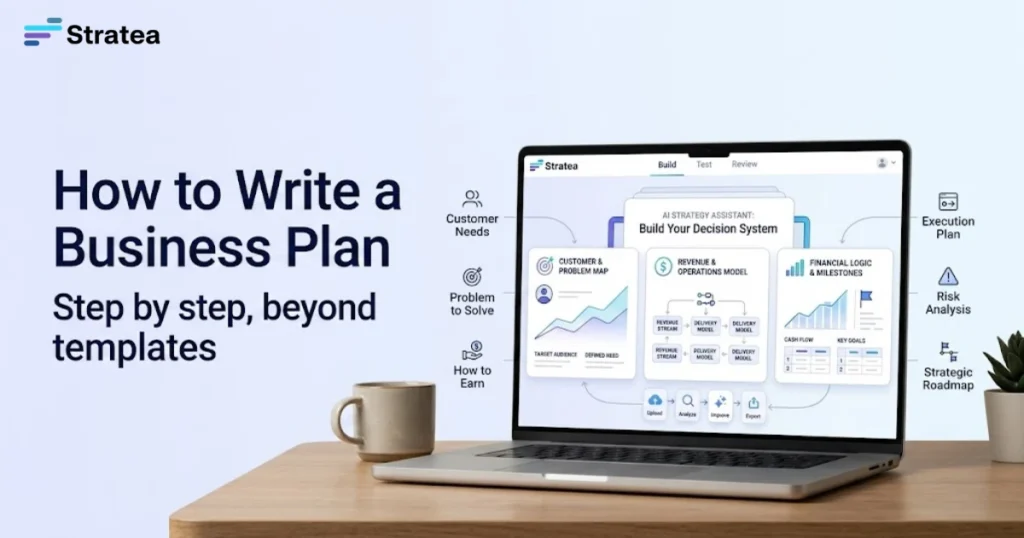
Most founders don’t get stuck on a business plan because the writing is hard. They get stuck because a real plan forces real decisions.
You have to commit to who you’re selling to, which problem you’re solving first, how the business actually makes money, and what has to be true before any of it works. None of that fits neatly into a fill-in-the-blank template.
So learning how to write a business plan isn’t about completing a generic document. It’s about turning a fuzzy idea into a clear operating model you can trust, before you spend money, pitch an investor, apply for a loan, or launch.
This guide walks through how to clarify your idea, research your market, define your business model, write each core section, and build financial projections that hold up. An AI business plan like STRATEA can speed this up enormously, but the strongest plans still come from your own decisive thinking.
Before You Start: Know What Your Plan Needs to Do
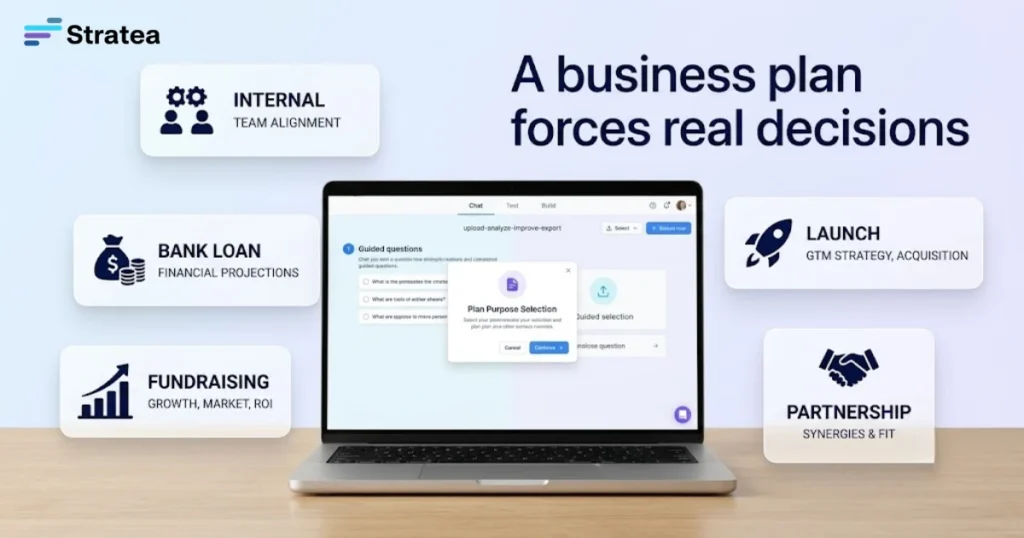
The most common mistake is opening a template before deciding who the plan is for.
A document for your own team reads nothing like one for a bank. The purpose sets the depth, the tone, and what you choose to emphasize.
| Plan Purpose | What to Emphasize |
| Internal planning | Priorities, target customer, startup costs, first 90 days, key risks |
| Bank loan | Cash flow, repayment ability, owner experience, collateral, operating expenses |
| Fundraising | Market opportunity, business model, traction, growth logic, use of funds |
| Launch planning | Pricing, customer acquisition, operations, staffing, break-even point |
| Partnerships | Strategic fit, responsibilities, mutual value, execution plan |
Before writing a single paragraph, ask: what decision should this plan help someone make? That one question keeps your writing sharp and stops the plan from drifting.
A structured workspace like Stratea ties each section back to that purpose, so the plan stays a thinking tool instead of a template you’re filling out on autopilot.
Step 1: Clarify Your Business Idea
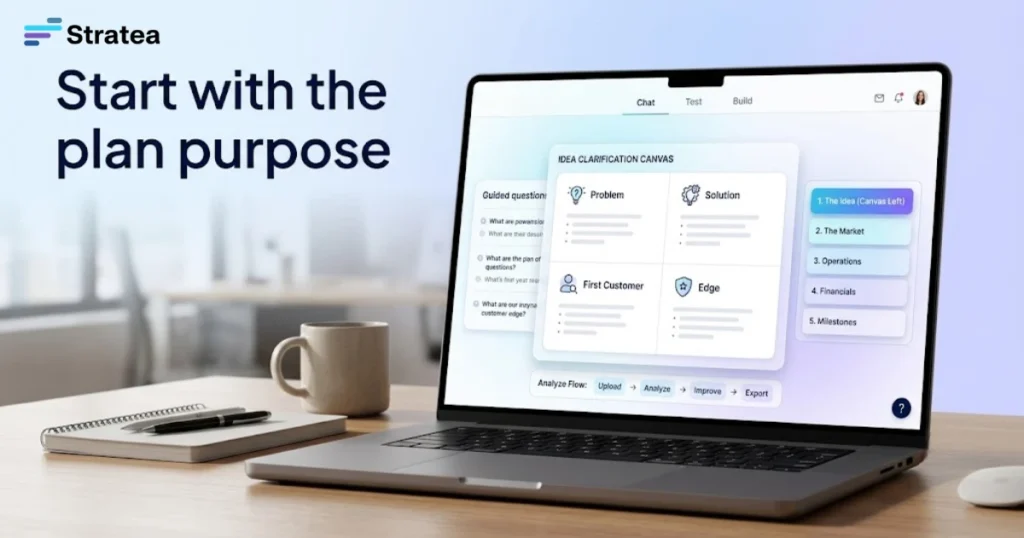
A vague idea isn’t a business plan. “I want to start a digital agency” is an idea. “We help B2B SaaS companies improve website conversion through fixed-scope landing page audits and implementation support” is a business.
Tighten your concept until it can guide everyday decisions:
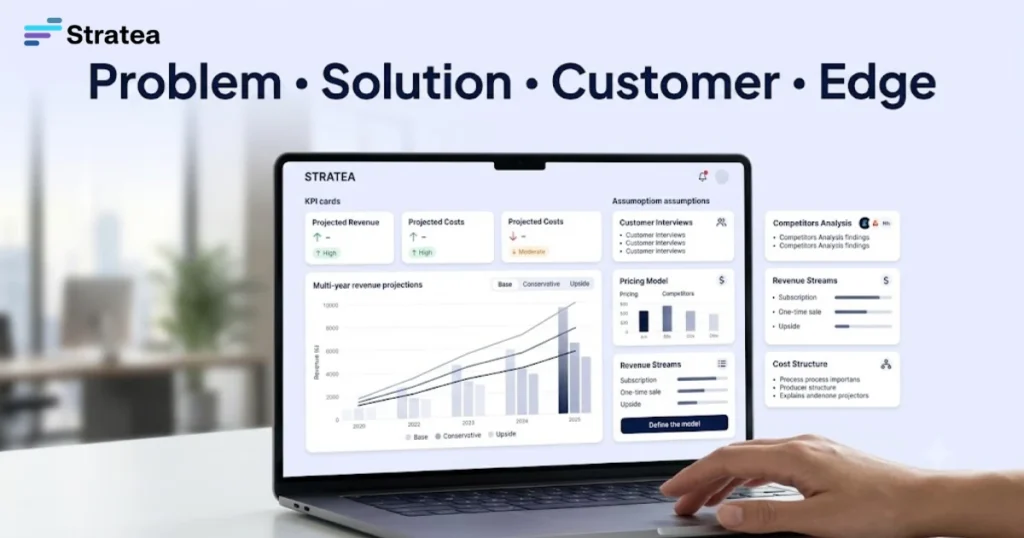
Start with the problem. What specific pain are you solving? Skip vague lines like “businesses need marketing.” Something sharper works far better: “Local landscapers lose referred leads because they have no online booking and no clear service packages.”
Define the solution. How does your offer change the customer’s situation? Don’t list features. Explain the outcome.
Choose your first customer. Not everyone who could buy should be your starting market. Narrowing here is what makes your pricing, messaging, and marketing land.
Find your edge. Why now, and why you? Lower costs, sharper operations, a deeper read on the customer? Name it.
If you can’t answer these yet, don’t force the writing. Fix the business first.
Step 2: Research Your Market
Market research doesn’t mean grabbing a billion-dollar industry stat and pasting it in. A huge market never proves your business can win customers and serve them profitably. Research is about reducing uncertainty.
Talk to potential customers. Ask what they use today, what frustrates them, and what the problem actually costs them. The goal isn’t to get them to praise your idea, it’s to understand how they behave.
Study the competition. Look at direct competitors, indirect alternatives, and the customer simply doing nothing, which is often your real rival.
Then get practical. How do competitors price? Which channels do they use to acquire customers? Where do their customers complain? If competitors charge $180 for a service and you plan to charge $95, your plan has to explain exactly how your margins survive.
Step 3: Define Your Business Model
Your business model is how the company creates, delivers, and captures value. This is where a lot of plans collapse: founders obsess over the product and skim over how the money actually changes hands.
Revenue streams. How do you charge? One-time purchases, subscriptions, retainers, usage-based pricing?
Cost structure. Which costs rise with each sale (variable) and which stay flat (fixed)? What has to be paid before any revenue arrives?
Customer acquisition. How do people find you? Paid ads, SEO, referrals, outbound sales? If you lean on paid ads, you need a customer acquisition cost (CAC) assumption in writing.
Retention. If customers buy once, you’re on a permanent acquisition treadmill. If they come back, the entire economics change.

Step 4: Write Each Core Section
Once the decisions are clear, the writing comes easily. Include only the sections that help your reader understand the business.
Executive Summary. Write it last. One page covering what you do, who you serve, how you make money, and what you need next.
Company Description. Who you are, your legal structure, and your current stage.
Products & Services. What you sell, what’s included, how it’s delivered, and why customers value it.
Market Analysis. The demand environment, backed by real evidence: customer interviews, pricing checks, local data.
Marketing Strategy. How customers find, trust, and buy from you. Drop buzzwords like “we’ll use social media” and explain the channel logic instead.
Operations Plan. What happens day to day for the business to function, including staffing, suppliers, software, and delivery.
Management Team. Who’s executing. Be honest about skill gaps and how you’ll fill them.
Financial Plan. The economic engine: startup costs, cash flow, break-even, and projections.
Funding Needs (if applicable). Exactly how much you need, what it buys, and which milestones it unlocks.
Appendix. Detailed tables, resumes, permits, and heavy data, so the main narrative stays clean.
Step 5: Build Realistic Financial Projections
Projections aren’t predictions from a crystal ball. They’re your assumptions made visible in a spreadsheet.
Map out startup costs. What has to be paid before day one? Software, permits, insurance, working capital, and the small recurring fees that quietly add up.
Build revenue from behavior. Don’t start at “$1M in ARR” and reverse-engineer it. Start at the bottom: how many leads can you reach, what’s the conversion rate, what’s the price?
Watch cash flow. A business can look profitable on paper and still go under if expenses come due before customer payments land.
Plan for scenarios. Build a base case, an upside case, and a conservative case. What happens if every sale takes twice as long to close?
Step 6: Review and Improve
Your first draft is a starting point, not a finish line. Test it for logic. Does the target market actually match the marketing strategy? Do the financial projections reflect what the operations plan can realistically deliver?
The toughest, most useful question to ask yourself: if this weren’t my idea, would I believe this plan?
This is where a structured platform earns its keep. Stratea helps you organize the moving parts, revisit assumptions, and adjust your strategy without losing track of your core data, so a change in one section doesn’t quietly break another.
Common Business Plan Mistakes to Avoid
Description without decision. Don’t just describe the brand. Explain how you’ll acquire customers and manage cash.
No evidence. A plan built purely on founder intuition is fragile. Use quotes, pilot results, and competitor data.
Unrealistic financials. Hockey-stick revenue with perfectly flat costs destroys your credibility on sight.
Underestimating competition. Customers always have an alternative, even if it’s a spreadsheet instead of your software.
Leaning entirely on templates. A template gives you structure. It can’t make a single strategic decision for you.
Can AI Help You Write a Business Plan?
Yes, and it’s genuinely good at it. AI excels at organizing messy notes, summarizing market research, rewriting dense paragraphs, and producing a clean first draft in a fraction of the usual time.
What AI shouldn’t do is make the business decisions for you.
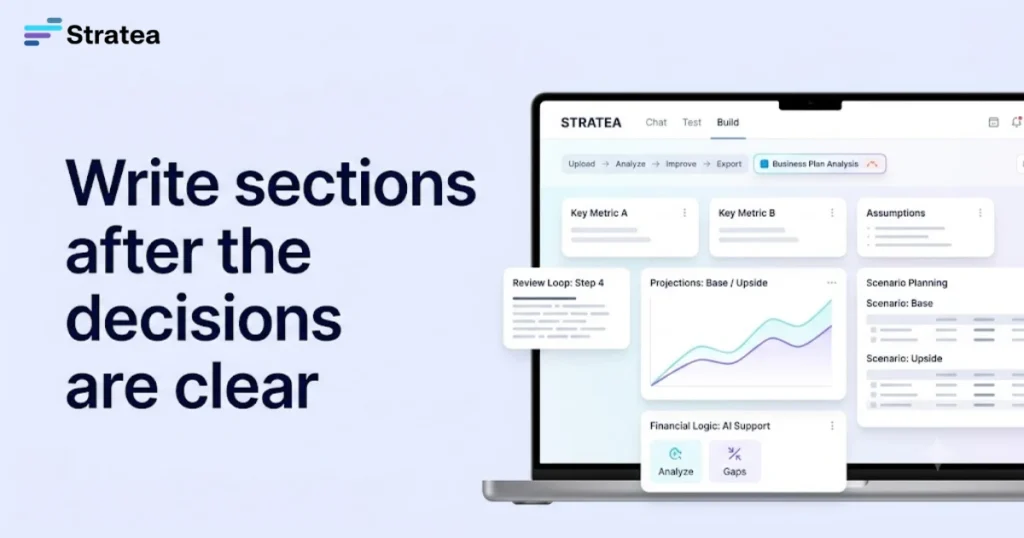
The smart way to use it is to bring it your raw thinking, your customer research, pricing ideas, and operational constraints, then let it structure that material and surface the gaps. A generic AI chat leaves you re-prompting and reorganizing endlessly. An AI-native planning workspace like Stratea is built differently: it guides you through a discovery process across your idea, market, resources, and risks, so the output becomes a plan you can actually use rather than another long draft to clean up.
Final Thoughts
Learning how to write a business plan really comes down to turning uncertainty into focus. You don’t have to wait until every answer is perfect. Build the first useful version, name what you don’t know, research the gaps, and iterate.
Once your decisions are on paper, you can move with fewer surprises and a much clearer path to making the business real.
FAQs
What are the main sections of a business plan?
The core sections are usually the executive summary, company description, products/services, market analysis, marketing strategy, operations plan, management team, financial plan, and an appendix.
How long should a business plan be?
Long enough to support the decision it’s meant to inform. An internal plan might run 3–5 pages, while an investor plan needs more depth on cash flow and risk. Prioritize clarity over page count.
Can I write a business plan without investors?
Absolutely. The biggest value of a plan is internal clarity. It helps you define your model, estimate cash needs, and avoid expensive early mistakes.
How detailed should financial projections be?
Detailed enough to show the logic behind your revenue, expenses, and cash flow. A 12-month view is often enough for internal use; bank loans usually require multi-year assumptions.
How often should I update my business plan?
Whenever reality challenges your assumptions, after your first 10 sales, a shift in the market, or a jump in operating costs. Treat it as a living document.